Advanced Chocolate Texture and Flavor Science
Emulsification Science
The Science of Smoothness
If you've ever tried to mix oil and vinegar for a salad dressing, you know they don't naturally get along. No matter how hard you whisk, they eventually separate. This is because oil and water-based liquids are immiscible—they can't be blended into a stable mixture on their own.
Chocolate faces a similar challenge. It's a combination of fat (cocoa butter) and solids (sugar and cocoa particles). To create the smooth, uniform texture we expect, these ingredients need help to mix properly. This is where emulsification comes in. An emulsion is a stable mixture of two or more liquids that are normally immiscible. The key to making it work is a special agent called an emulsifier.
An emulsifier molecule has a unique structure. One end is hydrophilic, meaning it's attracted to water. The other end is hydrophobic, meaning it's repelled by water but attracted to fats and oils. This dual nature allows it to act as a bridge, holding the oil and water-based components together in a stable suspension.
Lecithin to the Rescue
In chocolate making, the most common emulsifier is lecithin, a fatty substance typically derived from soybeans or sunflower seeds. Its job is to reduce the friction between the solid particles (sugar, cocoa solids) and the liquid fat (cocoa butter).
When lecithin is added to the chocolate mixture, its molecules wrap around the sugar and cocoa particles. The fat-loving tails of the lecithin molecules face outward, allowing the coated particles to disperse smoothly and evenly throughout the liquid cocoa butter. This process dramatically reduces the viscosity of the chocolate, making it flow much more easily. Better flow is critical for processes like molding and enrobing, where the chocolate needs to fill intricate shapes or form a thin, even coating.
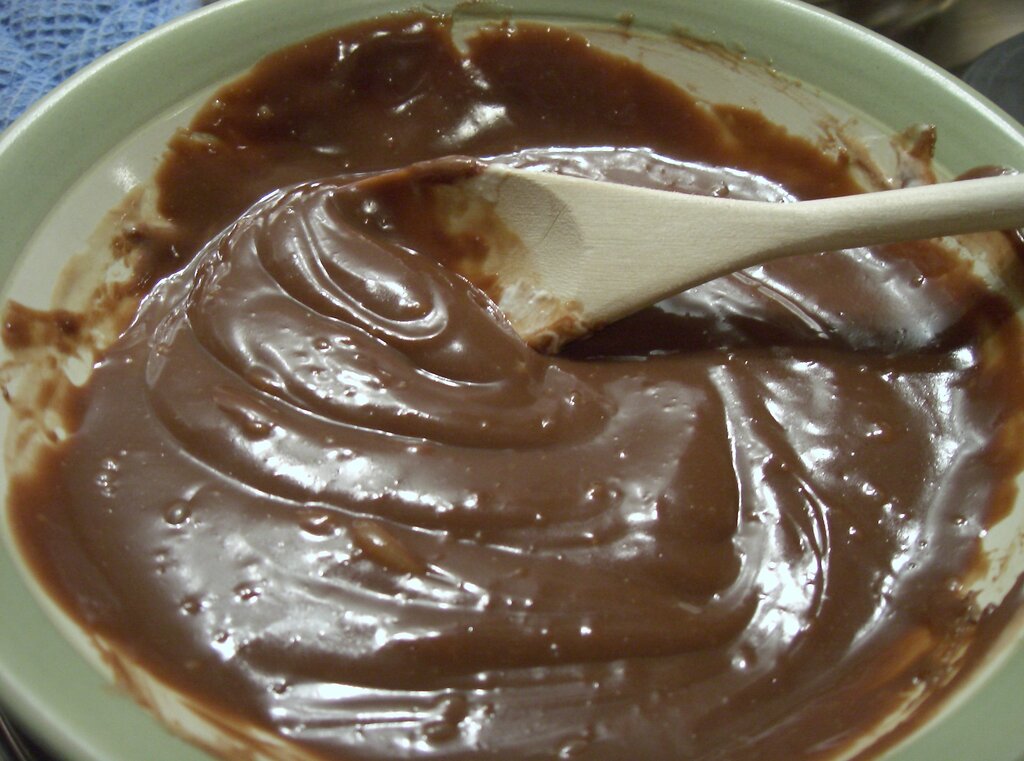
Without an emulsifier, chocolate would be thick, pasty, and difficult to work with. Manufacturers would need to add significantly more expensive cocoa butter to achieve a workable consistency, which would also alter the flavor and texture of the final product.
Impact on Taste and Texture
Proper emulsification is fundamental to the sensory experience of eating chocolate. By ensuring all the particles are finely and evenly dispersed, emulsifiers create a perfectly smooth texture that feels luxurious in the mouth. A gritty or coarse chocolate is often a sign of poor emulsification.
This smoothness also has a direct impact on flavor. When chocolate melts on your tongue, the even distribution of cocoa solids and sugar allows for a gradual and consistent release of flavor compounds. A poorly emulsified chocolate might release its flavors in jarring bursts or feel greasy due to pockets of separated fat.
A smooth texture allows for a more complete and satisfying flavor release. The two are inextricably linked.
The stability provided by emulsification is also a prerequisite for the next critical steps in chocolate making. It creates the ideal, homogenous base that will be further refined during conching and crystallized during tempering. Without a stable emulsion to start with, achieving the characteristic snap and gloss of high-quality chocolate would be impossible.
What is the primary function of an emulsifier like lecithin in chocolate making?
An emulsifier molecule works because one end is attracted to water (hydrophilic) and the other end is attracted to ____.
Understanding emulsification helps explain why chocolate can be so incredibly smooth. It's a bit of chemical magic that brings unlike ingredients together.