Advanced Chemical Solution Dynamics
Molar Concentration Metrics
Molarity in Practice
Concentration is a measure of how much stuff is dissolved in a liquid. While there are many ways to express this, molarity (M) is the workhorse of the chemistry lab. It connects the count of solute particles (moles) to the total volume of the solution (litres).
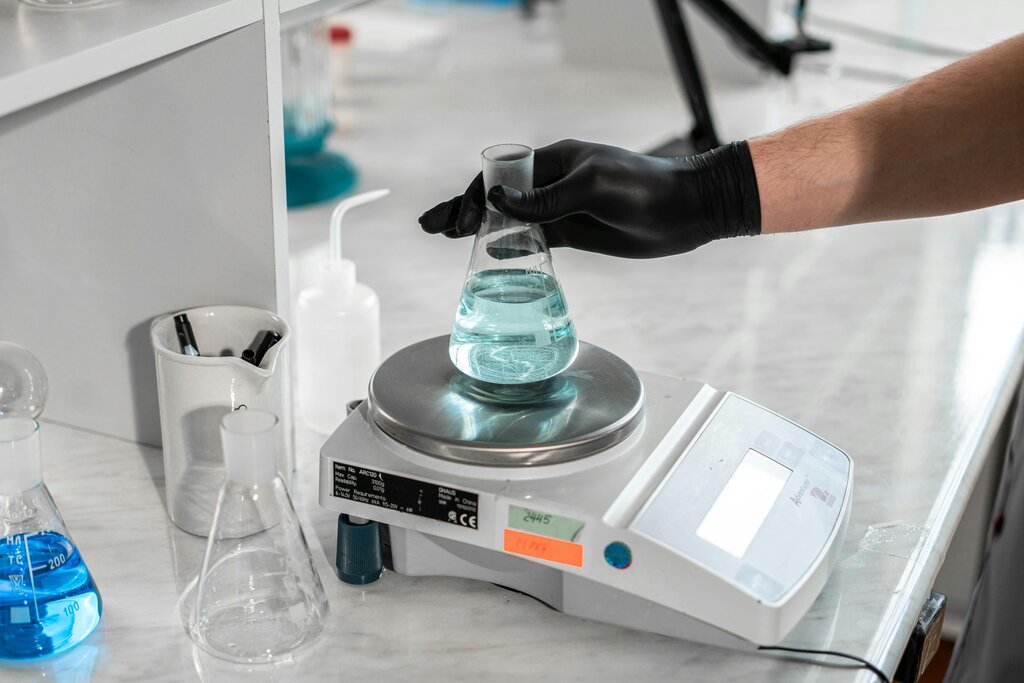
This definition seems straightforward, but precision is everything in analytical chemistry. To prepare a solution with a specific molarity, you don't just add a solvent to a solute. The process is meticulous. You first weigh the exact mass of the solute needed. Then, you dissolve it in a smaller amount of the solvent, usually in a specialized piece of glassware called a volumetric flask. Only after the solute is fully dissolved do you carefully add more solvent until the total volume reaches the calibration mark on the flask.
Accounting for Water
Calculating the mass of solute needed gets tricky when dealing with hydrated salts . These are ionic compounds that have a specific number of water molecules locked into their crystal structure. When you weigh out a hydrated salt, you are also weighing these trapped water molecules. This 'extra' mass must be included in your molar mass calculation, otherwise your final solution concentration will be incorrect.
| Salt Type | Chemical Formula | Molar Mass Calculation | Notes |
|---|---|---|---|
| Anhydrous Copper(II) Sulfate | CuSO₄ | 63.55 + 32.06 + 4(16.00) = 159.61 g/mol | No water in the crystal structure. |
| Hydrated Copper(II) Sulfate | CuSO₄·5H₂O | 159.61 + 5(18.02) = 249.71 g/mol | Five water molecules are part of the molar mass. |
Let's say you need to prepare 250 mL (0.250 L) of a 0.5 M copper(II) sulfate solution. First, calculate the moles needed:
Moles = Molarity × Litres = 0.5 mol/L × 0.250 L = 0.125 moles
If you use anhydrous CuSO₄, the mass required is:
Mass = 0.125 moles × 159.61 g/mol = 19.95 g
But if you use the hydrated form, CuSO₄·5H₂O, the mass is different:
Mass = 0.125 moles × 249.71 g/mol = 31.21 g
Using the wrong form would result in a significant error in the solution's final concentration. Always check the label on the reagent bottle.
The Effect of Temperature
Volume is not a constant property; it changes with temperature. Most liquids, including water, expand when heated and contract when cooled. Since molarity is defined by the volume of the solution, temperature fluctuations can introduce errors. A solution prepared at 20°C will have a slightly lower molarity if it's used in a lab that is 25°C because its total volume will have expanded.
This is why volumetric glassware is calibrated to be accurate at a specific temperature, usually 20°C. For highly precise work, such as preparing standard solutions for , chemists must work in a temperature-controlled environment or apply correction factors to their measurements.
When making a precise measurement, always ensure your eye is level with the surface of the liquid. This avoids parallax error, which can make the volume appear higher or lower than it actually is.
You must also read the volume correctly from the meniscus , the curved upper surface of the liquid. For water and most aqueous solutions, the meniscus is concave (it curves downwards). The measurement should always be taken from the bottom of the curve.
These careful considerations are not just academic. In a medical setting, physiological saline solutions must have a precise ionic concentration to be isotonic with human blood. A mistake in molarity could have serious consequences. Likewise, in environmental testing, accurately measuring the concentration of pollutants down to parts per million requires flawlessly prepared standard solutions. In chemistry, getting the concentration right is fundamental.