Advanced Chemical Bonding Models
Introduction to Chemical Bonding
Why Atoms Stick Together
At the heart of chemistry is a simple question: why do some atoms link up to form molecules while others don't? The answer is stability. Atoms are constantly seeking a more stable, lower-energy state. For most atoms, this means having a full outer shell of electrons, much like the noble gases which are famously unreactive. This stable arrangement is often called an "octet," because it usually involves eight outer electrons.
Think of it like this: atoms are social creatures that feel most comfortable when their outer friend group is full. To achieve this, they bond with other atoms.
The Role of Electrons
To understand bonding, we need to know where electrons live. Electrons don't just circle the nucleus randomly; they occupy specific regions of space called atomic orbitals. Each orbital has a distinct shape and can hold a maximum of two electrons.
The simplest orbital is the s orbital, which is spherical. The next type is the p orbital, which has a dumbbell shape and comes in a set of three, oriented along the x, y, and z axes.
The arrangement of electrons in these orbitals is called the electron configuration. For example, a carbon atom has six electrons. Its configuration is $1s^22s^22p^2$. This notation tells us:
- Two electrons are in the first energy level's s orbital ($1s^2$).
- Two electrons are in the second energy level's s orbital ($2s^2$).
- Two electrons are in the second energy level's p orbitals ($2p^2$).
The electrons in the outermost shell, in this case the second level, are called valence electrons. These are the electrons involved in chemical bonding. Carbon has four valence electrons ($2s^22p^2$).
Sharing Electrons
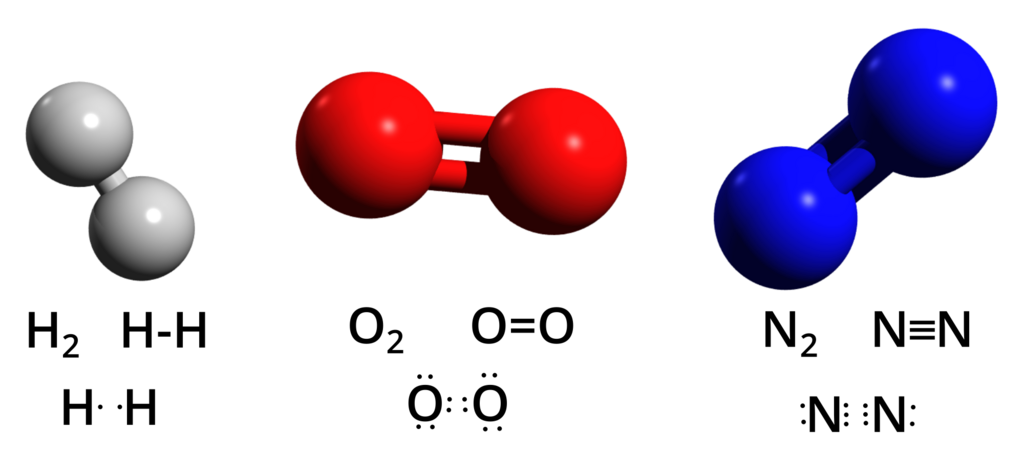
The most common way atoms bond is by sharing their valence electrons. This type of bond is called a covalent bond. When two atoms approach each other, their atomic orbitals can overlap. If each atom contributes an electron to this overlap, the two electrons form a pair that is shared between them. This shared pair effectively belongs to both atoms, helping each to complete its outer shell.
A covalent bond is “one in which electrons from two (or three) atoms are shared by both/all.”
Consider two hydrogen atoms. Each has one electron in a 1s orbital. By sharing their electrons, they form a molecule of hydrogen, H₂. Now, each hydrogen atom effectively has two electrons, filling its first energy shell. Sometimes atoms share more than one pair of electrons to satisfy the octet rule, leading to double bonds (two shared pairs) or triple bonds (three shared pairs).
Drawing Molecules
Chemists use a simple tool called a Lewis structure to visualize covalent bonds. In these diagrams, the chemical symbol represents the atom's nucleus and inner electrons, and dots represent the valence electrons. A line connecting two atoms represents a shared pair of electrons, or a covalent bond.
Let's draw one for water ():
- Count valence electrons: Oxygen is in group 16, so it has 6 valence electrons. Hydrogen is in group 1, so it has 1. Total = 6 + 1 + 1 = 8.
- Arrange atoms: Oxygen is less electronegative than hydrogen, so it's the central atom.
- Form single bonds: Connect the hydrogens to the oxygen with single bonds. This uses 4 electrons (2 per bond).
- Distribute remaining electrons: We have 8 - 4 = 4 electrons left. Place them on the oxygen atom as two "lone pairs."
Now, each hydrogen is stable with 2 electrons, and the oxygen atom has a full octet (4 from lone pairs + 4 from bonds).
Lewis structures are incredibly useful, but they have limitations. They are 2D representations of 3D molecules and don't tell us about the actual shape. They also don't work well for all molecules, especially those with an odd number of electrons or where the octet rule is broken.
Shapes and Polarity
The 3D arrangement of atoms in a molecule, its molecular geometry, is crucial because it determines many of the substance's properties. For example, the water molecule isn't linear (); it's bent. This bent shape is due to the two lone pairs on the oxygen atom, which push the hydrogen atoms downwards.
Furthermore, not all sharing is equal. In some covalent bonds, one atom pulls the shared electrons more strongly than the other. This creates a polar bond, with a slight negative charge on the atom that pulls harder and a slight positive charge on the other. In water, oxygen is more electronegative than hydrogen, so the shared electrons spend more time near the oxygen. This makes the O-H bonds polar.
The combination of a molecule's shape and the polarity of its bonds determines if the molecule itself is polar. Water's bent shape and polar bonds make it a polar molecule, which is why it's so good at dissolving other polar substances, like salt and sugar.
Ready to check your understanding of these foundational ideas?
What is the primary motivation for most atoms to form chemical bonds?
An atom has the electron configuration . How many valence electrons does it have?
Understanding how and why atoms connect is the first step in unlocking the secrets of the molecular world.