Advanced CFD for Digital Twins
Advanced Meshing Techniques
The Art of the Mesh
In Computational Fluid Dynamics (CFD), the quality of your simulation hinges on the quality of your mesh. A mesh is the digital equivalent of a scaffold, a grid of points and cells that breaks down a complex shape into simple, manageable pieces for a computer to analyze. While you might already know the basics, building a truly effective mesh is a craft. The goal is to create a grid that accurately captures the geometry and the physics of the fluid flow without being computationally wasteful.
A bad mesh will always produce a bad result, no matter how powerful the solver.
Advanced meshing isn't just about filling a space with cells. It’s a strategic process of deciding where you need detail and where you can afford to be coarse. This balancing act is key to getting results that are both accurate and timely. Let's explore the primary strategies for building these digital scaffolds.
Structured meshes are orderly and efficient. They use quadrilateral elements (in 2D) or hexahedral elements (in 3D) arranged in a regular grid. Each point can be identified with simple indices, like coordinates on a map. This structure makes them computationally fast because the solver knows exactly where to find neighboring cells without having to search.
However, their rigid nature makes them difficult to apply to highly complex geometries. Imagine trying to wrap a checkerboard pattern perfectly around a detailed sculpture. It's challenging and often requires dividing the geometry into multiple blocks, which adds complexity to the setup.
Unstructured meshes offer the opposite trade-off. They typically use triangles (in 2D) or tetrahedrons (in 3D) and can be generated automatically for even the most intricate shapes. This flexibility is their greatest strength. Need more detail in a specific spot? Just add more, smaller elements there. The downside is computational overhead. The solver has to store information about the connectivity of each cell, which uses more memory and can slow down calculations.
Hybrid and High Quality
Why choose one when you can have both? Hybrid meshing combines structured and unstructured approaches in a single model. A common strategy is to use a structured mesh in areas where flow is critical and follows a predictable direction, like near the surface of an airplane wing. This region, called the boundary layer, is where fluid velocity changes rapidly, and an orderly grid of hexahedral cells can capture this gradient efficiently.
Away from the surface, where the flow is less complex, an unstructured mesh of tetrahedrons can fill the remaining space, easily conforming to the overall geometry. This gives you the accuracy of a structured mesh where it matters and the flexibility of an unstructured mesh everywhere else.
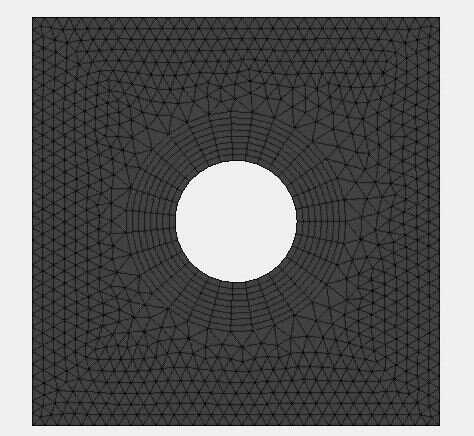
But how do you know if your mesh, regardless of type, is any good? Several metrics help quantify mesh quality:
- Skewness: This measures how distorted a cell is from its ideal shape (e.g., an equilateral triangle or a perfect cube). High skewness can lead to significant errors in the simulation. A value of 0 is perfect, while a value near 1 is very bad.
- Orthogonality: This checks how close the angles between cell faces and the lines connecting cell centers are to 90 degrees. Poor orthogonality can also reduce accuracy.
- Aspect Ratio: This is the ratio of the longest side of a cell to its shortest side. Cells that are long and skinny can be problematic, especially if the flow is not aligned with the long direction.
Refinement and Accuracy
Even a good initial mesh may not be enough. Mesh refinement is the process of selectively increasing the density of cells in areas with important flow features. For example, in a simulation of airflow over a car, you'd want a very fine mesh around mirrors and spoilers where vortices and complex flow patterns occur. In open areas far from the car, a much coarser mesh is sufficient.
There are two main approaches to refinement:
Static Refinement: The user identifies critical regions beforehand and builds a finer mesh there from the start.
Adaptive Refinement: The solver automatically refines the mesh during the simulation. It identifies areas where errors are high (like a developing shockwave) and adds more cells on the fly to capture the physics more accurately.
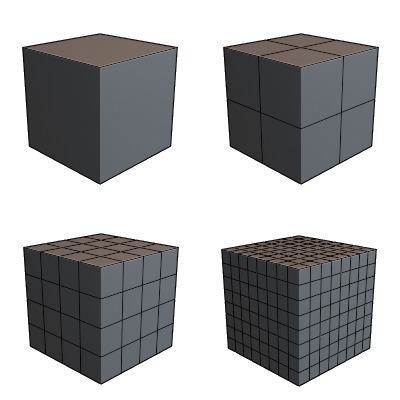
The quality of the mesh has a direct and profound impact on the simulation's accuracy. A coarse or poor-quality mesh might not capture small but crucial details, leading to incorrect predictions. It could fail to show the separation of flow from a surface or might miscalculate drag forces. Ultimately, the time spent creating a high-quality mesh is an investment. It ensures that the simulation converges to a stable solution and, most importantly, that the solution is a trustworthy reflection of reality.
What is the primary trade-off when choosing between a structured and an unstructured mesh in CFD?
Which mesh quality metric evaluates how distorted a cell is from its ideal, equilateral or cubic shape?
Building the right mesh is a foundational skill for any serious CFD work, turning a complex problem into one a computer can solve with precision.