Advanced Cellular Dynamics of the Nervous System
Neuronal Diversity and Subtypes
Beyond the Textbook Neuron
You've likely seen the classic diagram of a neuron: a cell body, branching dendrites, and a long axon. While that model is a useful starting point, it's like describing all buildings as 'four walls and a roof'. The reality is far more diverse and elegant. The brain contains a staggering variety of neurons, each with a unique shape, location, and role that defines its contribution to thought and behaviour.
The most fundamental division among neurons in the cerebral cortex is between those that excite and those that inhibit. Think of it as the brain's accelerator and brake system. The vast majority of excitatory neurons are pyramidal cells, the long-distance communicators of the cortex. In contrast, the inhibitory cells, known as GABAergic interneurons, act as local micro-managers, fine-tuning the activity of their neighbours with incredible precision.
A Specialist for Every Job
Interneurons are not a monolithic group. They come in several specialised subtypes, each targeting a different part of a pyramidal cell to control its firing. This specialisation allows for sophisticated control over neural circuits.
Imagine a pyramidal cell as a busy CEO. Different interneurons act as specialised assistants:
- Basket cells wrap around the CEO's office (the cell body or soma), providing powerful, direct inhibition to veto a decision to fire an action potential.
- Chandelier cells are even more specific, targeting the axon initial segment—the exact spot where an action potential is generated. They are the ultimate gatekeepers of neuronal output.
- Martinotti cells target the very tips of the pyramidal cell's dendrites, controlling which incoming signals are even considered in the first place.
Location and Communication
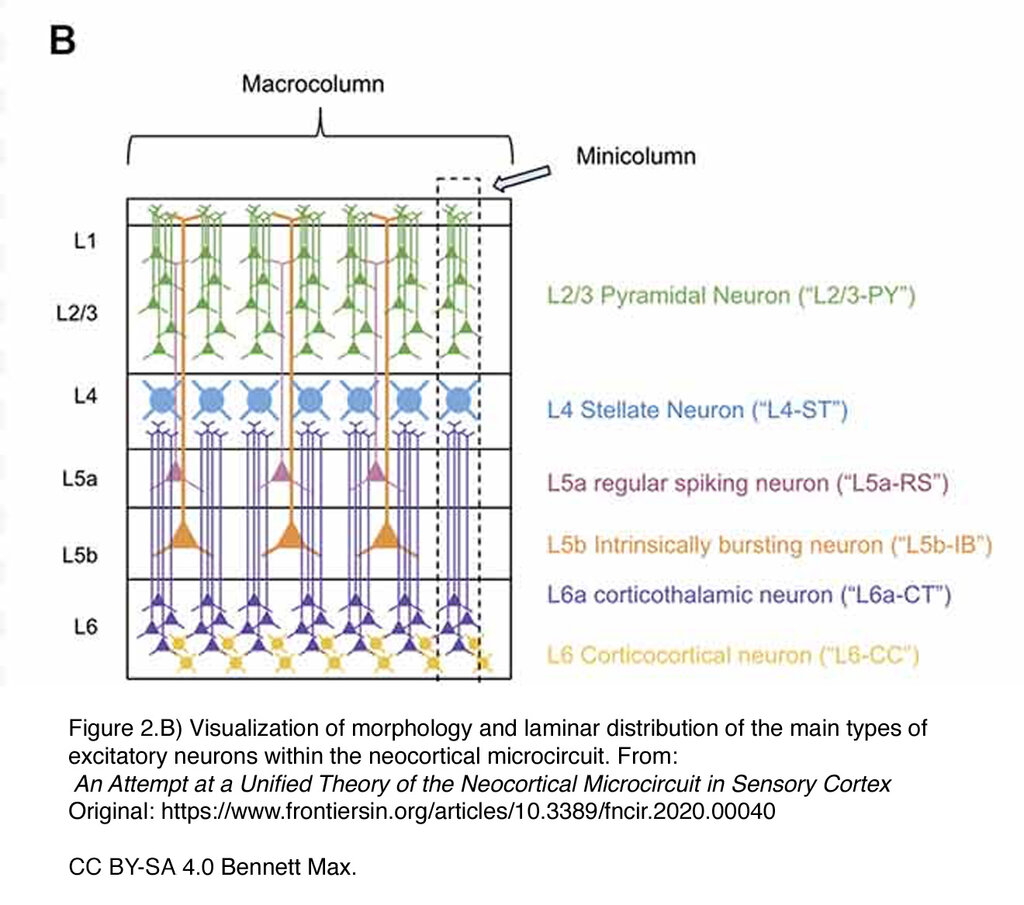
A neuron's function is also defined by its address. The cerebral cortex is organised into six distinct layers, and a neuron's layer determines its primary connections. For example, neurons in Layer 4 are the main recipients of sensory information from the thalamus, while neurons in Layer 5 send outputs down to control movement.
| Layer | Primary Function | Key Connections |
|---|---|---|
| I | Integration | Receives input from other cortical areas |
| II/III | Cortico-cortical | Projects to other cortical areas |
| IV | Main Input Layer | Receives input from the thalamus |
| V | Main Output Layer | Projects to subcortical structures |
| VI | Thalamic Feedback | Projects back to the thalamus |
This layered architecture creates a highly organised processing stream. Information flows between layers in a canonical way, allowing for complex computations to be built up from simpler sensory inputs.
Chemical Conversations
Beyond shape and location, neurons are defined by the chemical messages they send. While we often think of one neuron releasing one neurotransmitter, the reality is more complex. Many neurons engage in , releasing a primary fast-acting neurotransmitter like glutamate or GABA alongside a slower-acting neuromodulator, such as dopamine or a neuropeptide.
The effect of a message doesn't depend on the sender, but on the receiver. A single neurotransmitter, like acetylcholine, can be excitatory at one synapse and inhibitory at another. This all comes down to the type of receptor on the postsynaptic neuron. The diversity of receptors is immense, allowing a single chemical signal to orchestrate a wide range of cellular responses, from opening an ion channel to initiating changes in gene expression.
Finally, neurons can be classified by their distinctive electrical personalities, or firing patterns. When stimulated, some fire action potentials at a steady, regular pace (regular spiking). Others, particularly certain inhibitory interneurons, fire in rapid, high-frequency bursts (fast-spiking). Still others fire in rhythmic clusters of spikes followed by a pause (bursting). These firing dynamics are critical for encoding different types of information and generating the complex rhythms of the brain.
Let's check your understanding of these complex neural building blocks.
What is the primary role of the vast majority of pyramidal cells in the cerebral cortex?
A neuroscientist wants to specifically block incoming signals at the tips of a pyramidal cell's dendrites. Which type of interneuron should they target?
This rich diversity of neuronal types, their precise connectivity, and their complex chemical language is what allows the brain to be so much more than the sum of its parts.