Advanced Cell Biology: Endomembrane Dynamics and Regulation
Protein Folding and Quality Control
The Protein Folding Factory
As a newly synthesized polypeptide chain enters the endoplasmic reticulum, its journey is far from over. It arrives as a linear sequence of amino acids, which must be precisely folded into a complex three-dimensional structure to become functional. The ER acts like a sophisticated factory, not just producing proteins, but also ensuring they meet strict quality standards before being shipped out to other parts of the cell.
This folding process is incredibly delicate. The crowded environment of the ER is full of other proteins, and an unfolded polypeptide has sticky, hydrophobic regions exposed. If left alone, these regions would cause proteins to clump together into useless, and potentially harmful, aggregates. To prevent this, the cell employs a team of specialized proteins called molecular chaperones.
Molecular chaperones act like guides, binding to unfolded proteins to prevent aggregation and help steer them toward their correct, final shape.
Meet the Chaperones
Two major families of chaperones are at work in the ER. The first is BiP (Binding immunoglobulin Protein), a member of the Hsp70 family. BiP recognizes and binds to exposed hydrophobic amino acid stretches on a new polypeptide. This binding is a cycle powered by ATP. BiP latches on, preventing the sticky patch from interacting with other proteins. Then, using energy from ATP, it releases the polypeptide, giving it a brief window to try and fold correctly. This cycle of binding and releasing can repeat multiple times until all hydrophobic regions are tucked away inside the protein's core.
The second key system involves calnexin and calreticulin. These chaperones are lectins, which means they bind to sugars. They work specifically with glycoproteins, proteins that have a complex sugar chain (an oligosaccharide) attached. As a glycoprotein is synthesized, this sugar chain is modified. Calnexin and calreticulin recognize and bind to a specific version of this sugar chain that has only one glucose molecule remaining. This holds the protein within the ER, giving it time to fold. An enzyme called glucosidase II then snips off that last glucose, releasing the protein from the chaperone.
Quality Control and Disposal
How does the cell know if the protein is folded correctly after being released from calnexin? It uses a clever sensor enzyme called UGGT (UDP-glucose:glycoprotein glucosyltransferase). This enzyme inspects the protein for exposed hydrophobic patches. If it finds any, it means the protein is still misfolded. UGGT then acts as a marker, adding a single glucose molecule back onto the sugar chain. This "re-tags" the protein, sending it back to calnexin for another round of folding.
This cycle gives the protein multiple chances to get it right. However, it can't go on forever. If a protein repeatedly fails to fold correctly, it becomes a liability. The cell needs a way to dispose of it. This is where the ER-associated degradation (ERAD) pathway comes in.
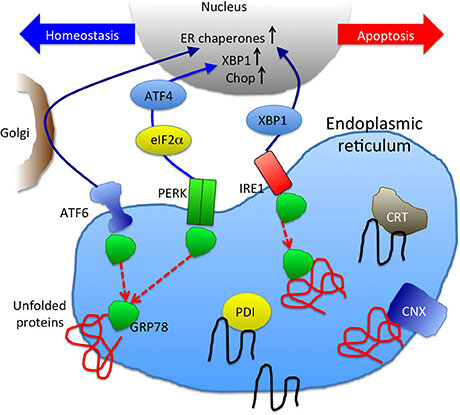
Proteins that are stuck in the folding cycle are eventually recognized as terminally misfolded. They are escorted to a channel in the ER membrane, where they are ejected back into the cytoplasm. As they emerge, they are tagged with a small protein called ubiquitin. This ubiquitin tag is a signal for destruction. The cell's recycling center, a large protein complex called the proteasome, recognizes the ubiquitin-tagged protein, unfolds it, and chops it up into small peptides.
The ERAD pathway is a crucial cleanup crew, preventing the buildup of faulty proteins that could disrupt cellular function or cause disease.
Time to test your knowledge on the ER's quality control systems.
What is the primary role of the chaperone protein BiP in the endoplasmic reticulum?
The enzyme UGGT acts as a quality control sensor. What does it do when it detects a misfolded glycoprotein?
Through this intricate system of chaperones, sensors, and degradation pathways, the cell ensures that only correctly folded and functional proteins are sent on their way, maintaining cellular health and order.