Advanced CCNA Networking Mastery
Advanced Routing Protocols
Scaling OSPF with Areas
As a network grows, a single OSPF area becomes inefficient. Imagine a city where every single street change is broadcast to every single driver, all the time. It would be overwhelming. To solve this, OSPF uses a multi-area design, dividing a large network into smaller, more manageable areas.
At the heart of this design is the backbone area, Area 0. All other areas must connect to it, either directly or through another area. This hierarchical structure keeps routing information contained. A router in one area knows the detailed layout of its own territory but only receives summarized information about other areas. This reduces the size of routing tables and minimizes the processing required when the network topology changes.
This leads directly to route summarization. An Area Border Router (ABR), which connects an area to the backbone, can consolidate multiple specific routes into a single summary route. For instance, instead of advertising routes for 10.1.1.0/24, 10.1.2.0/24, and 10.1.3.0/24 individually, an ABR can advertise one summary route: 10.1.0.0/22.
This single advertisement covers all the individual networks, making the routing information sent to other areas much more concise. It's the difference between giving someone a full phone book and just giving them the area code for a city.
The main goals of multi-area OSPF are stability and scalability. Changes within one area don't force every router in the entire network to recalculate their paths.
Communication within OSPF is handled by Link-State Advertisements (LSAs). These are packets of information that routers exchange to describe the network's topology. Each router builds a complete map of its area based on these LSAs. There are several types of LSAs, each with a specific purpose.
| LSA Type | Name | Purpose |
|---|---|---|
| Type 1 | Router LSA | Describes a router's active links and their status within an area. |
| Type 2 | Network LSA | Generated by a Designated Router to describe all routers on a network segment. |
| Type 3 | Summary LSA | Used by ABRs to advertise routes from one area to another (summarized routes). |
| Type 5 | AS External LSA | Advertises routes to networks outside of the OSPF domain, like the internet. |
BGP and Internet Routing
While OSPF manages routing within a single organization's network (an Autonomous System, or AS), Border Gateway Protocol (BGP) handles routing between them. BGP is the protocol that makes the internet work, connecting massive networks managed by ISPs, cloud providers, and large enterprises.
Unlike OSPF, which prioritizes the shortest path, BGP is a path-vector protocol focused on policy. It doesn't just find a path; it finds the best path according to the rules set by network administrators. This is crucial because routing decisions between ASes often involve business agreements and cost considerations, not just technical efficiency.
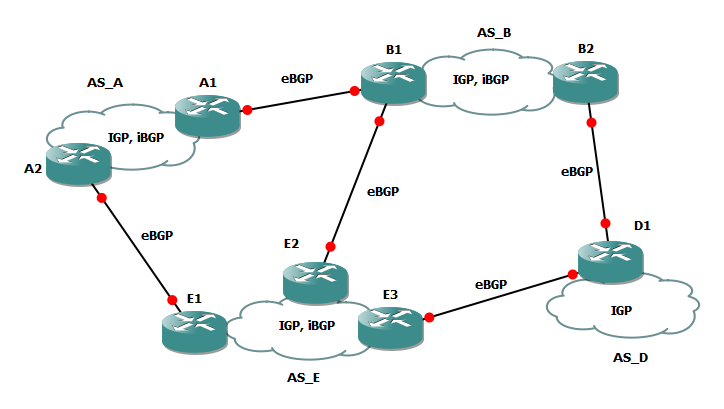
When a BGP router receives multiple paths to the same destination, it runs a complex decision process to select the single best one. This process follows a strict order of criteria.
BGP's path selection isn't about speed; it's about control and adhering to routing policies.
This path selection process is deterministic. If a router learns about several ways to reach a network, it steps through a list of attributes until one path is chosen as superior. Some of the most important attributes in this process are:
| Attribute | Description |
|---|---|
| Weight | A Cisco-proprietary value, local to the router. The path with the highest weight is preferred. |
| Local Preference | A value shared within an AS to influence outbound traffic. Higher is better. |
| AS_PATH | The list of AS numbers a route has passed through. The shortest AS_PATH is preferred. |
| MED (Multi-Exit Discriminator) | An attribute used to influence how a neighboring AS sends traffic to your AS. Lower is better. |
Mastering these attributes is key to implementing BGP route policies. Using tools like route maps, administrators can manipulate these attributes to control how traffic enters and leaves their network. For example, you could set a higher local preference for a route through a faster, more expensive ISP link to make it the primary path, while keeping a cheaper link as a backup. This level of granular control is why BGP is essential for the global internet.
What is the primary function of Area 0 in a multi-area OSPF network?
An Area Border Router (ABR) learns the specific routes 10.1.4.0/24, 10.1.5.0/24, 10.1.6.0/24, and 10.1.7.0/24. What is the most efficient summary route it can advertise to other areas?
Understanding how to scale OSPF and implement BGP policies are advanced skills that form the backbone of modern network engineering.