Advanced Canine Science and Behavior
Evolutionary Biological Foundations
From Wolf to Woofer
The story of the domestic dog, Canis lupus familiaris, doesn't begin with a modern gray wolf. Instead, genetic evidence points to a shared ancestor, an extinct wolf population that roamed Eurasia between 20,000 and 40,000 years ago. This means dogs aren't descended from the gray wolves we see today; rather, they are cousins, both having diverged from a common, now-vanished lineage. This split marked the beginning of one of the most successful partnerships in the animal kingdom.
Domestic dogs have descended from pack-living gray wolf-like ancestors.
For a long time, the prevailing theory was that humans actively captured wolf pups and raised them. This is known as artificial selection, where humans deliberately choose organisms with desirable traits to breed. While this certainly happened later in the dog's history to create specific breeds, the initial step towards domestication was likely more passive.
A Partnership by Choice
A more current theory suggests a process of self-domestication, or social selection. Imagine ancient human settlements. These were sources of leftover food. For a wolf pack, this was a potential meal, but getting close to humans was risky. Most wolves, naturally wary and aggressive, would have kept their distance.
However, within any wolf population, there's natural variation in temperament. Some wolves would have been slightly less fearful, slightly bolder. These individuals might have ventured closer to human camps to scavenge, gaining access to a reliable food source. This wasn't a conscious choice, but an instinctual weighing of risk and reward. Over generations, the wolves that were less stressed by human proximity were more successful in these new environments. They survived better and had more offspring, passing on their tamer traits. Essentially, the wolves chose us as much as we chose them.
The Domestication Syndrome
This shift in temperament brought with it a surprising suite of physical changes, collectively known as the "domestication syndrome." These traits, which appear in many different domesticated species, include floppy ears, shorter snouts, smaller teeth, curled tails, and patches of white fur. It also includes physiological changes like a reduced brain size compared to their wild ancestors.
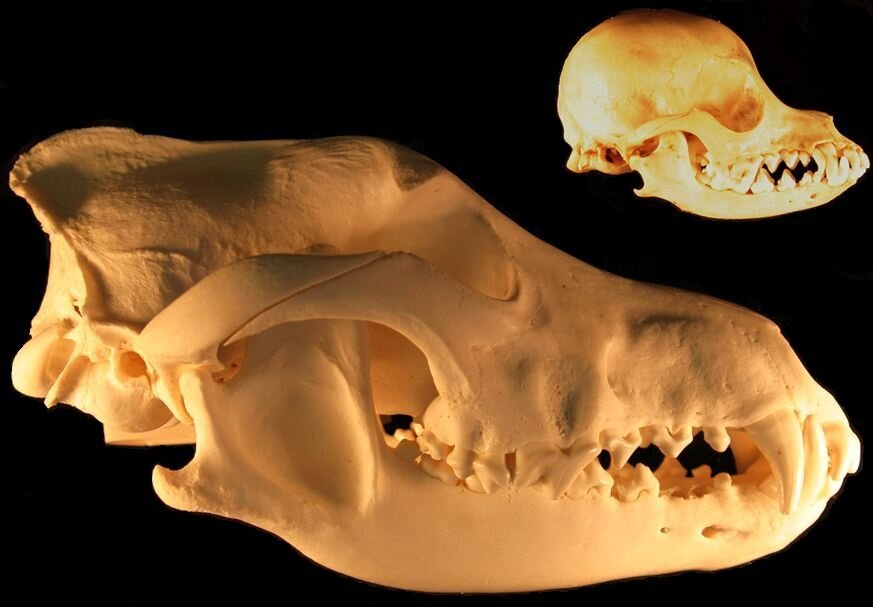
Why would selecting for a single behavioral trait—tameness—result in such a diverse set of physical changes? The leading hypothesis centers on neural crest cells.
These are a special type of stem cell that forms early in embryonic development. They migrate from the developing neural tube to various parts of the body, differentiating into a wide range of tissues. This includes cartilage for the ears and snout, dentin for teeth, melanocytes for skin and fur pigment, and the adrenal glands, which produce stress hormones like adrenaline.
The theory posits that selecting for tameness—a trait linked to the adrenal glands—inadvertently selected for a mild deficit in neural crest cell function. Fewer or slower-migrating neural crest cells would lead to smaller adrenal glands and lower stress, but it would also affect all the other structures these cells help build. The result is a cascade of seemingly unrelated physical changes, all tied to this single developmental pathway.
An Evolving Diet
Living alongside humans didn't just change how dogs looked and behaved; it changed what they could eat. Wolves are hypercarnivores, with a diet consisting almost exclusively of meat. Early human settlements, especially after the advent of agriculture, produced waste rich in another type of food: starch.
For a wolf, a pile of discarded grains or tubers would offer little nutritional value. Their bodies are not equipped to efficiently break down complex carbohydrates. However, for the proto-dogs scavenging around human camps, the ability to digest starch was a massive evolutionary advantage. This led to one of the most significant genetic changes separating dogs from wolves: copies of the amylase gene (AMY2B).
While wolves have only two copies of this gene, one from each parent, domestic dogs have many more—anywhere from 4 to 30 copies. More copies of the gene mean more amylase enzyme is produced, allowing dogs to unlock the energy stored in starchy foods that were abundant around humans.
| Feature | Gray Wolf (Canis lupus) | Domestic Dog (C. lupus familiaris) |
|---|---|---|
| Primary Diet | Carnivore (meat, organs, bone) | Omnivore (meat, grains, vegetables) |
| AMY2B Copies | 2 | 4 - 30 |
| Starch Digestion | Very low efficiency | High efficiency |
| Environment | Wilderness | Anthropogenic (human-influenced) |
This metabolic adaptation was critical. It allowed dogs to thrive not just as hunting partners, but as full-time residents of human society, subsisting on our leftovers and carving out a unique evolutionary niche. This journey, from a wary wolf ancestor to the diverse companions we know today, is a powerful example of evolution in action, shaped by behavior, development, and diet.
According to genetic evidence, what is the direct ancestor of the modern domestic dog (Canis lupus familiaris)?
The current leading theory suggests the initial process of dog domestication was primarily driven by: