Advanced Cancer Therapeutics and Molecular Mechanisms
Oncogenic Signaling Pathways
Receptor Tyrosine Kinase Dysregulation
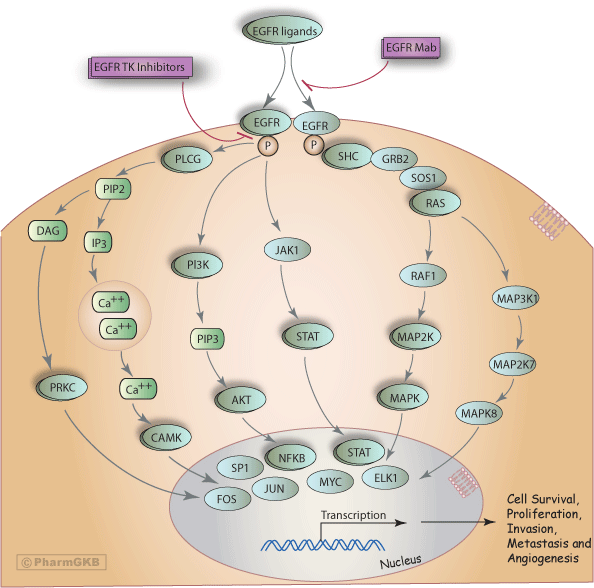
The initiation of many oncogenic signaling cascades begins with the aberrant activation of receptor tyrosine kinases (RTKs). In normal physiology, RTKs are tightly regulated, requiring ligand binding for dimerization and subsequent trans-autophosphorylation. Cancer cells employ several strategies to bypass this control. Gene amplification, such as ERBB2 (HER2) amplification in breast cancer, leads to receptor overexpression, increasing the probability of ligand-independent dimerization and constitutive signaling. Activating mutations are another common mechanism. For example, specific point mutations in the EGFR kinase domain, like the L858R mutation or exon 19 deletions found in non-small cell lung cancer, stabilize the active conformation of the kinase, rendering it perpetually “on” even in the absence of its ligand, EGF.
Furthermore, cancer cells can establish autocrine or paracrine signaling loops. By producing and secreting the very ligands that activate their own RTKs, they create a self-sustaining positive feedback circuit. This circumvents the need for external growth signals from the microenvironment, contributing to the hallmark of self-sufficient growth.
Core Oncogenic Cascades
Downstream of activated RTKs lie several core signaling pathways that are frequently hyperactivated in cancer. The PI3K/AKT/mTOR pathway is a central regulator of cell growth, survival, and metabolism. Hyperactivation is often driven by activating mutations in the PIK3CA gene, which encodes the p110α catalytic subunit of PI3K, or by the loss of the tumor suppressor , a phosphatase that antagonizes PI3K signaling by dephosphorylating PIP3. Once activated, AKT phosphorylates a multitude of substrates, promoting cell survival by inhibiting pro-apoptotic proteins like BAD and driving cell growth through the complex. mTORC1, in turn, phosphorylates S6K and 4E-BP1 to unleash protein synthesis.
The MAPK/ERK pathway is another critical axis controlling proliferation and differentiation. While often depicted as a linear cascade (RAS-RAF-MEK-ERK), its regulation is far more nuanced. The efficiency and specificity of MAPK signaling are heavily influenced by like KSR (Kinase Suppressor of Ras), which bring pathway components into close proximity. This architecture prevents unwanted crosstalk and modulates signal duration and intensity. Oncogenic mutations, most famously in RAS and BRAF (e.g., BRAF V600E in melanoma), lock the pathway in a state of high-output, driving relentless cell division.
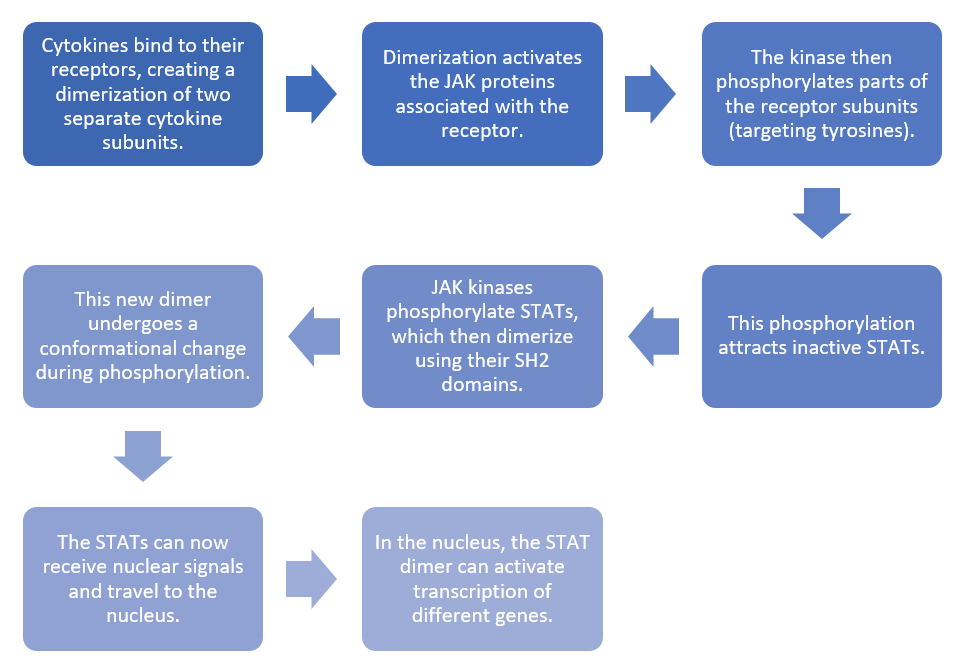
The JAK/STAT pathway is a more direct route from the cell surface to the nucleus, primarily mediating responses to cytokines and growth factors. It is particularly crucial in hematopoiesis and immune function. Persistent activation in cancer often arises from mutations in the JAK family of kinases, such as the JAK2 V617F mutation common in myeloproliferative neoplasms. This mutation renders the kinase constitutively active, leading to constant phosphorylation and activation of STAT transcription factors, which then dimerize, translocate to the nucleus, and drive the expression of genes involved in proliferation and survival.
Network Dynamics and Regulation
These oncogenic pathways do not operate in isolation. They are part of a complex, interconnected network characterized by significant crosstalk. For instance, the PI3K/AKT and MAPK/ERK pathways are heavily intertwined. Activation of one can influence the other, and this has profound clinical implications. A common mechanism of resistance to RAF or MEK inhibitors is the compensatory activation of the PI3K/AKT pathway through RTK-mediated signaling. This redundancy allows cancer cells to survive targeted therapy by simply rerouting their proliferative signals.
Crosstalk between pathways is not a bug, but a feature of robust biological systems. Cancer cells exploit this interconnectivity to develop resistance to targeted therapies.
Negative feedback loops are also critical for maintaining homeostasis, and their subversion is key to sustained oncogenic signaling. For example, a major downstream target of AKT, mTORC1, normally initiates a negative feedback loop by phosphorylating and inhibiting Insulin Receptor Substrate 1 (IRS1), which dampens upstream PI3K signaling. Cancer cells can acquire secondary mutations or activate parallel pathways that override these intrinsic brakes.
This sustained signaling directly fuels metabolic reprogramming. Hyperactive AKT, for example, promotes the Warburg effect by increasing the expression and membrane translocation of the glucose transporter GLUT1 and by phosphorylating key glycolytic enzymes like hexokinase 2. This shifts cellular metabolism towards aerobic glycolysis, providing the building blocks necessary for rapid cell division.
Finally, the regulation of these pathways is further complicated by non-coding RNAs. MicroRNAs (miRNAs) and long non-coding RNAs (lncRNAs) can function as oncogenes or tumor suppressors. For example, the oncomiR miR-21 can promote tumorigenesis by directly targeting and repressing the translation of PTEN mRNA, thereby activating the PI3K/AKT pathway. Conversely, tumor-suppressive miRNAs may be lost, leading to the overexpression of key oncogenes. LncRNAs can act as scaffolds, decoys, or guides for chromatin-modifying complexes to modulate the expression of pathway components.
Now, let's test your understanding of these complex interactions.
How does amplification of the ERBB2 (HER2) gene contribute to oncogenic signaling in some breast cancers?
A cancer cell line shows high levels of PIP3 and hyperactivated AKT signaling, even though it has no mutations in the PIK3CA gene. What is the most likely molecular defect in this cell line?
Understanding the intricate wiring of these oncogenic networks, including their feedback loops and crosstalk, is essential for developing more effective and durable anti-cancer therapies.