Advanced Calculus Limits and Continuity
Epsilon-Delta Definition
The Formal Definition
So far, we've thought about limits intuitively, as a value a function approaches. While useful, this idea isn't mathematically precise. To build the rest of calculus, we need a more rigorous foundation. This is where the epsilon-delta definition comes in. It formalizes the idea of getting "arbitrarily close" to a limit.
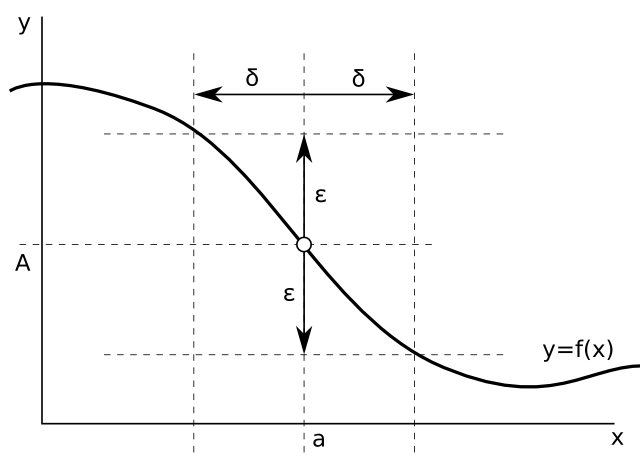
At its heart, the definition is a challenge. You give me a target range for the output (an "epsilon"), and I must find an input range (a "delta") that guarantees the function's output falls within your target.
For any small positive number , there must exist another small positive number that makes the relationship true.
Let's state it formally. The limit of as approaches is if, for every number , there is a number such that:
Think of (epsilon) as the error tolerance for the function's output, and (delta) as the error tolerance for the input. The definition demands that no matter how small a tolerance you demand, a corresponding can always be found.
A Brief History
For over a century after Newton and Leibniz developed calculus, its foundations were surprisingly shaky. Mathematicians relied on intuitive ideas about infinitesimals, which were problematic and led to paradoxes. It wasn't until the 19th century that the French mathematician Augustin-Louis Cauchy began to formalize the concept of a limit.
Cauchy's work was a huge step forward, but it was the German mathematician Karl Weierstrass who refined it into the precise definition we use today. This rigorous approach removed the fuzzy concept of "infinitesimals" and placed calculus on a solid logical footing, paving the way for modern mathematical analysis.
Proving a Limit
The epsilon-delta definition isn't just a theoretical concept; it's a tool for proving that a limit is correct. The process is like a game. A skeptic gives you an arbitrary . Your goal is to find a formula for (usually in terms of ) that satisfies the definition.
Let's prove that .
Here, , , and our proposed limit .
Our goal is to find a such that if , then . We'll start with the conclusion and work backward to find the connection to .
Let's simplify the expression inside the absolute value.
Now, we can factor out a 2.
Finally, we isolate .
This gives us the relationship we were looking for! We have shown that the condition is equivalent to . This tells us exactly how to choose our .
If we choose , then whenever , our steps above show that will be true. Since we can find a for any given , the proof is complete.
What is the fundamental relationship between ε (epsilon) and δ (delta) in the formal definition of a limit?
Which mathematician is credited with refining the concept of a limit into the precise (ε, δ) definition we use today?
This method of working backward from the inequality to find a suitable is the standard technique for epsilon-delta proofs.