Advanced Bodyweight Mastery and Calisthenics Progression
Mastering Leverage Mechanics
Beyond Reps: The Power of Leverage
You’ve mastered the basic push-up and can hold a pull-up for a decent amount of time. What’s next? The path to more advanced calisthenics isn't just about adding more repetitions. It's about making each repetition harder. The secret lies not in adding weight, but in manipulating your body's own leverage.
Think of your bones as levers and your joints as pivots, or fulcrums. When you perform an exercise, your muscles generate force to move these levers against resistance, which is usually just your body weight acting under gravity. By changing your body's position, you can change the length of the lever arm, which dramatically alters how difficult the movement is.
Making an exercise harder is often a matter of increasing the distance between the force (your weight) and the pivot point (your joints).
This principle introduces the concept of mechanical disadvantage. Instead of making it easier to lift a heavy object, like a crowbar does, you're intentionally making it harder for your muscles to lift your own body. This forces them to generate more torque to accomplish the same movement, leading to greater strength gains.
Torque
noun
A measure of the force that can cause an object to rotate around an axis. In fitness, it's the rotational force your muscles must overcome at a joint.
Shifting Your Centre
Every object has a (CoM), the point where its mass is evenly distributed. For the human body, this point is typically around your navel when standing still, but it shifts as you move your limbs. The key to unlocking advanced calisthenics is learning to consciously shift your CoM relative to your base of support.
Let's apply this to a practical example: the pseudo-planche push-up. You start in a standard push-up position. Your hands are the pivot point. To make it harder, you don't just do more reps. Instead, you lean your body forward, moving your hands closer to your waist. As you do this, your CoM shifts further in front of your hands. This lengthens the effective lever arm that your shoulders and chest have to control, dramatically increasing the torque and the muscular effort required.
This same idea applies to pulling movements. Consider the difference between a regular pull-up and a tucked front lever hold. In a pull-up, your CoM is directly under your hands (the pivot). To hold a front lever, you extend your body horizontally. Your hips (and thus your CoM) move away from the pivot point, creating a long lever arm that your lats and core must work incredibly hard to support against gravity.
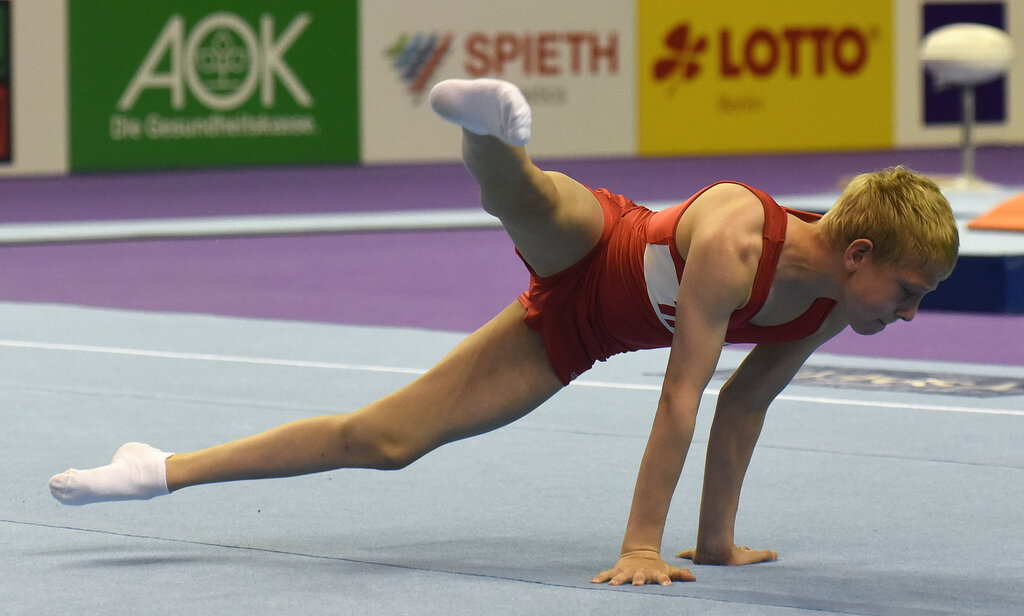
The Physics of Static Holds
Static holds like the L-sit, planche, and front lever are pure expressions of torque management. In these positions, your body is in a state of —all the forces and torques acting on you are balanced. Gravity is creating a torque that tries to pull your body down, and your muscles are creating an equal and opposite torque to hold you up.
To progress from a tucked front lever to a full, straight-body front lever, you slowly extend your legs. Each inch you extend moves your CoM further from the bar, increasing the gravitational torque. Your muscles must adapt and get stronger to produce the opposing torque needed to maintain the hold. This provides a smooth, infinitely adjustable path of resistance. You are your own weight machine.
With calisthenics, you achieve progressive overload by manipulating leverage, stability, and volume.
By understanding these principles of leverage, torque, and center of mass, you can move beyond simply counting reps. You gain the tools to design your own progressions, turning your body into an adjustable resistance machine. This is the foundation for building the strength required for the most impressive skills in bodyweight training.
According to the text, what is the primary method for advancing in calisthenics beyond basic movements?
How does performing a pseudo-planche push-up (leaning your body forward) increase the exercise's difficulty?