Advanced Bloom's Taxonomy Application
Understanding Bloom's Taxonomy
A Ladder for Your Mind
Not all learning is the same. Memorizing a fact is different from inventing something new. In the 1950s, a group of educational psychologists led by Benjamin Bloom developed a framework to classify different levels of thinking. It's called Bloom's Taxonomy, and it's often shown as a pyramid.
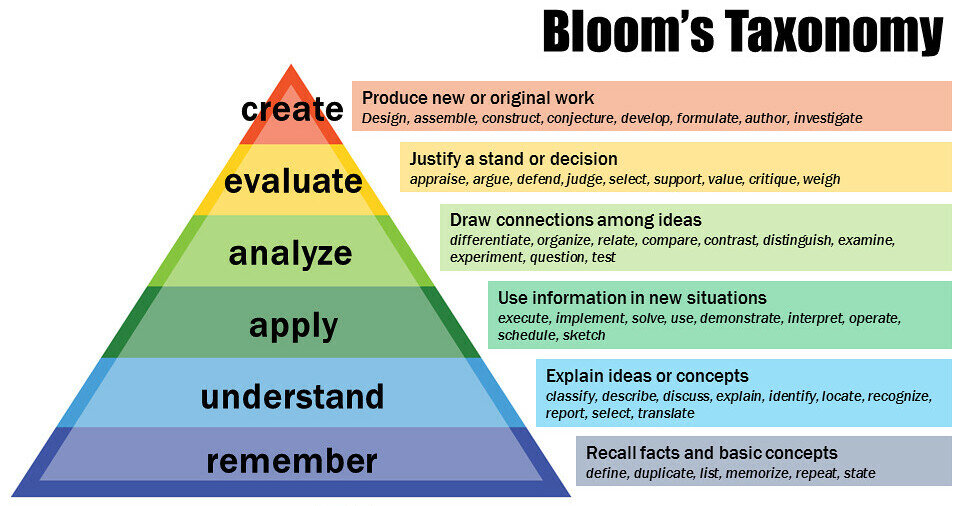
The base of the pyramid includes skills like remembering facts, understanding concepts, and applying knowledge. These are essential, but the real magic happens at the top. The top three levels—Analyzing, Evaluating, and Creating—are known as higher-order thinking skills. They're what allow us to move beyond simply knowing things to truly engaging with information in a deep and meaningful way. Let's explore these top tiers.
The Higher Levels of Thinking
Once you can remember, understand, and apply information, you're ready to climb higher. This is where you learn to work with knowledge, not just consume it.
Analyzing: Taking It Apart Analysis is about breaking down information into its essential parts to understand how they relate to one another. It's like being a detective, looking for clues and patterns. When you analyze something, you're not just seeing the whole picture; you're examining the individual pieces and their connections. This could mean distinguishing between fact and opinion in an article, identifying the underlying themes in a novel, or examining the results of a scientific experiment to see what the data really means.
Next up the ladder is evaluation.
Evaluating: Making a Judgment Evaluation involves making judgments based on criteria and standards. This is where you form and defend an opinion. It’s about assessing the value, quality, or credibility of an idea or a piece of work. Are you critiquing a film, judging the strength of a debater's argument, or deciding which of two business proposals is more likely to succeed? That's evaluation. It requires you to weigh evidence, consider different perspectives, and justify your conclusions.
At the very peak of the pyramid is the ultimate act of cognition.
Creating: Building Something New Creating is the highest level of thinking in the taxonomy. It's the process of putting elements together to form a new, coherent whole. This is where innovation happens. Creating involves generating, planning, and producing. Whether you're designing a website, composing a song, writing a script, or developing a new scientific hypothesis, you are operating at this level. You're taking what you know and making something entirely original from it.
Why It Matters
Focusing on higher-order thinking skills is crucial for deep, lasting learning. Simply memorizing facts is fragile; that knowledge is easily forgotten. But when you learn to analyze, evaluate, and create, you develop the ability to think critically and solve complex problems.
These skills are not just for school. In any job and in everyday life, the ability to break down problems, assess situations, and come up with new solutions is invaluable. By understanding these levels, educators can design lessons that push students beyond memorization, and learners can become more aware of how to challenge themselves.
Promote Deeper Thinking: Push students beyond surface-level recall to analyze, synthesize, and evaluate.
Ready to test your understanding of these powerful thinking skills?
According to the commonly used pyramid model of Bloom's Taxonomy, which skill is considered the pinnacle of cognitive processes?
Which of the following tasks best exemplifies the 'Analyzing' level of Bloom's Taxonomy?
Mastering these skills transforms you from a passive recipient of information into an active participant in your own learning.