Advanced Blockchain dApp Development
Advanced Solidity Patterns
Making Contracts Upgradeable
Smart contracts on the blockchain are typically immutable. Once deployed, their code can't be changed. While this ensures trust and predictability, it's a problem when you discover a bug or need to add new features. This is where the Proxy Pattern comes in.
Think of it like a P.O. Box. Your address (the proxy contract) always stays the same, so people know where to send mail. However, you can change who picks up the mail from that box. The proxy contract holds the contract's state (its data), but forwards all function calls to a separate logic contract. When you want to upgrade, you simply deploy a new logic contract and tell the proxy to point to the new address. Users continue interacting with the same old address, but their calls are now handled by the new logic.
The key is that the user's address for the contract never changes, but the underlying logic that executes can be swapped out.
This is achieved using a special low-level function called delegatecall. When the proxy contract uses delegatecall to the logic contract, the code from the logic contract is executed in the context of the proxy contract. This means it acts on the proxy's storage, not its own. It's as if the proxy temporarily borrows the logic contract's brain to operate on its own data.
// This is a simplified proxy contract.
contract Proxy {
    address public implementation;

    // The fallback function is executed for any call
    // that doesn't match a function in this contract.
    fallback() external payable {
        address _implementation = implementation;
        assembly {
            // Copy msg.data to memory
            calldatacopy(0, 0, calldatasize())

            // Delegate the call to the implementation contract
            let result := delegatecall(gas(), _implementation, 0, calldatasize(), 0, 0)

            // Copy the return data back
            returndatacopy(0, 0, returndatasize())

            // Revert if the call failed, otherwise return the data
            switch result
            case 0 { revert(0, returndatasize()) }
            default { return(0, returndatasize()) }
        }
    }
}
The Contract Factory
Imagine you need to deploy many similar contracts. Maybe you're building a platform where each user gets their own personal wallet contract, or a decentralized exchange where a new contract is created for each trading pair. Deploying them one by one would be inefficient and hard to track.
The Factory Pattern solves this. You create one contract, the "factory," whose sole job is to deploy other contracts. It acts as a single point of creation and management.
When you need a new contract, you just call a function on the factory. The factory uses the new keyword to deploy a new instance of the target contract and can then store its address in a list. This makes it easy to keep track of all the contracts it has created. It simplifies deployment, saves on gas by reusing deployment logic, and provides a central registry of all contract instances.
// A simple contract to be deployed
contract MyContract {
    address public owner;

    constructor(address _owner) {
        owner = _owner;
    }
}

// The factory that creates MyContract instances
contract MyContractFactory {
    MyContract[] public deployedContracts;

    function createMyContract() public {
        // The `new` keyword deploys a new contract.
        // We pass the creator's address to its constructor.
        MyContract newContract = new MyContract(msg.sender);
        deployedContracts.push(newContract);
    }
}
Controlling Access
Many smart contracts have special functions that only certain users should be able to call. For instance, only the contract creator should be able to withdraw funds, or only designated administrators should be able to pause the contract in an emergency.
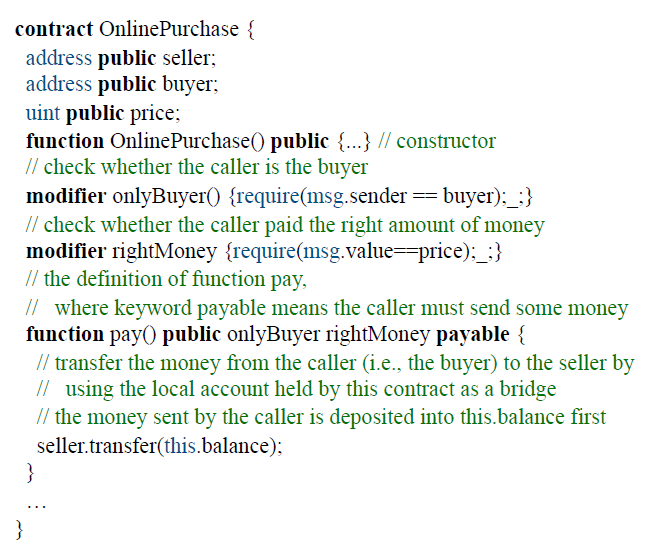
The Access Control Pattern provides a clear and secure way to manage these permissions. The most common implementation is the Ownable pattern. It's very simple: the contract has an "owner," and certain functions can only be executed if the caller (msg.sender) is that owner.
This is usually implemented with a custom modifier, a reusable piece of code that checks a condition before a function runs.
The contract stores the owner's address in a state variable. The constructor sets this variable to the address of the person who deployed the contract. A modifier, often called onlyOwner, then checks if msg.sender matches the stored owner address. If it doesn't, the function call is rejected.
contract Ownable {
    address public owner;

    // This event is emitted when ownership is transferred.
    event OwnershipTransferred(address indexed previousOwner, address indexed newOwner);

    // The constructor sets the original owner to the deployer.
    constructor() {
        owner = msg.sender;
    }

    // This modifier restricts function access to the owner.
    modifier onlyOwner() {
        require(msg.sender == owner, "Caller is not the owner");
        _;
    }

    // A function to transfer ownership to a new address.
    function transferOwnership(address newOwner) public onlyOwner {
        require(newOwner != address(0), "New owner is the zero address");
        emit OwnershipTransferred(owner, newOwner);
        owner = newOwner;
    }
}

// Example of how to use it
contract MyAdminContract is Ownable {
    function criticalFunction() public onlyOwner {
        // Only the owner can call this!
    }
}
For more complex needs, this pattern can be extended to Role-Based Access Control (RBAC), where you can define multiple roles (like 'admin', 'minter', 'pauser') and assign them to different addresses.
What is the primary problem that the Proxy Pattern solves for smart contracts?
Which scenario is the best fit for using the Factory Pattern?
These advanced patterns are foundational for building secure, flexible, and scalable decentralized applications. They solve common, critical problems in smart contract development.