Advanced Biology and Management of Candida
Pathogenicity and Morphological Plasticity
The Pathogenic Switch
Candida albicans usually lives harmlessly on our skin and mucosal surfaces. But under certain conditions, this peaceful coexistence ends. The fungus undergoes a dramatic transformation, switching from a rounded, single-celled yeast to a filamentous, invasive form called a hypha. This change in shape, known as morphological plasticity, is the key to its virulence.
This isn't a random event. Specific environmental cues act as triggers, telling the fungus it's in a location ripe for invasion. The most potent signals are a temperature of 37°C (our body temperature), a neutral pH, and the presence of serum components in the blood. When C. albicans detects this combination, it activates internal signaling networks that initiate the switch.
Two primary signaling cascades translate these external cues into an internal command. The cAMP-PKA pathway is highly sensitive to temperature and carbon dioxide levels, acting like a thermostat and atmospheric sensor. The Cek1-MAPK pathway, on the other hand, responds more to direct contact with host cells and serum. It’s the fungus’s sense of touch and taste, confirming it's in a prime location.
These pathways don't directly build the hyphae. Instead, they act like messengers, racing to the cell's nucleus to activate a group of master-switch proteins known as transcription factors.
Orchestrating the Invasion
Once the signal is received, specific transcription factors take control of the cell's genetic machinery. The two main players are Efg1 and Cph1. Efg1 is the primary target of the cAMP-PKA pathway, while Cph1 is activated by the MAPK pathway. Together, they turn on a suite of genes required for filamentous growth.
A third crucial factor is Ume6. Think of Ume6 as a lock that holds the hyphal state in place. Once Efg1 and Cph1 initiate the change, Ume6 is expressed and maintains the hyphal development program, ensuring the fungus doesn't revert back to the yeast form prematurely. This sustained commitment is vital for successful tissue invasion.
Weapons of Invasion
Changing shape is only the first step. To penetrate host tissues, the newly formed hyphae deploy a molecular arsenal. They secrete a family of enzymes called Secretory Aspartyl Proteinases, or SAPs. These act like molecular scissors, breaking down host proteins like collagen and keratin. This clears a path for the hyphae to burrow deeper and also releases nutrients for the fungus to consume.
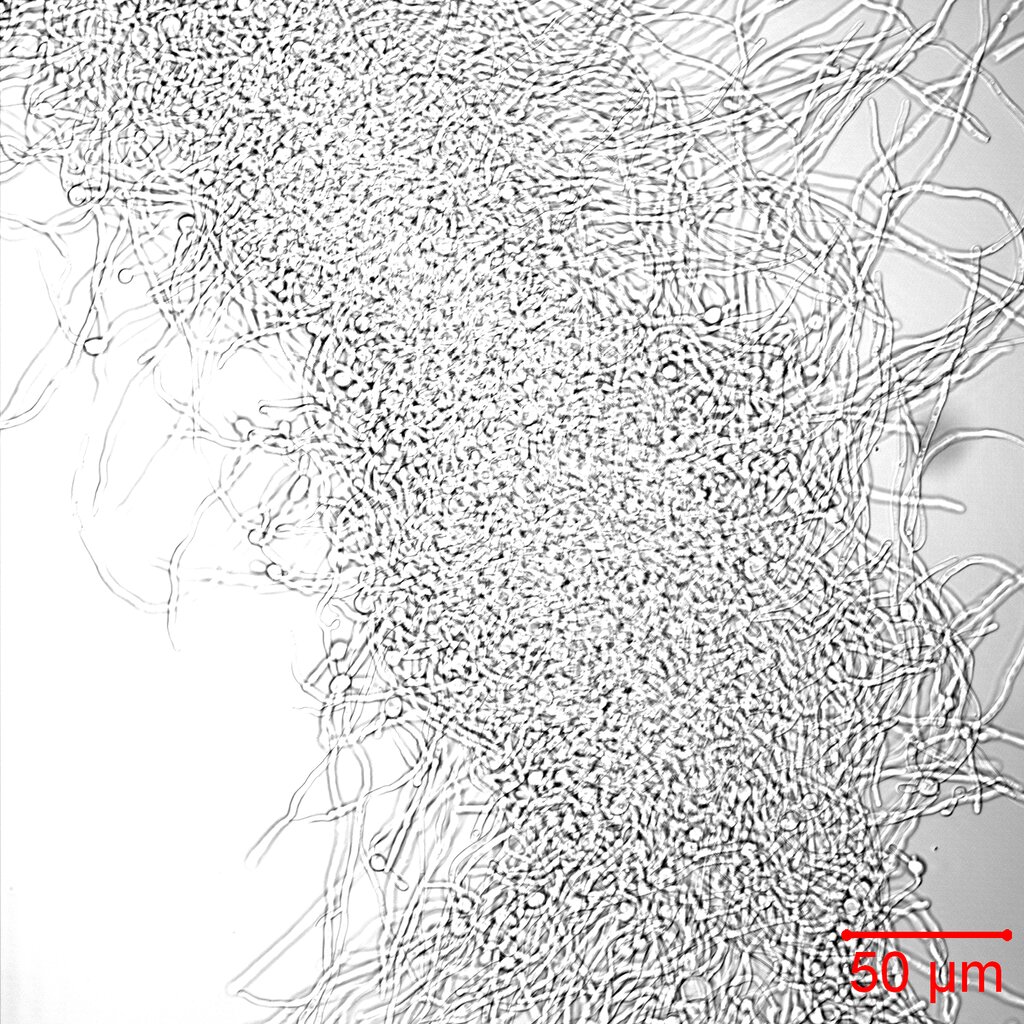
Alongside the SAPs, the hyphae produce a potent toxin called Candidalysin from a gene named Ece1. This small peptide acts like a hole-punch, assembling into structures that perforate the membranes of host cells. This direct damage kills cells, disrupts epithelial barriers, and triggers a strong inflammatory response from the host immune system. The physical force of the growing hyphae, combined with the chemical warfare of SAPs and Candidalysin, makes C. albicans a formidable pathogen.
The yeast-to-hyphal transition is a trade-off. The hyphal form is excellent for tissue invasion but poor for travelling through the bloodstream. The smaller, rounded yeast form is much better suited for dissemination to new sites in the body.
Ready to test your knowledge on how this commensal fungus turns into a pathogen?
Which of the following combinations represents the most potent environmental cues for Candida albicans to switch to its invasive hyphal form?
What is the primary function of the toxin Candidalysin during an infection?