Advanced Automatic Manufacturing Systems
System Architecture
The Automation Ecosystem
Modern manufacturing isn't just about individual automated components. It's about creating a single, intelligent system where every part works in concert. At the heart of this system is a powerful trio: Programmable Logic Controllers (PLCs), Supervisory Control and Data Acquisition (SCADA) systems, and industrial robotics.
Think of it like a highly efficient crew. The PLC is the hands-on specialist, the brain on the factory floor executing tasks with microsecond precision. It directly controls the motors, valves, and sensors of a specific machine or process. The SCADA system is the supervisor, observing the entire operation from a control room. It provides the 'big picture' view, collecting data, flagging alarms, and allowing human operators to monitor and direct the workflow. Finally, the robots are the skilled labourers, performing the physical work—welding, painting, assembling—with tireless accuracy.
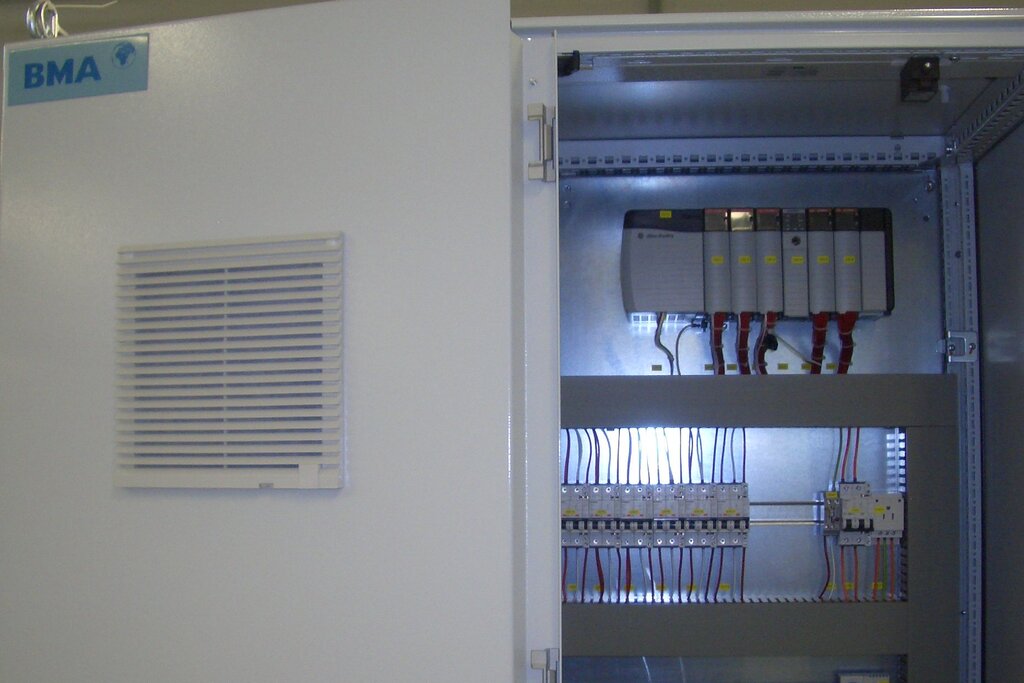
This synergy allows for a level of control and efficiency that was previously impossible. A SCADA system might log that a particular robotic arm is completing its task 5% slower than usual. This data is analyzed, and a new directive can be sent down to the PLC controlling that robot to adjust its parameters, all without stopping the production line.
The Control Hierarchy
To manage this complexity, industrial systems are organized into a control hierarchy, often based on the Purdue Model for Control Hierarchy. While you don't need to memorize all the levels, understanding the first few is key to grasping system architecture.
At the bottom is Level 0, the physical process itself. This includes the sensors that measure temperature or pressure, and the actuators that open valves or start motors.
Level 1 is where real-time control happens. PLCs and robot controllers live here. They take input from Level 0 sensors and execute their pre-programmed logic to control the Level 0 actuators. This layer is all about speed and direct machine control.
Level 2 is the supervisory layer. This is the domain of SCADA and Human-Machine Interfaces (HMIs). Systems at this level monitor the activities of multiple Level 1 devices, collect data for analysis, and provide a centralized interface for operators to oversee the entire production area. They don't control motors directly; they give commands to the PLCs, which then handle the low-level execution.
By integrating PLCs with higher-level systems like Supervisory Control and Data Acquisition (SCADA) or Manufacturing Execution Systems (MES), manufacturers can gain insights into production trends, identify inefficiencies, and make data-driven decisions to optimize operations.
Making the Connection
For this ecosystem to function, components need to speak the same language. This is where communication protocols and data handshaking come in. In older systems, this was often a tangled web of proprietary protocols and physical wiring. Today, standards like Industrial Ethernet have simplified things, but the underlying principles remain.
Data is exchanged using a system of 'tags'. A tag is simply a named variable that represents a piece of data, like Tank_A_Temperature or Robot_1_Position. When a PLC reads a temperature sensor, it updates its internal tag. The SCADA system is configured to poll or subscribe to that specific tag from the PLC. When the value changes, the SCADA display updates, and the new value is logged in a database.
This real-time data handshaking is critical. Imagine a robot needs to pick up a part from a conveyor belt. The robot's controller needs to know precisely when the part has arrived. A sensor (Level 0) detects the part and sends a signal to the conveyor's PLC (Level 1). The PLC then sends a 'part in position' signal to the robot's controller (also Level 1). The robot performs its task and then signals back to the PLC that it's finished, allowing the conveyor to move again. The entire interaction is monitored and logged by the SCADA system (Level 2).
To ensure seamless communication between devices from different manufacturers, the industry relies on open protocols. While older standards like are still in use, modern systems often use protocols built on standard Ethernet technology. Two of the most important are OPC UA and MQTT.
- OPC UA (Open Platform Communications Unified Architecture) is a robust, secure, and platform-independent standard. Think of it as a universal translator for industrial devices. It allows a SCADA system from one vendor to easily communicate with a PLC from another.
- MQTT (Message Queuing Telemetry Transport) is a lightweight messaging protocol ideal for sending small packets of data over networks with limited bandwidth. It's often used for sending sensor data up to cloud platforms for big data analysis, a key part of the Industrial Internet of Things (IIoT).
| Protocol | Primary Use Case | Key Feature |
|---|---|---|
| OPC UA | Machine-to-machine communication (e.g., PLC to SCADA) | High security, rich data models |
| MQTT | Sensor-to-cloud communication (IIoT) | Lightweight, efficient, low bandwidth |
The hardware and software integration workflow brings all these pieces together. It begins with defining the control logic—what needs to happen and when. This logic is then programmed into the PLC. Next, the SCADA/HMI screens are designed, and tags are mapped from the PLCs to the graphical elements. Finally, the robot's movements are programmed and coordinated with the PLC logic. Each step is tested individually before a full system test ensures every component communicates and acts as expected.
Ready to test your understanding of how these systems fit together?
What is the primary role of a SCADA system in an industrial control hierarchy?
A temperature sensor on a mixing tank and the valve that adds a coolant are both components at which level of the Purdue Model for Control Hierarchy?