Advanced Audio Circuit Engineering
High Performance Op-Amp Topologies
Choosing the Right Op-Amp
You already know how to build a basic gain stage or a buffer with an operational amplifier. But in professional audio, where every decibel of noise and every microsecond of transient response counts, the choice of op-amp itself becomes a critical design decision. Moving beyond the generic 741, we enter a world of specialized devices designed for sonic purity, each with its own set of strengths and compromises.
The game is about managing trade-offs. An op-amp that excels in one area, like having an incredibly low noise floor, might have limitations in another, like its ability to handle fast, sharp signals. Understanding these trade-offs starts at the very beginning of the op-amp's internal signal path: the input stage.
The Input Stage Debate
The first transistors an audio signal encounters inside an op-amp largely define its behavior. For audio, the choice typically comes down to two technologies: JFETs or Bipolar Junction Transistors (BJTs).
JFET-input op-amps are ideal for high-impedance sources. BJT-input op-amps are better suited for low-impedance sources.
A JFETs-input op-amp, like the popular OPA1642, has a very high input impedance and extremely low input bias current. This means it barely draws any current from the source. This is a huge advantage when working with high-impedance sources like piezo pickups or certain filter designs, as it prevents the op-amp from 'loading down' the source and altering its frequency response.
The trade-off is in their noise characteristics. JFETs have higher voltage noise but lower current noise compared to their bipolar counterparts.
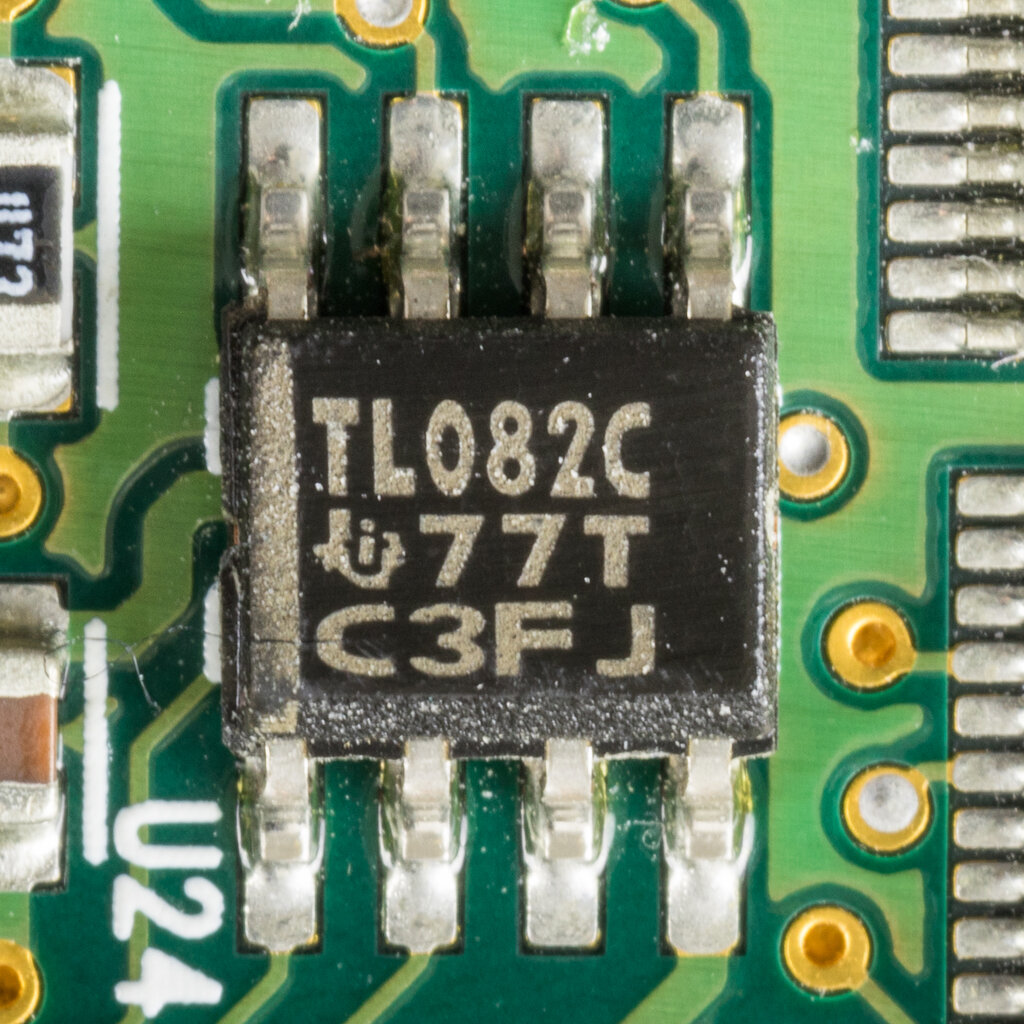
On the other hand, BJT-input op-amps, like the venerable , have lower voltage noise, making them a go-to choice for preamplifiers dealing with low-impedance sources like dynamic microphones or summing buses in mixing consoles. The lower source impedance makes the BJT's higher current noise less of an issue, allowing its superior voltage noise performance to shine through. However, their higher input bias current makes them unsuitable for circuits with very high source impedances.
Speed, Distortion, and Bandwidth
Beyond the input stage, we need to consider how fast the op-amp can respond to changes. This is where slew rate comes in. Slew rate measures the maximum rate of change of the op-amp's output voltage, usually expressed in volts per microsecond (V/µs).
Slew Rate
noun
The maximum rate at which an amplifier's output voltage can change. A low slew rate can cause distortion on fast-moving signals.
If an input signal demands the output to change faster than the op-amp's slew rate allows, a particularly harsh form of distortion called (TIMD) occurs. This blurs the sharp, percussive elements of music—the snap of a snare drum, the pluck of a guitar string. For high-fidelity audio, a slew rate of at least 10 V/µs is often considered a good starting point.
Another key specification is the Gain-Bandwidth Product (GBW). This tells you the maximum gain you can achieve at a given frequency, or vice-versa. For an op-amp with a GBW of 10 MHz, you can get a gain of 100 up to 100 kHz (), or a gain of 1000 up to 10 kHz (). A high GBW is crucial for microphone preamps that need to provide high gain across the entire audio spectrum (20 Hz to 20 kHz) with plenty of headroom.
Stability and Compensation
High-gain, high-speed op-amps can be prone to instability. They can turn into oscillators, producing high-frequency tones that are at best annoying and at worst can damage other equipment like tweeters. This instability is often caused by phase shift within the op-amp's feedback loop at high frequencies.
To prevent this, designers use frequency compensation. Most general-purpose op-amps are 'unity-gain stable,' meaning they have an internal compensation capacitor that makes them stable even at a gain of 1. However, this internal capacitor also limits the op-amp's slew rate and bandwidth.
Some high-performance op-amps are 'decompensated,' requiring a minimum amount of gain to be stable. They trade unconditional stability for higher speed.
Op-amps like the NE5534 (the single-channel version of the 5532) allow for external compensation. By adding a small external capacitor, a designer can tailor the compensation to the specific gain of their circuit. This allows them to achieve a higher slew rate and wider bandwidth than would be possible with a one-size-fits-all internal capacitor. The trade-off is that the circuit is no longer unity-gain stable and requires careful design to avoid oscillation.
You are designing a preamplifier for a piezo pickup, which is a very high-impedance source. Which type of op-amp input stage would be the most suitable to prevent 'loading down' the source and altering its frequency response?
An input signal requires an op-amp's output to change faster than its maximum rate allows. This results in a harsh form of distortion that can blur percussive sounds. What is this type of distortion called?
Selecting the right op-amp involves a careful balancing act, weighing the needs of the source signal against the performance specifications of the device to achieve transparent, high-fidelity audio.