Advanced Antigravity Physics
Negative Mass Frameworks
Gravity's Opposite
General Relativity is built on a beautiful idea: matter and energy tell spacetime how to curve, and spacetime tells matter how to move. This relationship is captured in the Einstein Field Equations. The key component on the matter-and-energy side of the equation is the stress-energy tensor, which describes the density and flow of energy and momentum in a given region.
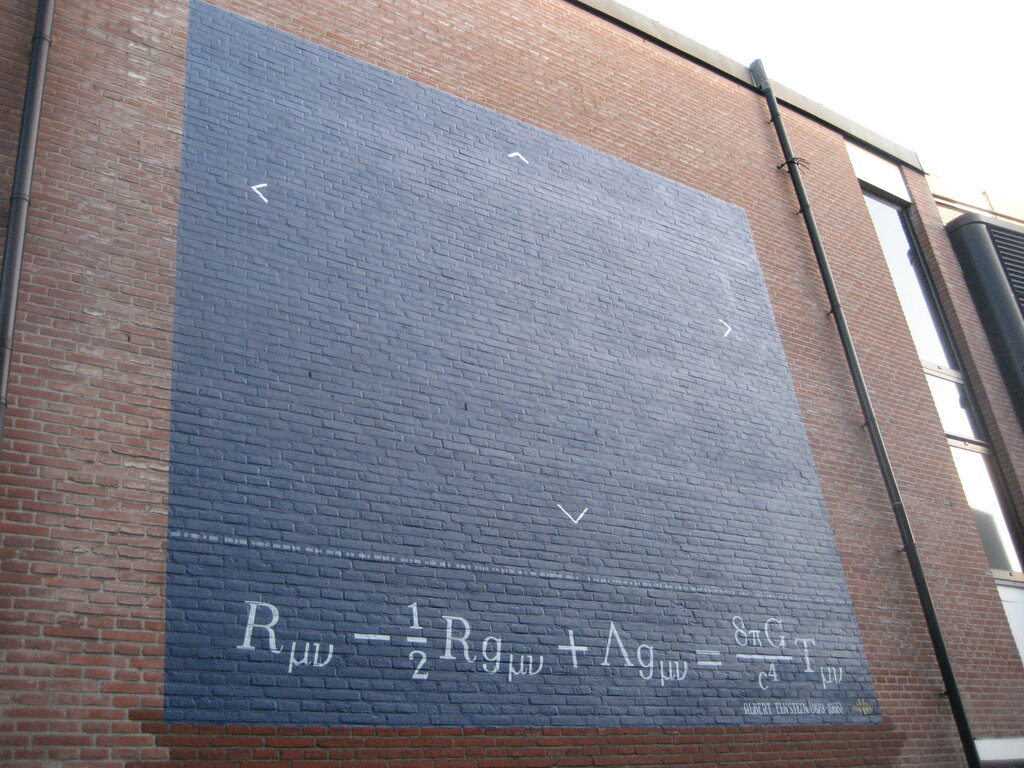
Normally, we assume the energy density term in this tensor is positive. After all, mass is a form of energy (), and we don't encounter objects with negative mass in daily life. But what if we did? Mathematically, nothing stops us from plugging a negative value for energy density or mass into the equations. When you do, you get a strange result: repulsive gravity. Instead of pulling things together, spacetime curves in a way that pushes things apart.
Positive mass creates a gravitational 'well' that attracts objects. Negative mass would create a gravitational 'hill' that repels them.
The Runaway Paradox
In 1957, physicist Hermann Bondi explored this idea seriously. He considered how a negative mass would behave. A positive mass, like a planet, attracts everything, whether it has positive or negative mass. A negative mass, however, would repel everything. Things get really weird when you put a positive mass and a negative mass near each other.
Let's break it down:
- The positive mass attracts the negative mass, pulling it closer.
- The negative mass repels the positive mass, pushing it away.
The strange result? The positive mass chases the negative mass, which is constantly pushed away from it. The pair accelerates indefinitely in the same direction, seemingly creating energy from nothing. This is known as runaway motion().
This doesn't actually violate the conservation of momentum. Momentum is mass times velocity (). If the negative mass has negative momentum, and the positive mass has positive momentum, the total momentum of the two-particle system can remain zero even as they both speed up. It's a perfectly valid mathematical solution, however bizarre it seems.
Forbidden Fruit?
For a long time, physicists dismissed solutions involving negative mass by invoking a set of rules called the (). These are essentially assumptions added to General Relativity that forbid exotic phenomena like negative energy density. The most relevant one here is the Weak Energy Condition, which states that the energy density measured by any observer should always be non-negative. This rule conveniently outlaws negative mass and prevents scenarios like runaway motion.
However, these conditions are just assumptions, not proven laws. And it turns out that quantum mechanics provides a loophole. The is a real, measured phenomenon where two uncharged plates placed very close together in a vacuum experience an attractive force. This force arises because the space between the plates has a lower energy density than the space outside—a negative energy density, in fact.
This discovery proves that localized regions of negative energy are not just a mathematical fantasy; they exist in the real world. While the Casimir effect only generates a tiny amount of negative energy, it opens the door to the possibility that more significant amounts could exist elsewhere in the universe or be created artificially. This cracks open the theoretical possibility for concepts that rely on negative mass or negative energy density, challenging us to rethink what's possible within the laws of physics.