Advanced Airborne Military English Vocabulary
Airborne Equipment
The Paratrooper's Lifeline
The single most iconic piece of airborne equipment is the parachute. It's a paratrooper's connection to the ground, and its reliability is paramount. There are two primary methods for parachute insertion: static line and military freefall.
Parachute
noun
A device, typically made of light, strong fabric in the shape of a dome, used to slow the motion of an object through an atmosphere by creating drag.
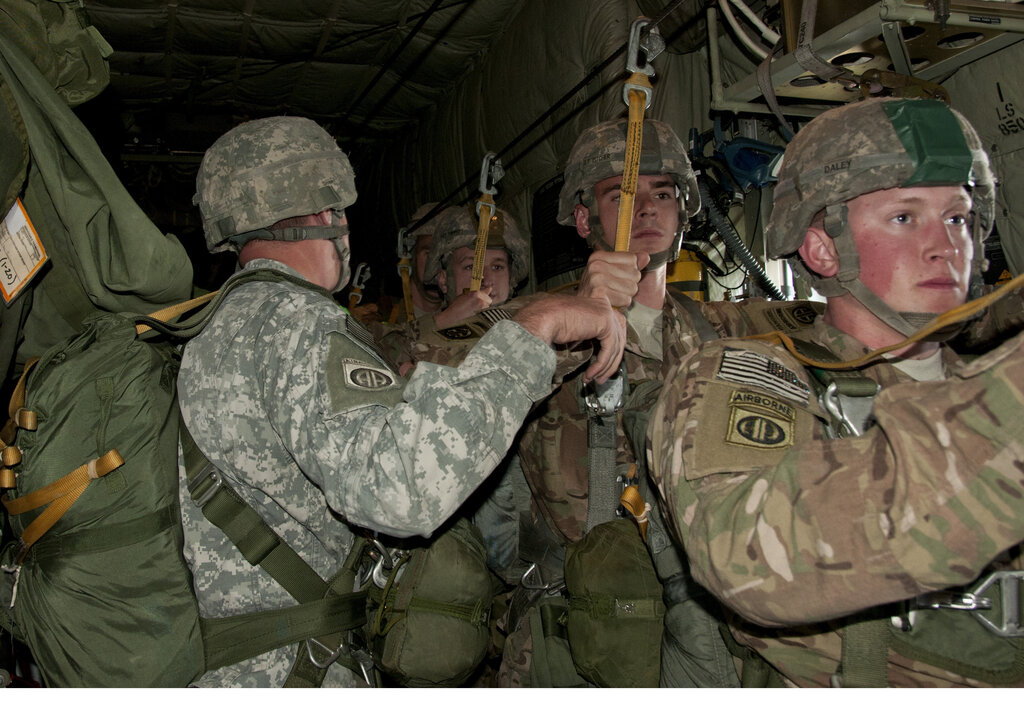
Most conventional airborne forces use the static line method. A strong cord, the static line, is attached to the aircraft on one end and to the paratrooper's parachute deployment bag on the other. As the soldier jumps, the line pulls the parachute from its pack, initiating an automatic deployment. This system is designed for mass jumps from relatively low altitudes, ensuring parachutes open quickly and at a consistent height. The U.S. Army's T-11 parachute is a common example, designed to handle heavier loads and provide a slower, more stable descent than its predecessors.
Special operations forces often employ military freefall techniques for stealthier insertions. These jumps require manually deployed, steerable parachutes like the RA-1. They fall into two main categories:
- High Altitude Low Opening (HALO): Troopers exit the aircraft at high altitudes (up to 35,000 feet) and fall for a long period, opening their parachutes close to the ground to minimize detection.
- High Altitude High Opening (HAHO): Troopers exit at a similar altitude but open their parachutes shortly after, allowing them to glide long distances across borders or behind enemy lines.
Aircraft and Personal Gear
Airborne operations rely on robust aircraft capable of transporting troops and equipment. The C-130 Hercules and C-17 Globemaster III are workhorses, known for their ability to take off and land on short, unprepared runways. Helicopters like the CH-47 Chinook are also essential, particularly for air assault missions where troops are inserted directly into a location without parachutes.
A paratrooper's personal gear is just as critical. The harness is the interface between the soldier and the parachute, designed to distribute the shock of deployment and the weight of the soldier evenly. Modern harnesses are integrated with webbing to attach other essential gear.
Helmets are specially designed to protect against impacts during the jump and on landing, while also accommodating communication systems. Protective equipment like gloves, goggles, and knee pads help prevent injuries during what can be a very rough landing.
Essential Tools of the Trade
Paratroopers are combat soldiers first, so they carry specialized weapons and equipment. Rifles are often modified with folding or collapsible stocks to be more compact during a jump. Ammunition is distributed across their gear in specialized pouches for easy access after landing. The goal is to be combat-ready within moments of touching down.
Communication is vital for coordinating forces that are dispersed after a jump. Each team carries radios to maintain contact with leaders and with each other. For navigation, especially at night or in unfamiliar territory, airborne troops rely on a combination of classic and modern tools. A map and compass are always carried as a reliable backup, but GPS devices provide precise, real-time location data.
For operations in low-light conditions, specialized equipment becomes indispensable. Night Vision Goggles (NVGs) amplify ambient light, allowing soldiers to see in near-total darkness. Freefall jumpers also use an altimeter, a device worn on the wrist or chest that displays their altitude. It's crucial for knowing exactly when to deploy the parachute during a HALO jump.
What is the primary purpose of the static line in a parachute jump?
An airborne team needs to covertly insert behind enemy lines, gliding a long distance after exiting the aircraft. Which insertion technique should they use?
Mastering this equipment is what makes an airborne soldier effective. From the moment they leave the aircraft to the completion of their mission on the ground, their gear is integral to their success.