Advanced AI Product Management Mastery
U.S.I.D.O. Product Lifecycle
Beyond the Waterfall: The U.S.I.D.O. Framework
Traditional software development lifecycles (SDLC) are maps for predictable journeys. You define a destination, plot a course, and build. AI product development is different. It’s more like navigating open water. The destination might shift, and the path is rarely a straight line. This requires a new map.
Enter the U.S.I.D.O. framework: Understand, Specify, Implement, Deploy, and Optimize. This isn't a rigid, linear process. It's an iterative cycle designed for the non-deterministic nature of AI, helping you steer a product from a promising idea to a continuously improving system.
Understand and Specify
The journey begins with the Understand phase. Here, the focus isn't just on technical feasibility but on business impact. Forget the old model of building a Proof of Concept (PoC) to see if something can be done. The new standard is the (PoV). A PoV demonstrates that an AI solution can deliver a measurable, significant business outcome. It answers the question, "If we build this, will it create enough value to justify the investment and complexity?"
Once a high-value use case is identified, you move to the Specify phase. This is where AI product management diverges sharply from traditional PM. You aren’t writing specs for predictable, rule-based logic. You're defining requirements for probabilistic systems. Instead of binary pass/fail criteria, you define acceptable ranges of performance. You must answer: "What does 'good' look like when the answer isn't always 100% correct?" This involves defining key metrics, accuracy thresholds, and fallback behaviors for when the model is uncertain.
For an AI-powered customer support bot, a probabilistic requirement might be: "The bot must correctly identify user intent with at least 90% accuracy and successfully resolve 75% of tier-1 inquiries without human intervention."
Implement and Deploy
The Implement phase marks the rise of the paradigm. In 2025 and beyond, the most effective AI PMs don't just write documents and pass them to engineering. They are hands-on, actively participating in the prototyping process. Using low-code platforms, LLM playgrounds, and agentic frameworks, the Builder PM can create rudimentary versions of the product. This allows for rapid iteration and helps bridge the communication gap between product vision and technical implementation. You're not expected to write production code, but you must be able to shape the initial clay.
The Deploy phase in AI is not a one-time event. Traditional software is released; AI models are unleashed. Once a model is in production, it's interacting with live, unpredictable data. This means deployment is the beginning of a continuous monitoring process, not the end of a development cycle. You aren’t just pushing a static build. You're deploying a dynamic system that will change over time.
Optimize
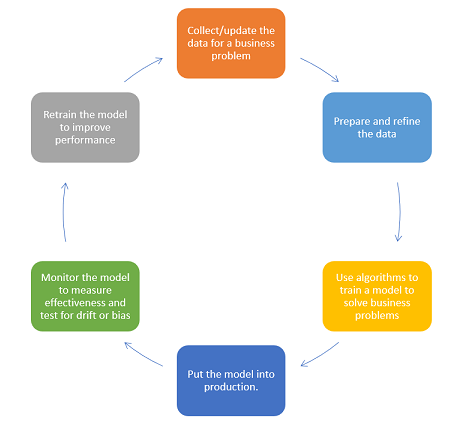
Finally, the Optimize phase is a perpetual state of being for any AI product. Models are not static. Their performance can degrade over time as real-world data patterns shift away from the data they were trained on. This phenomenon is a central concern for AI PMs.
model performance drift
noun
The degradation of a machine learning model's predictive power over time due to changes in the underlying data and relationships in the operational environment. For example, a fraud detection model trained on pre-pandemic data may become less accurate as consumer spending habits change.
Optimization involves creating robust feedback loops. This means collecting data on the model's predictions, identifying where it's failing, and using that information to inform the next cycle of development. You'll constantly be asking questions like:
- Is the input data changing?
- Are we seeing new edge cases?
- Is the model's accuracy meeting the thresholds defined in the Specify phase?
This feedback flows directly back into the Understand phase, restarting the U.S.I.D.O. loop. Perhaps the data reveals a new high-value use case, or it shows that the initial problem was framed incorrectly. This continuous, iterative process is the engine of successful AI product management.
Ready to check your understanding of the U.S.I.D.O. framework?
In the 'Understand' phase of the U.S.I.D.O. framework, what is the primary goal that replaces the traditional Proof of Concept (PoC)?
An AI product manager is defining success criteria for a new fraud detection model. Instead of a simple pass/fail test, they specify an acceptable accuracy of >95% and a maximum false positive rate of 2%. This activity primarily belongs to which phase of the U.S.I.D.O. framework?
Mastering this framework provides a reliable compass for navigating the ambiguous and exciting world of AI product development.