Advanced AI Agents and LLMs for Medical Imaging
Advanced Prompt Engineering
Smarter Prompts for Medical AI
Getting a large language model (LLM) to perform complex tasks requires more than just a simple question. In a high-stakes field like medical imaging, where precision and verifiable reasoning are critical, we need to guide the AI's thinking process. Advanced prompting techniques move beyond basic instructions, structuring the model's approach to problem-solving to make its outputs more accurate, transparent, and useful.
Show Your Work
Chain-of-Thought (CoT) prompting is a straightforward yet powerful technique. Instead of just asking for a final answer, you instruct the model to first explain its reasoning step-by-step. This forces the LLM to break down a complex problem into smaller, logical pieces, which often leads to a more accurate conclusion.
Think of it as asking a radiologist not just for a diagnosis, but for a detailed walkthrough of what they see in an MRI scan, how they're interpreting the different shades and shapes, and what possibilities they're ruling out along the way. This transparency makes the final result easier to verify and trust.
Standard Prompt: "Analyze this chest X-ray report and identify the primary finding."
CoT Prompt: "Read the following chest X-ray report. First, list all abnormalities mentioned. Second, explain the clinical significance of each abnormality. Finally, based on these steps, determine the most critical finding."
By outlining the required steps, the CoT prompt creates a logical pathway for the model, reducing the chance of it jumping to a conclusion or overlooking important details.
Thinking in Code
Program of Thought (PoT) prompting takes CoT a step further. It instructs the model to generate and execute code as part of its reasoning process. This is especially useful for tasks requiring precise quantitative analysis, something natural language can be clumsy at. LLMs are excellent at writing code, and by using code as its 'thought process,' the model can perform calculations, handle data, and arrive at answers with much higher precision.
For instance, if a model needs to calculate the growth rate of a tumor between two scans, it can write a small script to extract the measurements, perform the calculation, and present the result. This outsources the hard math to a reliable calculator—the code itself.
/* Example PoT Prompt Structure */

// Task: Analyze the provided lesion measurements from two CT scans
// taken 6 months apart and calculate the percentage change in volume.

// Step 1: Define a function to calculate the volume of a lesion
// assuming an ellipsoid shape (Volume = 4/3 * pi * a * b * c).

// Step 2: Extract the semi-axes measurements (a, b, c) from the text
// for the initial scan and the follow-up scan.

// Step 3: Call the function to calculate the initial and final volumes.

// Step 4: Calculate the percentage change using the formula:
// ((final_volume - initial_volume) / initial_volume) * 100.

// Step 5: Output the final percentage change.
Reasoning and Acting
The ReAct framework combines reasoning with action. It enables an LLM to not only generate thought processes but also to interact with external tools to gather more information. The model operates in a loop: it reasons about what it needs to know, selects an action (like querying a database), performs the action, observes the result, and then uses that new information to continue its reasoning.
In a clinical setting, a ReAct agent could be given a medical image and a question. It might first reason that it needs more context. Its first action could be to query the patient's electronic health record for their age and relevant history. After observing this data, it might then form a new thought about what to look for in the image, leading to a more informed analysis.
Fresh Knowledge on Demand
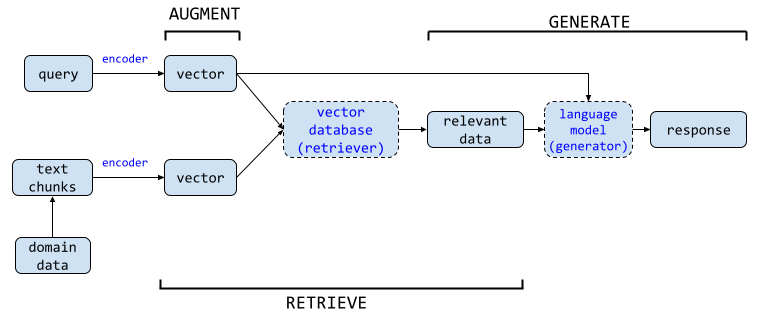
Retrieval-Augmented Generation (RAG) addresses a core limitation of LLMs: their knowledge is frozen at the time of training. RAG connects the LLM to an external, up-to-date knowledge base. When a prompt is received, the system first retrieves relevant documents or data chunks from this base. This retrieved information is then provided to the LLM as context, along with the original prompt, to generate a more accurate and current response.
For medical imaging, this is invaluable. A RAG system can pull the latest clinical guidelines, research papers, or case studies related to a specific finding. The LLM's analysis is then grounded in the most current medical knowledge, not just the data it was trained on months or years ago.
These advanced techniques transform prompts from simple questions into sophisticated programs that guide an AI's cognitive process. By structuring how an LLM thinks, acts, and accesses information, we can build more reliable and capable tools for complex domains like medicine.
Time to test your understanding.
What is the primary purpose of Chain-of-Thought (CoT) prompting?
A clinician needs an LLM to analyze an MRI and provide a diagnosis grounded in the most recent clinical trial results published last month. Which technique is essential for this task?
By mastering these methods, developers and clinicians can unlock more of the potential hidden within large language models, pushing the boundaries of what's possible in AI-assisted medicine.