Advanced AI Agent Development
Advanced Agent Architectures
Beyond Basic Blueprints
Simple agent designs, like those based on pure reflexes or straightforward deliberation, are useful starting points. But to tackle complex, dynamic problems, we need more sophisticated blueprints. Modern AI agents are built less like a single, monolithic program and more like a well-organized team of specialists.
The key idea is modularity. Instead of one giant block of code trying to do everything, a modular system breaks down the agent’s functions into separate, interchangeable components. Think of it like building with LEGO bricks. Each brick has a specific purpose—one for perception, one for planning, another for acting on the world, and one for remembering past events. These modules communicate with each other, but they can be developed, tested, and upgraded independently.
This design makes the agent more adaptable. If a better way to perceive the environment comes along, you can simply swap out the old perception module for a new one without redesigning the entire system. It also improves scalability. As tasks become more complex, you can add new specialized modules to the agent's toolkit.
The Rise of Agentic Architectures
A modular design sets the stage for what we call an agentic architecture. This isn't just a structural choice; it's a fundamental shift in how we think about AI. Instead of being a passive tool that responds to queries, an agentic system is an autonomous actor that actively works to achieve goals.
AI agent architecture refers to the structural design that defines how AI agents perceive, reason, and act in dynamic environments.
At the heart of most modern agentic architectures is a Large Language Model (LLM). The LLM acts as the orchestrator or cognitive core, taking a high-level goal and breaking it down into a series of smaller, executable steps. It coordinates the various modules, deciding which tool to use, what information to retrieve from memory, and how to interpret incoming data.
This creates a reasoning loop: the LLM observes the state of the world, thinks about what to do next, and then acts. The outcome of that action updates the state, and the loop begins again until the goal is achieved.
A Look Inside
Let's break down the key components that enable this loop. A typical agentic architecture integrates a model with tools, memory, and a planning process.
| Component | Role | Example |
|---|---|---|
| Model (Core) | The reasoning engine, usually an LLM. | An LLM receives the goal: "Plan a weekend trip to Seattle." |
| Tools | External functions the agent can use to act. | Search APIs, code interpreters, databases, other specialized agents. |
| Memory | Stores information from past interactions. | Remembers user preferences and previous search results. |
| Planning | The process of creating and executing a plan. | The model creates a plan: 1. Search for flights. 2. Find hotels. 3. Look for activities. |
This structure is incredibly powerful. By giving an LLM access to tools, it can overcome its inherent limitations. An LLM can't browse the internet or run code on its own, but it can direct a tool to do so. Memory allows the agent to learn from experience and maintain context over long, multi-step tasks.
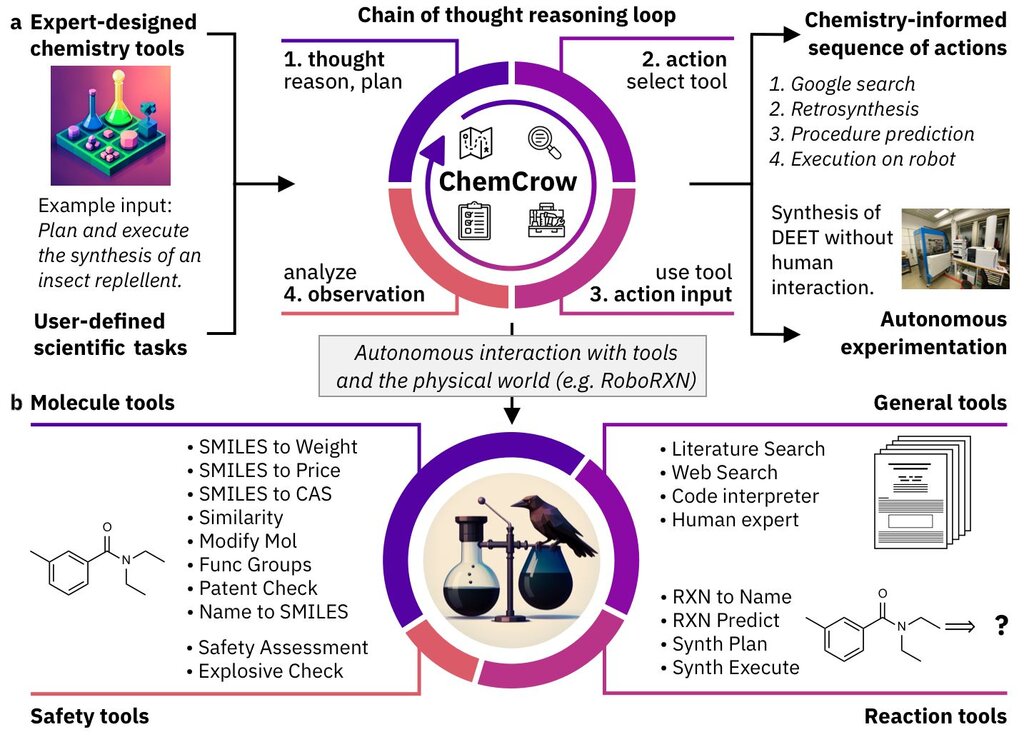
Consider a real-world example in scientific research. An agent designed to help chemists might be given the goal of synthesizing a specific molecule. Its LLM core would access a 'planning' module to break the problem down. It would then use 'tools' to search chemical databases for reaction pathways, consult safety protocols, and even operate robotic lab equipment. Its 'memory' would keep track of successful and failed experiments to refine its approach over time.
This modular, LLM-driven approach provides a scalable and resilient framework. You can build systems of agents, where different agents specialize in different tasks and collaborate to solve enormous problems, much like a company is organized into different departments. If one tool or agent fails, the orchestrator can adapt and try a different approach, making the whole system more robust.
What is the primary advantage of a modular design in AI agent architectures?
In an agentic architecture, the Large Language Model (LLM) typically acts as the __________.
These advanced architectures are pushing the boundaries of what AI can accomplish, transforming them from simple information processors into capable, autonomous partners in complex tasks.