Advanced AI Agent Design and Evaluation
Advanced AI Agent Design
Building Smarter Agents
Once you have a basic AI agent working, the real fun begins. The next step is to move beyond simple, single-purpose designs and build agents that are more robust, adaptable, and intelligent. This isn't about tweaking prompts; it's about rethinking the agent's fundamental structure.
Advanced agent design focuses on three key areas: how the agent is built (its architecture), how it thinks (its control flow), and what it knows (its memory and tools). Getting these right is the difference between a simple chatbot and a truly autonomous system that can tackle complex, multi-step problems.
Modular Architecture
Imagine trying to build a car where every part is welded together into one giant piece. Fixing or upgrading anything would be a nightmare. Early AI agents often felt like this—monolithic systems where every function was tangled together. A modular architecture solves this by breaking the agent down into distinct, interchangeable components.
Think of it like a team of specialists. Instead of one person trying to do everything, you have a researcher, a planner, a writer, and a fact-checker. Each module has a specific job.
A modular agent might have separate components for perception (understanding the environment), planning (deciding on a course of action), memory (storing and retrieving information), and execution (using tools to act).
This approach has huge benefits. It makes the agent easier to debug, maintain, and upgrade. If you develop a better memory system, you can swap out the old module without rebuilding the entire agent. This flexibility is crucial for creating systems that can evolve and improve over time.
Effective Control Flow
If modules are the agent's organs, the control flow is its nervous system. It dictates the sequence of operations, manages the flow of information between modules, and makes decisions about what to do next. A simple agent might follow a linear script: perceive, plan, act. But advanced agents need more dynamic control flows.
One popular and effective pattern is an iterative loop, often called a reason-act loop. Instead of executing a plan blindly, the agent continuously cycles through observing its environment, thinking about what to do, and taking a small action. This allows it to correct its course and react to unexpected changes.
Good agent architectures follow these principles:Modularity: separate planning, memory, tool integration, and execution for testability.Scalability: design for concurrent agents, sharding of state, and horizontal execution.Observability: capture traces, decisions, and inputs, so behavior can be audited and debugged.Resilience: include retries, fallbacks, and graceful degradation for tool failures.
A robust control flow also includes mechanisms for handling errors and reflecting on performance. If a tool fails, what's the backup plan? If a task isn't succeeding, can the agent pause, analyze its strategy, and try a different approach? Building in these loops for reflection and error correction is what elevates an agent from a simple automator to an adaptive problem-solver.
Integrating Tools and Memory
An agent's intelligence is limited by what it can know and what it can do. Large language models have a vast amount of built-in knowledge, but it's static—it doesn't update with real-time information. That's where tools and memory come in.
Tools are external functions the agent can call to get new information or perform actions. This could be anything from a simple calculator to a complex API for searching the web, checking stock prices, or sending emails. Integrating tools gives your agent superpowers, allowing it to interact with the world beyond its pre-trained knowledge.
Memory gives the agent a sense of history and context. Without it, every interaction is a fresh start. There are two main types:
- Short-term memory: This holds the context of the current conversation or task, like a running scratchpad. It helps the agent keep track of what's happening right now.
- Long-term memory: This is for storing and retrieving information over longer periods. An agent could store key facts, user preferences, or lessons learned from past tasks. This allows for personalization and continuous learning.
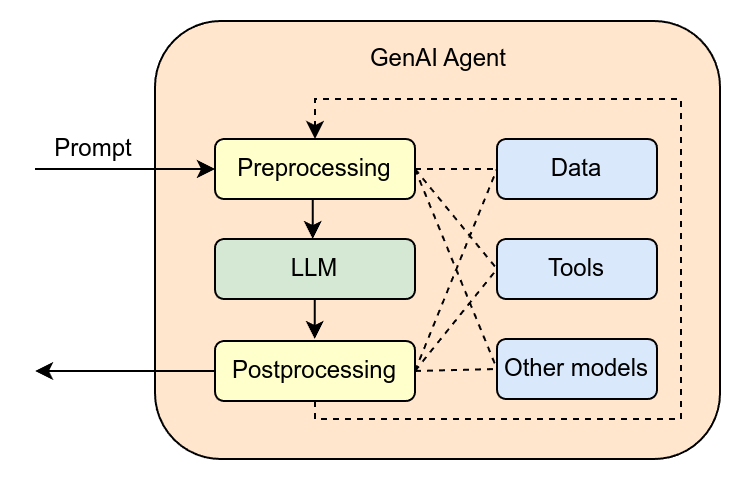
The key challenge is designing an efficient system for the agent to decide which tool to use or what memory to retrieve. This often involves the planning module, which analyzes the current goal and queries the memory and tool systems to find the most relevant information or capability.
By combining a modular architecture, a flexible control flow, and rich tool and memory systems, you can design agents that are not only powerful but also adaptable and efficient. They can learn from experience, recover from errors, and tackle problems that are far too complex for simpler designs.
Time to check your understanding of these advanced concepts.
What is the main advantage of using a modular architecture when designing an AI agent?
The "reason-act loop" is a control flow pattern that improves an agent's adaptability. How does it work?
Mastering these design strategies is a major step toward building truly autonomous and intelligent AI systems.