Advanced AI Agent Architecture
Agentic Reasoning Loops
From Responder to Reasoner
You already know that Large Language Models (LLMs) are powerful text generators. You give them a prompt, and they provide a response. This one-shot interaction is useful, but it's like having a conversation with someone who has no memory of what was said a moment ago. To build truly autonomous systems, we need to move beyond this static model.
Enter the agentic AI. Instead of just responding, an agent acts. It perceives its environment, makes a plan, and executes it. This isn't a single transaction; it's a continuous cycle. The LLM shifts from being a simple text generator to becoming the central reasoning engine of a system that can pursue complex goals over time.
Powered by large language models (LLMs), Agentic AI systems integrate perception, reasoning, and action to solve problems autonomously.
This architectural shift enables an AI to tackle multi-step problems, interact with external tools, and adapt its strategy based on new information. It's the difference between asking a calculator for an answer and giving a project manager a goal.
The Autonomous Reasoning Loop
At the heart of an agent is a cycle that allows it to operate autonomously. This is often called the Perceive-Plan-Act-Observe loop. It's a simple but powerful framework that turns a passive model into an active problem-solver.
Here’s how it works:
- Perceive: The agent takes in the current state of its environment. This could be a user's initial prompt, data from a website, the output of a code execution, or an error message.
- Plan: With a high-level goal in mind, the LLM core reasons about the new information. It performs , breaking the primary objective into a series of smaller, executable sub-tasks.
- Act: The agent executes the most immediate sub-task. This action isn't just generating text; it could be calling an API, querying a database, or using another specialised tool.
- Observe: The agent receives the outcome of its action. This feedback—the new information—becomes the input for the next turn of the cycle. The agent's internal state is updated, and the loop begins again.
This iterative process continues until the agent's goal is complete or it determines it cannot proceed. Each loop refines the agent's understanding and brings it closer to a solution. This ability to handle feedback, correct course, and manage an internal state is what separates a basic LLM from a true agent.
ReAct: Where Thinking Meets Doing
One of the most popular frameworks for implementing this reasoning loop is ReAct (Reasoning and Acting). It provides a structured way for an LLM to
The core idea is to prompt the model to externalise its thought process. At each step, the LLM generates not just an action to take, but also the reasoning behind it. This creates a clear, interpretable chain of thought.
Consider a user asking: "Who is the current monarch of the UK, and what year were they born?" A ReAct agent wouldn't just spit out the answer. Its internal process might look something like this:
Thought: The user wants two pieces of information: the current UK monarch and their birth year. I'll find the monarch first. Action:
Search("current monarch of the United Kingdom")Observation: King Charles III is the current monarch.
Thought: I have the name. Now I need his birth year. Action:
Search("King Charles III birth year")Observation: November 14, 1948.
Thought: I have both pieces of information. I can now form the final answer. Action:
Finish("The current monarch of the UK is King Charles III, who was born in 1948.")
This synergy between reasoning (thought) and doing (action) allows the agent to build context, handle multi-step queries, and recover from errors. If the first search had failed, the agent could observe the failure, reason about an alternative strategy, and act again.
The LLM as the Brain
In an agentic system, the LLM functions as the central processing unit, or brain. It's not just another component; it's the orchestrator that directs all other parts. The agent's tools—like search APIs, code interpreters, or databases—are like its hands and senses. The LLM is what decides which tool to use and how to interpret the information it gathers.
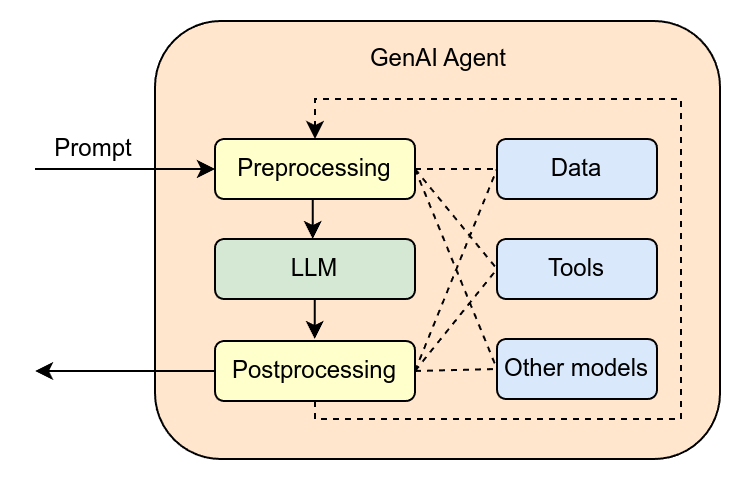
This approach, often called a Plan-and-Execute model, relies entirely on the LLM's ability to reason, decompose goals, and synthesise information. The quality of the agent's performance is directly tied to the reasoning capabilities of its underlying LLM. As models become more powerful, the agents built on top of them become more capable of tackling increasingly complex and dynamic tasks without human intervention.
This continuous loop of thought and action is what gives agents their power, transforming them from simple information retrievers into dynamic problem solvers.