Advanced A/B Testing and Experimentation Design
Advanced A/B Testing Principles
The Balancing Act
Every A/B test faces a fundamental dilemma: the trade-off between exploration and exploitation. Imagine you're trying to find the best-tasting apple in a huge orchard.
Exploration is like trying apples from many different trees to gather information. You might taste some sour ones, but you're learning about the orchard.
Exploitation is when you find a tree with delicious apples and decide to just pick from that tree for the rest of the day. You're using the knowledge you gained to get the best possible result right now.
In A/B testing, exploration means showing different versions of your page or feature to users to see which one performs best. Exploitation means showing only the winning version to maximize conversions once you're confident you've found it. The challenge is knowing when to stop exploring and start exploiting. Explore for too long, and you lose out on conversions you could have had. Exploit too soon, and you might settle on a mediocre version without realizing a much better one was available.
When Fixed Isn't Flexible
The classic A/B test uses a fixed traffic allocation. You might split your users 50/50 between Version A and Version B and run the test until you get a statistically significant result. This approach is simple but often inefficient.
Suppose after just two days, Version B is clearly underperforming, getting half the clicks of Version A. With a fixed allocation, you're committed to sending 50% of your users to a version that's almost certainly worse. Every user sent to the losing variant is a missed opportunity, a lost sale, or a frustrated customer. This is the cost of exploration, and fixed allocation can make that cost unnecessarily high.
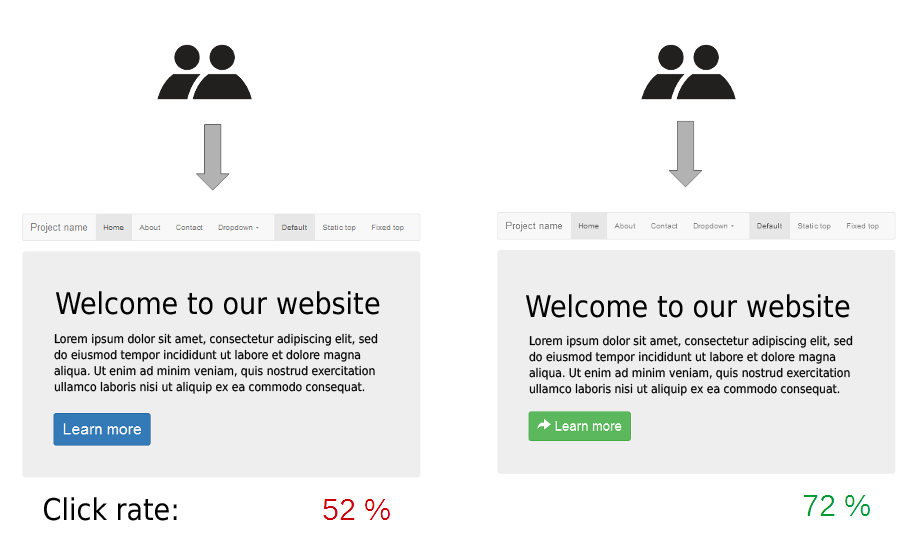
This rigidity becomes an even bigger problem when the feedback you're waiting for doesn't arrive right away.
The Waiting Game
Another major challenge is dealing with delayed outcomes. Many important metrics don't happen immediately. A user might sign up for a free trial right away (an immediate outcome), but the true goal is to see if they become a paying subscriber a month later (a delayed outcome).
Running a standard A/B test on a delayed outcome is painfully slow. You have to wait for the full delay period for each user in the test to pass before you can analyze the results. If you're testing which welcome email leads to more 90-day subscriptions, your test has to run for at least 90 days. This slows down your ability to learn and improve, leaving potentially poor-performing versions active for far too long.
So how can we overcome these limitations? The answer lies in moving from fixed tests to more dynamic, intelligent approaches.
Adaptive methodologies change the rules of the game. Instead of fixing the traffic split upfront, these methods continuously analyze performance during the test. As one version starts to look better, the system automatically allocates more traffic to it.
This approach directly tackles the exploration-exploitation trade-off. It explores in the beginning, but as it gathers more data, it starts to exploit the better-performing versions. This minimizes the cost of testing and gets you to a better result faster. One popular example of this is the multi-armed bandit algorithm. These strategies are more complex but offer a powerful way to make decisions more efficiently and with less risk.
In the context of A/B testing, what is the 'exploration vs. exploitation' trade-off?
An e-commerce site tests two checkout button colors: blue and green. After three days, data shows the green button results in significantly more purchases. The site manager stops the test and shows only the green button to all future visitors. This decision is an example of:
By understanding these advanced principles, you can move beyond simple A/B tests and adopt more sophisticated, efficient ways to learn and optimize.