Adult Swimming Fundamentals
Water Familiarization
Making Friends with Water
Feeling nervous in the water as an adult is perfectly normal. Many people share that feeling. The first step to swimming isn't about strokes or speed; it's about simply getting comfortable. This process is about building confidence at your own pace, turning the water from an unknown into a familiar, supportive environment.
Your only goal is to feel safe and relaxed. There's no rush and no pressure to perform.
Getting In and Out Safely
Confidence begins before you're even fully in the water. Knowing how to get in and out of the pool safely and easily is a fundamental skill that puts you in control. Always use a method that feels stable and secure.
The simplest way is the sit-and-swivel. Find a spot on the edge of the pool. Sit down, then swing your legs around and into the water. From there, you can gently lower yourself in. To get out, swim to the side, place both hands flat on the edge, and push yourself up until you can sit on the side again.
Ladders are another great option. When using a ladder, always face it. Hold onto the handrails with both hands and step down one rung at a time, just like on a normal ladder. Do the same thing in reverse to climb out.
Practicing this a few times will build a surprising amount of confidence. You're teaching your brain that you are in charge of when and how you interact with the water.
Face in the Water
Putting your face in the water is often the biggest mental hurdle. The key is to do it gradually and prove to yourself that it's safe.
Start in the shallow end where you can comfortably stand. Begin by just cupping water in your hands and splashing your face. Get used to the sensation. Next, try putting just your chin in the water. Then your mouth. Then your nose. Take your time with each step.
When you're ready to submerge your whole face, take a normal breath, hold it, and slowly lower your face into the water for just a second or two. Don't worry about opening your eyes yet. Just focus on the feeling of the water on your skin. When you come up, notice that you're perfectly fine.
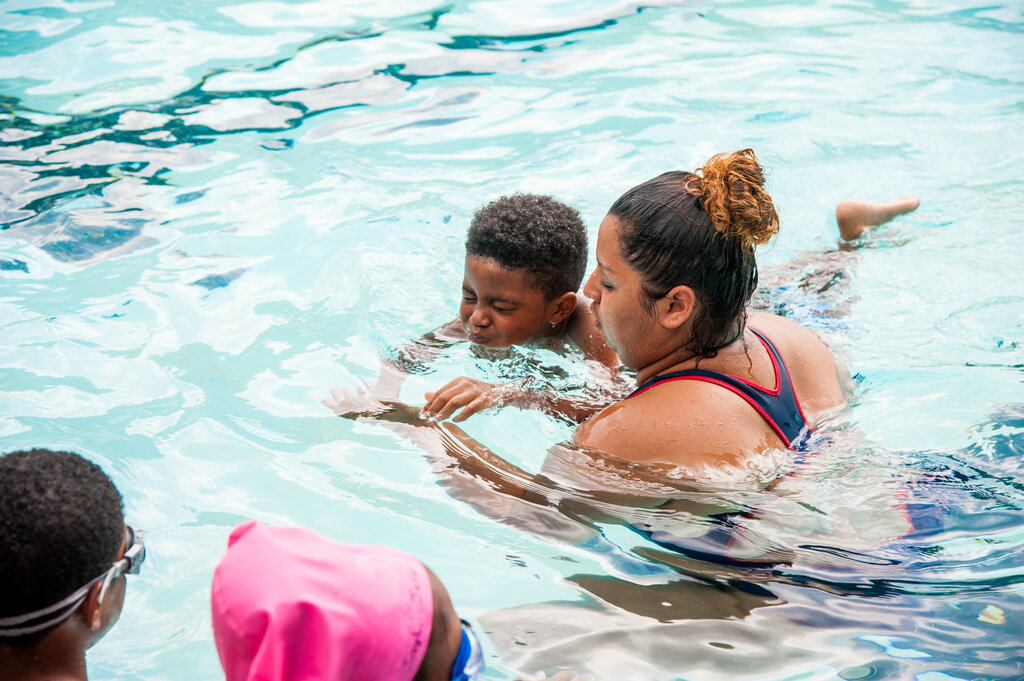
Once submerging your face feels comfortable, you can try opening your eyes. It might seem strange at first. The world will look blurry, and that's okay. Open them for a moment, then close them before you lift your face out. Repeat this until the novelty wears off. Goggles can make this step much more comfortable for many people, but it's good to know you can open your eyes without them if you need to.
The Feeling of Buoyancy
Water has an amazing property: it pushes back. This upward force is called buoyancy, and it's what allows giant ships to float. It also supports you.
buoyancy
noun
The upward force exerted by a fluid that opposes the weight of a partially or fully immersed object.
To feel this for yourself, stand in chest-deep water and bend your knees, bringing them up towards your chest. You'll notice the water helping to hold you up. You can gently push off the bottom of the pool and let the water support you for a moment before your feet touch down again.
Another way to feel this is to hold onto the side of the pool with both hands. Extend your legs out behind you and let them drift up toward the surface. Don't try to force them. Just relax and let the water do the work. This gentle lift is the same force that will eventually help you float and swim.
By getting familiar with entering the water, putting your face in, and feeling how the water supports you, you've built a solid foundation. You've shown yourself that you can be comfortable and in control in a new environment.