Adding Logarithms
Understanding Logarithms
The Inverse of an Exponent
Exponents answer the question: what do you get when you multiply a number by itself a certain number of times? For example, $2^3$ asks what you get when you multiply 2 by itself 3 times. The answer is 8.
Logarithms flip this question around. A logarithm asks: how many times do you need to multiply a base number by itself to get another number?
The expression asks, "To what power must we raise 2 to get 8?"
Since we know , the answer is 3. So, . The small number, 2, is called the base. The number in the parentheses, 8, is the argument.
This relationship is the most important thing to understand about logarithms. They are simply a different way to write an exponential relationship. They undo exponents, just like subtraction undoes addition and division undoes multiplication.
A logarithm is the inverse of an exponential function.
Let's look at a few more examples to make this solid.
| Exponential Form | Logarithmic Form | Explanation |
|---|---|---|
| 5 must be raised to the power of 2 to get 25. | ||
| 10 must be raised to the power of 3 to get 1000. | ||
| 3 must be raised to the power of 4 to get 81. |
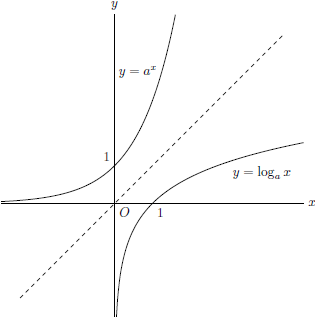
The inverse relationship between exponents and logarithms can be visualized by graphing them. The graph of a logarithmic function is a reflection of its corresponding exponential function over the line .
Special Bases
While you can have a logarithm with any positive base (except 1), there are two bases that are so common they have their own special notation.
Common Logarithm
noun
A logarithm with base 10. It is often written as without the base specified.
The common logarithm is useful because our number system is base-10. It answers the question, "To what power must we raise 10 to get a certain number?" For instance, because . This base is frequently used in fields like chemistry to measure pH and in engineering for signal processing.
Natural Logarithm
noun
A logarithm with base , a special irrational number approximately equal to 2.718. It is written as .
The number might seem strange at first, but it appears naturally in many areas of mathematics and science, especially those involving growth and change. The notation stands for logarithmus naturalis, which is Latin for "natural logarithm".
Basic Properties
From the definition of logarithms, a few basic properties emerge. These aren't new rules to memorize, but rather direct consequences of the inverse relationship with exponents.
First, what is ? This asks, "To what power do we raise to get 1?" For any base , the answer is always 0, because any number raised to the power of 0 is 1.
Next, what is ? This asks, "To what power do we raise to get ?" The answer is simply 1, since .
These two properties hold true for any valid base, including base 10 and base . So, , , , and . Understanding these foundational ideas is the key to working with logarithms.
Ready to check your understanding? Let's try a few questions.
Which logarithmic expression is equivalent to the exponential equation ?
What is the value of for any valid base ?
Logarithms provide a new way to think about and work with exponents. By understanding their core definition as an inverse, you've built a solid foundation for exploring their wider applications.