Acupressure for Pain Relief
Introduction to Traditional Chinese Medicine
A Different View of Health
Traditional Chinese Medicine, or TCM, is a complete system of health that has been practiced for thousands of years. Unlike Western medicine, which often focuses on specific symptoms or diseases, TCM looks at the body as an interconnected whole. The goal isn't just to treat illness but to maintain a state of balance and harmony, preventing problems before they start.
At the heart of this system are a few core ideas that explain how the body works and what keeps it healthy. These concepts might seem abstract at first, but they offer a powerful framework for understanding health from a holistic perspective.
The theory of Traditional Chinese Medicine (TCM) has a rich history that spans thousands of years.
Qi The Body's Vital Energy
Everything in TCM begins with Qi (pronounced "chee"). Qi is the vital life force or energy that flows through all living things. Think of it as the body's electricity. It powers our organs, circulates our blood, keeps us warm, and fuels every single process, from breathing to thinking.
Qi
noun
The vital life force or essential energy that flows through the body, forming the basis of Traditional Chinese Medicine.
When your Qi is abundant and flows smoothly, you feel energetic, healthy, and resilient. But if the flow of Qi becomes blocked, weak, or unbalanced, it can lead to pain, fatigue, and eventually, illness. Imagine a river: when it flows freely, it nourishes the land around it. But if a dam is built or the river dries up, the landscape suffers. In TCM, the goal is to keep the river of Qi flowing smoothly.
Yin and Yang
You've likely seen the black and white Yin-Yang symbol. It represents one of the most fundamental concepts in TCM: the idea that the universe is composed of opposing but complementary forces. Yin and Yang are not absolutes; they are relative and exist in a dynamic balance with each other.
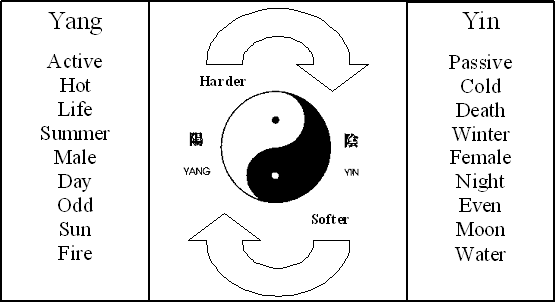
Yin is associated with qualities like cold, darkness, rest, and passivity. Yang is associated with heat, light, activity, and dynamism. Your body contains both. For example, the coolness and quiet of sleep are Yin, while the energy and warmth of being active are Yang.
Health is a state of equilibrium between these two forces. When Yin and Yang are in balance, your body functions optimally. Illness arises when one becomes excessive or deficient relative to the other. Too much Yang might manifest as fever, inflammation, or high blood pressure. Too much Yin could lead to feelings of cold, fluid retention, or sluggishness.
Health is not the absence of one force, but the harmonious dance of both.
The Five Elements
The Five Elements theory is another cornerstone of TCM. The elements are Wood, Fire, Earth, Metal, and Water. These aren't just the literal substances but are metaphors for different types of energy, seasons, and functions within the body. Each element is linked to specific organs and emotions, and they interact with each other in predictable cycles.
There are two main cycles:
-
The Generating Cycle (Sheng): This is a nurturing relationship where one element feeds the next. Wood feeds Fire, Fire creates Earth (ash), Earth bears Metal, Metal carries Water, and Water nourishes Wood. It's a cycle of creation and support.
-
The Controlling Cycle (Ke): This cycle provides checks and balances. Wood parts Earth (like roots), Earth dams Water, Water quenches Fire, Fire melts Metal, and Metal chops Wood. This prevents any one element from becoming too dominant.
A TCM practitioner uses this framework to understand how an imbalance in one organ system can affect another, allowing for a more holistic diagnosis.
The Meridian System
So how does Qi travel through the body? According to TCM, it flows through a network of pathways called meridians. These meridians are like an invisible circulatory system for energy, connecting all parts of the body, including organs, muscles, and tissues.
There are 12 primary meridians, each associated with a specific organ system. When the Qi in a meridian is blocked or deficient, it can cause pain or dysfunction in the area the meridian passes through or in the organ it's connected to.
This meridian system is the foundation for practices like acupuncture and acupressure. By stimulating specific points along these pathways, practitioners can influence the flow of Qi to relieve blockages, restore balance, and promote the body's natural ability to heal. Think of it as clearing a logjam in the river to let the water flow freely again.
Understanding these foundational concepts—Qi, Yin and Yang, the Five Elements, and the Meridian System—is the first step in appreciating the logic and depth of Traditional Chinese Medicine.
Let's test your knowledge on these foundational ideas.
What is the fundamental concept of Qi in Traditional Chinese Medicine?
According to the principle of Yin and Yang, illness is often the result of: