Accelerate Your Learning
Understanding Learning Principles
How We Learn
Learning is more than just soaking up information like a sponge. It's an active process that involves three key cognitive steps: encoding, storage, and retrieval. Think of your brain like a library.
-
Encoding is when a new book arrives. You don't just toss it on a random shelf. You read the title, understand its subject, and figure out where it belongs. In learning, this is the moment you first encounter new information and start making sense of it.
-
Storage is placing the book on the correct shelf. Your brain files the new information away, connecting it to other
The more connections you make between new information and what you already know, the stronger the memory will be.
- Retrieval is when you need the book later. You walk to the right section, find the shelf, and pull it out. This is recall—accessing stored information when you need it to solve a problem or answer a question.
Thinking About Thinking
Have you ever paused while studying and asked yourself, "Do I actually understand this?" That's metacognition. It’s the process of thinking about your own thinking. It’s your ability to step back and observe your own learning process from a higher vantage point.
Metacognition involves being aware of what you know, what you don't know, and which learning approaches work best for you. It's like being the manager of your own brain. A good manager doesn't just do the work; they plan the project, monitor progress, and change strategies when something isn't working. By developing your metacognitive skills, you can take control of your learning, identify gaps in your knowledge, and adjust your methods to learn more effectively.
Metacognition
noun
Awareness and understanding of one's own thought processes.
Your Mindset Matters
How you view your own intelligence has a huge impact on your ability to learn. This idea is captured in the concept of a growth mindset versus a fixed mindset.
A person with a fixed mindset believes that intelligence and talent are static traits. You're either good at something or you're not, and effort won't change that. When they fail, they tend to see it as a reflection of their limited ability.
Someone with a growth mindset believes that abilities can be developed through dedication and hard work. They see challenges as opportunities to grow and failure as a stepping stone to learning. This perspective fosters resilience and a greater love of learning.
For example, faced with a tough math problem, a fixed mindset says, "I'm just not a math person." A growth mindset says, "I don't get this yet, so I'll try a different approach."
The Levels of Learning
Not all learning is equal. Memorizing a definition is different from creating a new theory. Bloom's Taxonomy is a framework that organizes learning into different levels of complexity, from the most basic to the most advanced. Thinking about these levels can help you set clearer learning goals and push yourself beyond simple memorization.
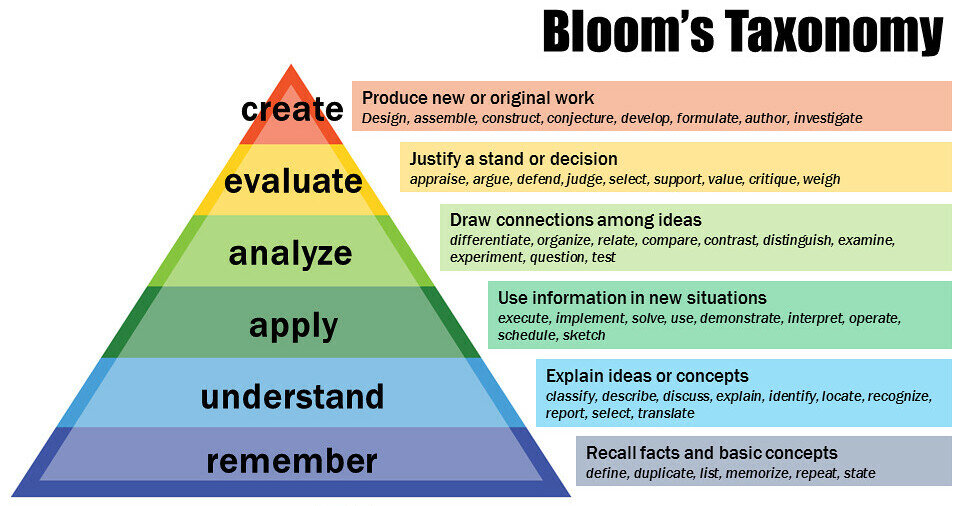
The taxonomy is often shown as a pyramid to illustrate how higher levels of thinking build on the foundations of the lower levels. Here’s a quick breakdown of the revised version, from bottom to top:
| Level | What It Means |
|---|---|
| Remember | Recalling facts and basic concepts. |
| Understand | Explaining ideas or concepts in your own words. |
| Apply | Using information in new situations. |
| Analyze | Drawing connections among ideas and breaking information into parts. |
| Evaluate | Justifying a stand or decision; critiquing. |
| Create | Producing new or original work. |
Understanding these foundational concepts—how your brain processes information, how to think about your thinking, the power of your mindset, and the different levels of learning—prepares you to become a more deliberate and effective learner.
Ready to check your understanding? Let's see what you've learned about these core principles.
A student creates a catchy song to remember the steps of photosynthesis. Which cognitive process of learning is primarily being used at this moment?
After getting a low score on a math quiz, a student concludes, "I'm just not good at math." This reaction is a classic example of what?