Academic Assignment Time Management
Eisenhower Matrix Implementation
Urgent vs. Important
Your to-do list is full. You have a major essay due in three weeks, a weekly quiz tomorrow, and a dozen emails from your course administrator to read. On top of that, you promised to design a poster for the film society. Everything feels urgent. But not everything is important.
Most students manage their time reactively, tackling whatever shouts the loudest. This leads to a constant state of firefighting, where you lurch from one deadline to the next. To break this cycle, you need a system for prioritisation. The most effective one is the Eisenhower Matrix.
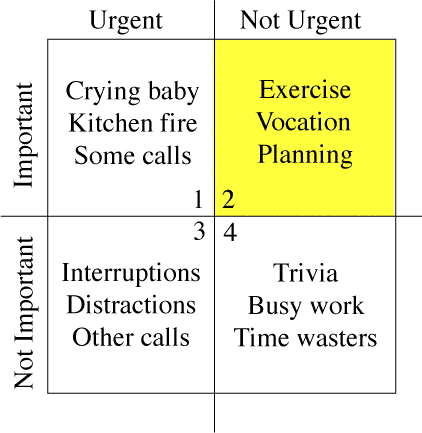
This framework, famously used by US President , splits tasks into four categories:
- Urgent & Important (Do): Crises and problems with immediate, serious consequences. Example: a major project due tomorrow.
- Not Urgent & Important (Schedule): Activities that contribute to your long-term goals. Example: starting research for your dissertation.
- Urgent & Not Important (Delegate): Tasks that demand your attention but don't move you closer to your goals. Example: responding to a non-critical group chat notification.
- Not Urgent & Not Important (Delete): Time-wasting activities. Example: endlessly scrolling through social media.
Escaping the Urgency Trap
In university life, the biggest challenge is the 'Urgency Trap'. This is where Quadrant 3 (Urgent, Not Important) masquerades as Quadrant 1 (Urgent, Important). Many academic tasks feel urgent simply because they have a notification attached or a person waiting for a reply. Answering a routine email from the library, for instance, feels pressing, but it rarely contributes to your degree in a meaningful way. This is the at play: our brains tend to prioritise tasks with a time-sensitive component, regardless of their long-term payoff.
The goal is to spend most of your time in Quadrant 2, working on things that are important but not yet urgent.
This is where real progress happens. Quadrant 2 activities are easy to postpone because they lack a looming deadline. Nobody will chase you to start brainstorming your final-year project six months in advance. Yet, this is the single most important work you can do. It involves planning, deep study, and skill development. Consistently scheduling time for Quadrant 2 work is the difference between scraping by and excelling.
A Student's Week in the Matrix
Let’s apply this to a realistic scenario. A student, Alex, has the following on his plate:
- A 3,000-word history essay due in three weeks.
- A weekly online politics quiz due by midnight tomorrow.
- Ten administrative emails to sort through.
- A commitment to design a poster for the film society meeting this Friday.
Without a system, Alex might panic and do the easiest task first, like the emails, or the one with the nearest hard deadline, the quiz. Let's sort these tasks using the matrix.
| Important | Not Important | |
|---|---|---|
| Urgent | Q1: Do - Politics quiz due tomorrow | Q3: Delegate/Minimise - Design film society poster - Answer urgent emails |
| Not Urgent | Q2: Schedule - Research & outline history essay | Q4: Delete - Answer non-urgent emails - Mindless social media scrolling |
Seeing it this way changes everything. The quiz is a clear Quadrant 1 task; it must be done now. But the big history essay is the most important thing on the list for his final grade. By recognising it as Quadrant 2, Alex can schedule dedicated time for it throughout the week, preventing it from ever becoming a Quadrant 1 crisis.
The poster and emails are urgent but not as important as his academic work. He could do the poster quickly (minimise) or see if someone else can help (delegate). He can scan the emails for anything truly critical and ignore the rest for now. This frees up crucial time and mental energy for the work that matters: the essay and the quiz.
By consistently using this matrix, you move from being a reactive firefighter to a proactive architect of your own success. You stop letting minor tasks dictate your schedule and start investing your time in the activities that deliver the greatest results.
Now let's check what you've learned.
What is the primary purpose of the Eisenhower Matrix?
According to the text, which quadrant is most often neglected but is crucial for long-term success?