A/B Testing for Prompt Engineers
Introduction to A/B Testing
What Is A/B Testing?
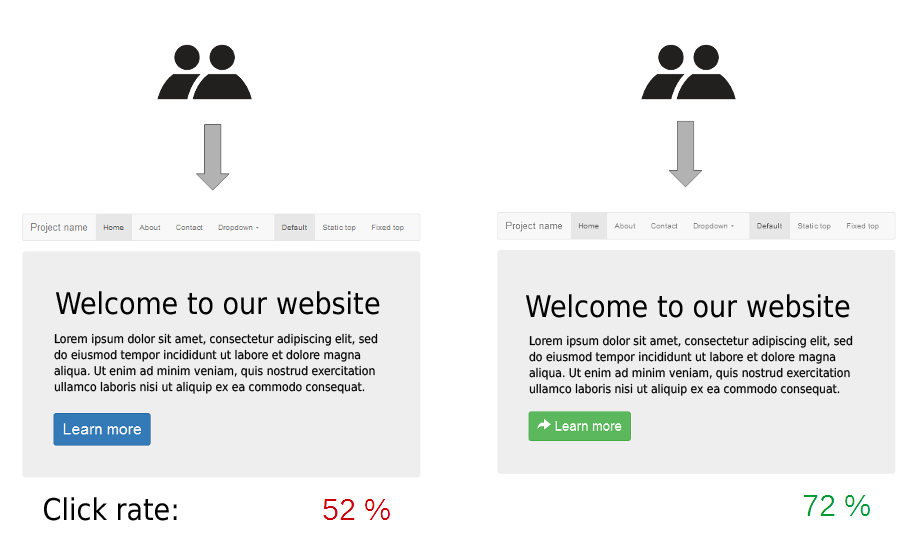
Imagine you run a website and want more people to sign up for your newsletter. You have a sign-up button, but you wonder if changing its color from blue to green would make a difference. Instead of just guessing, you could run a simple experiment. This is the core idea behind A/B testing.
A/B testing is a method of comparing two variations of something in order to see which performs better according to some metric.
It's a straightforward way to make decisions based on data, not just intuition. In an A/B test, you take two versions of something—a webpage, an email, an app feature—and show them to two different groups of users at the same time.
One version is the original, called the control (Version A). The other is the new version you're testing, called the variant or treatment (Version B). By measuring how each group responds, you can determine which version is more effective at achieving your goal.
The Statistical Foundation
A/B testing isn't just about seeing which version gets more clicks. It's about being confident that the difference is real and not just a fluke. This is where statistics comes in. The process starts with a clear question, framed as a hypothesis.
hypothesis
noun
A proposed explanation made on the basis of limited evidence as a starting point for further investigation.
In A/B testing, we start with a null hypothesis (), which assumes there is no difference between the two versions. The variant performs the same as the control. Our goal is to gather enough evidence to reject this idea.
The alternative hypothesis ( or ) is what we're actually testing. It states that there is a difference between the versions. For example, 'The green button will have a higher click-through rate than the blue button.'
After running the test for a while and collecting data, we analyze the results to see if the difference in performance is statistically significant. This is a way of saying we're confident the outcome wasn't due to random chance. If the results are significant, we can reject the null hypothesis and conclude that one version is truly better than the other.
Where A/B Testing Is Used
Once you know what A/B testing is, you start seeing it everywhere. It’s a powerful tool used across many industries to optimize and improve.
Marketing: Marketers test everything. They compare different email subject lines to see which gets more opens, test ad copy to find the most persuasive message, and experiment with landing page layouts to increase conversions.
Product Development: Tech companies constantly run A/B tests to improve their software. They might test a new feature with a small group of users before rolling it out to everyone, or compare different user interface designs to see which is more intuitive.
E-commerce: Online stores use A/B testing to optimize the shopping experience. They might test the placement of a 'Buy Now' button, different product images, or even the steps in the checkout process to reduce cart abandonment.
Media: News websites might A/B test headlines for the same article to see which one attracts more readers. Streaming services test different thumbnail images for movies and shows to see which one entices more people to click play.
The common thread is simple: using real-world data to make better decisions. By testing changes in a controlled way, organizations can learn what works and what doesn't, leading to gradual but significant improvements over time.
Time to check your understanding of these core concepts.
In an A/B test for an e-commerce website, the original version of the checkout page is referred to as the:
A marketing team wants to test if a new, shorter email subject line gets more opens. What would be the null hypothesis () for this experiment?
A/B testing provides a reliable framework for making evidence-based decisions, moving beyond guesswork to find out what truly works.