A0 to A1 English Teaching Toolkit
A0-A1 Launchpad
The First Five Minutes
Your first interaction with an absolute beginner sets the tone. Start without words. A smile and a wave are universal. These gestures build an immediate, stress-free connection.
After establishing a visual welcome, introduce the simplest verbal greetings. Point to yourself and say, "Hello." Wave and say, "Goodbye." Use clear, exaggerated mouth movements. Your goal is for the student to associate the sound with the action.
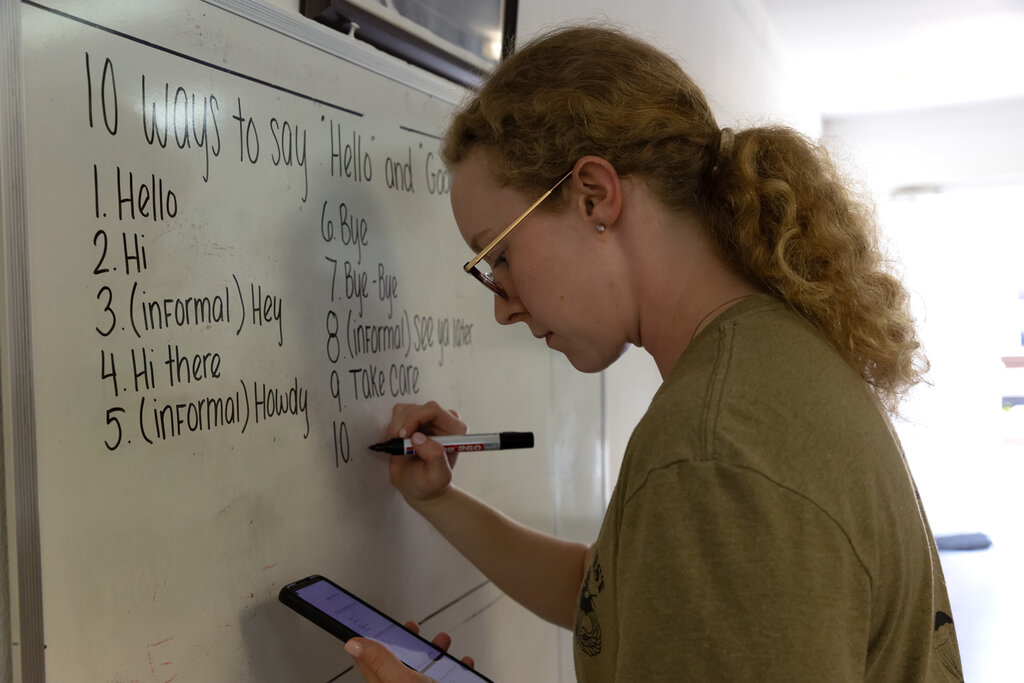
Now, introduce names. Point to yourself again and say, "My name is [Your Name]." Then, use an open, questioning gesture towards the student and ask, "What is your name?"
Repeat this pattern several times. This isn't just about learning phrases; it's about establishing the rhythm of call and response, a fundamental pattern in conversation.
Building Blocks The Alphabet
When teaching the alphabet, prioritize the sound of each letter over its name. A student needs to know that 'C' makes a /k/ sound far more than they need to know its name is "cee." This phonetic focus is the bedrock of pronunciation and reading.
Introduce letters in small, manageable groups. A common approach is to teach letters whose sounds cannot be confused with one another. For example, the group S, A, T, P, I, N contains common sounds that can be immediately blended into simple words like 'sat', 'pin', 'pan', and 'tap'.
Focus on phonics first. Pair the letter 'A a' with a clear /æ/ sound (as in 'apple'), not its name ("ay"). This direct sound-symbol mapping accelerates reading readiness.
Use visual aids heavily. Hold up a flashcard with the letter 'B' on it. Point to a picture of a ball. Say the sound /b/, then the word "ball." Have the student repeat the sound, then the word. This technique, visual-to-speech mapping, connects the abstract symbol to a concrete object and its sound.

Practical Numbers
Numbers are most effective when taught in a real-world context. Counting from one to twenty by rote is less useful than understanding what 'three' represents.
Start with 0-10. Use your fingers. Hold up two fingers and say "two." Have the student mirror you. Use classroom objects: count pens, books, or chairs. Make it tangible. Once they master 0-10, introduce 11-20, pointing out the patterns and the tricky teens like eleven and twelve.
| Number | Word | Context Example |
|---|---|---|
| 1 | One | One book |
| 2 | Two | Two pens |
| 3 | Three | Three chairs |
| 11 | Eleven | Eleven students |
| 12 | Twelve | Twelve o'clock |
| 20 | Twenty | Twenty pages |
Connect numbers to immediate needs. Use them to ask for a phone number or an age. Write a number on the board and ask the student to show you that many fingers or point to that many objects.
Classroom Survival
The most empowering thing you can teach a beginner is how to manage when they are lost. Providing them with a few key phrases gives them control over the learning pace and reduces anxiety. These aren't just phrases; they are tools for active participation.
Teach these phrases from day one. Model them with gestures. For 'Can you repeat?', cup your hand to your ear. For 'I don't understand,' use a slight shrug and a confused expression. The gesture will anchor the meaning long before the words are memorized.
# Essential Student Phrases

# To ask for repetition
"Can you repeat, please?"

# To indicate lack of understanding
"I don't understand."

# To ask about a word
"How do you say [points to object]?"

# To ask for spelling
"How do you spell that?"
Write these phrases on a poster and keep it visible in the classroom. When a student looks confused, don't just wait. Point to the poster and model the appropriate phrase. This proactive approach teaches them to advocate for their own learning needs immediately.
According to the provided text, what is the recommended first step when interacting with an absolute beginner?
When teaching the alphabet, what is the most important initial focus?
With these foundational tools, you can build a confident and capable learner from the very first hour. The focus is on function, connection, and empowerment.