A-Level Mathematics Essentials
Algebra and Functions
Solving Quadratic Equations
Many problems in math and science boil down to solving equations. You've likely worked with linear equations, like . Quadratic equations are the next step up. They are equations where the highest power of the variable (usually ) is 2. The standard form looks like this: , where , , and are constants, and isn't zero.
While some simple quadratics can be solved by factoring, there's a powerful tool that works for every single one: the quadratic formula. It might look intimidating, but it's just a recipe. You identify the values of , , and from your equation and plug them into the formula to find the value(s) of .
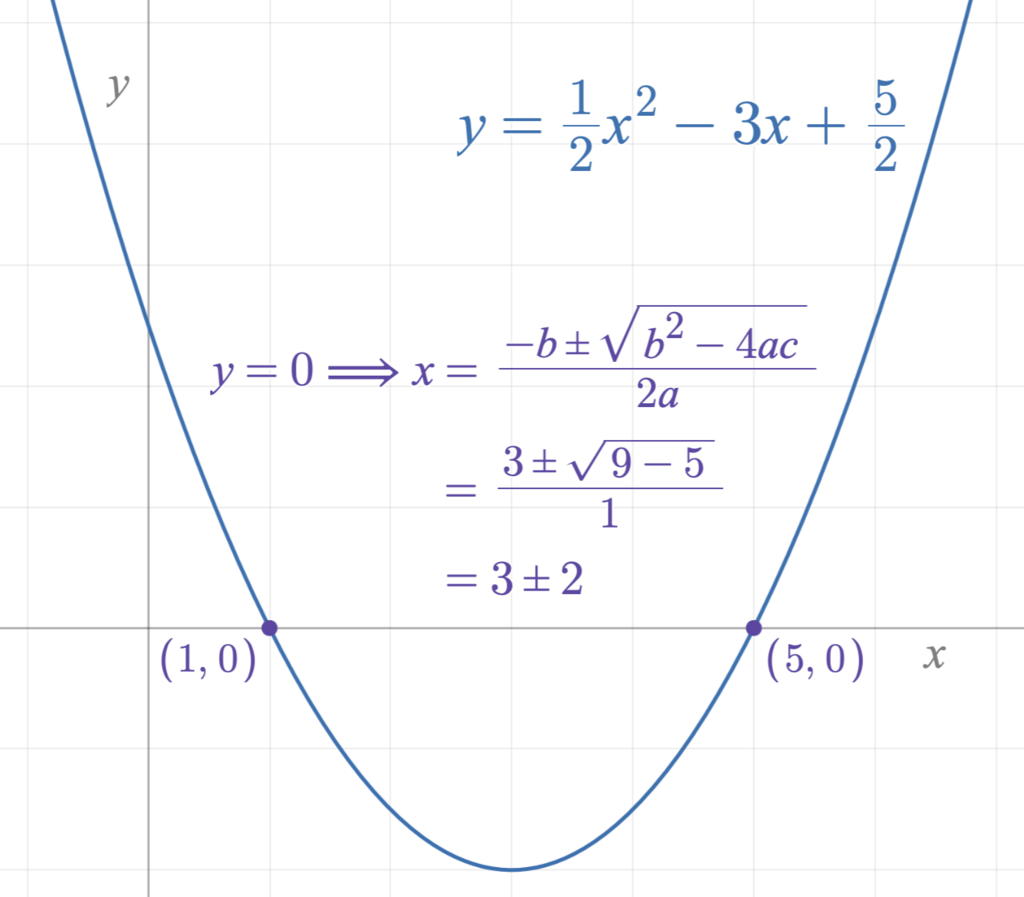
Let's try an example: . Here, , , and . Plugging these in gives us:
This gives us two solutions: and . These solutions, also called roots, are the points where the graph of the equation, a parabola, crosses the x-axis.
From Equations to Inequalities
Equations look for an exact value, but inequalities deal with ranges. Instead of asking "when does equal zero?" we might ask, "when is greater than zero?"
Solving a quadratic inequality like involves a few steps:
- First, find the roots of the related equation, . This gives us and . These are our critical points.
- These points divide the number line into three regions: less than -3, between -3 and 3, and greater than 3.
- Pick a test value from each region to see if it satisfies the inequality. For example, let's test . , which is greater than 0. So, the region is part of the solution. Now test . , which is not greater than 0. Finally, test . , which is greater than 0. So, the region is also a solution.
The solution is the set of all numbers where or . Visually, this corresponds to the parts of the parabola that are above the x-axis.
The Idea of a Function
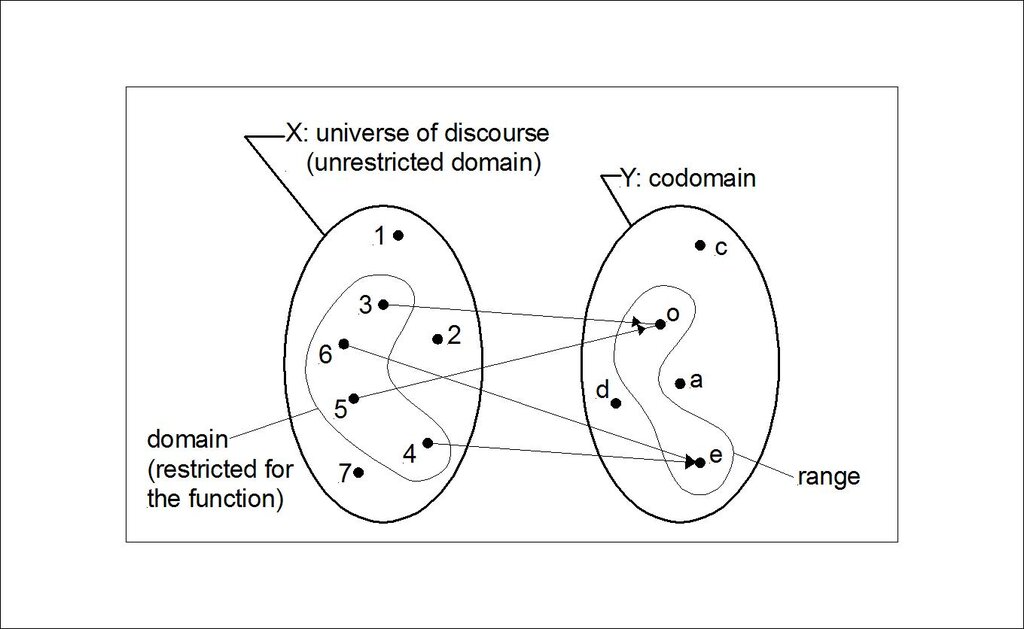
At the heart of algebra is the concept of a function. Think of it as a machine: you put an input in (usually an value), the machine follows a specific rule, and it gives you exactly one output (a value). For any given input, there is only one possible output. We often write functions using notation like , read as "f of x".
function
noun
A relation between a set of inputs and a set of permissible outputs with the property that each input is related to exactly one output.
The set of all possible inputs is called the domain, and the set of all possible outputs is the range. Quadratic equations like are functions. For any you plug in, you get a single value out. So we can write it as .
Understanding functions allows us to model relationships in the real world, from the trajectory of a ball to the growth of an investment. Let's look at how we can manipulate the graphs of these functions.
Transforming Functions
Once you know the basic shape of a function's graph, like the U-shape of , you can move it around without having to plot points every time. These movements are called transformations.
Vertical Shift: Adding a constant to the entire function moves the graph up or down. shifts the graph up by units. shifts it down.
Horizontal Shift: Adding a constant inside the function, to the value itself, moves the graph left or right. shifts the graph right by units. shifts it left.
These shifts let you quickly sketch related functions. For example, the graph of is just the basic parabola shifted 3 units to the right and 2 units up. This is incredibly useful for visualizing how different parameters in an equation affect its behavior.
Let's check your understanding of these core algebraic concepts.
What are the values of , , and for the quadratic equation when written in the standard form ?
The solutions to a quadratic equation are also known by what name?
These building blocks—solving equations, understanding inequalities, and working with functions—are essential for tackling more advanced mathematics. They provide the language and tools to describe and analyze the world around us.