A Journey Through Graphic Design History
Origins of Visual Communication
The First Marks
Long before alphabets and writing, humans communicated visually. The desire to make a mark, to leave a trace, is a fundamental part of our history. These early forms of communication weren't just random doodles. They were humanity's first attempts to record ideas, share stories, and make sense of the world.
These visual records began simply, with handprints on a rock wall or lines scratched into bone. But over thousands of years, they evolved into complex and beautiful expressions of thought, laying the groundwork for every form of visual communication that followed.
Stories on Stone
Deep inside caves, protected from the elements, early humans created stunning galleries of art. These paintings weren't just decoration. They were a powerful form of storytelling, a way to share knowledge, document important events, and perhaps even perform rituals. The subjects were often animals: bison, horses, mammoths, and lions, all depicted with surprising realism and energy.
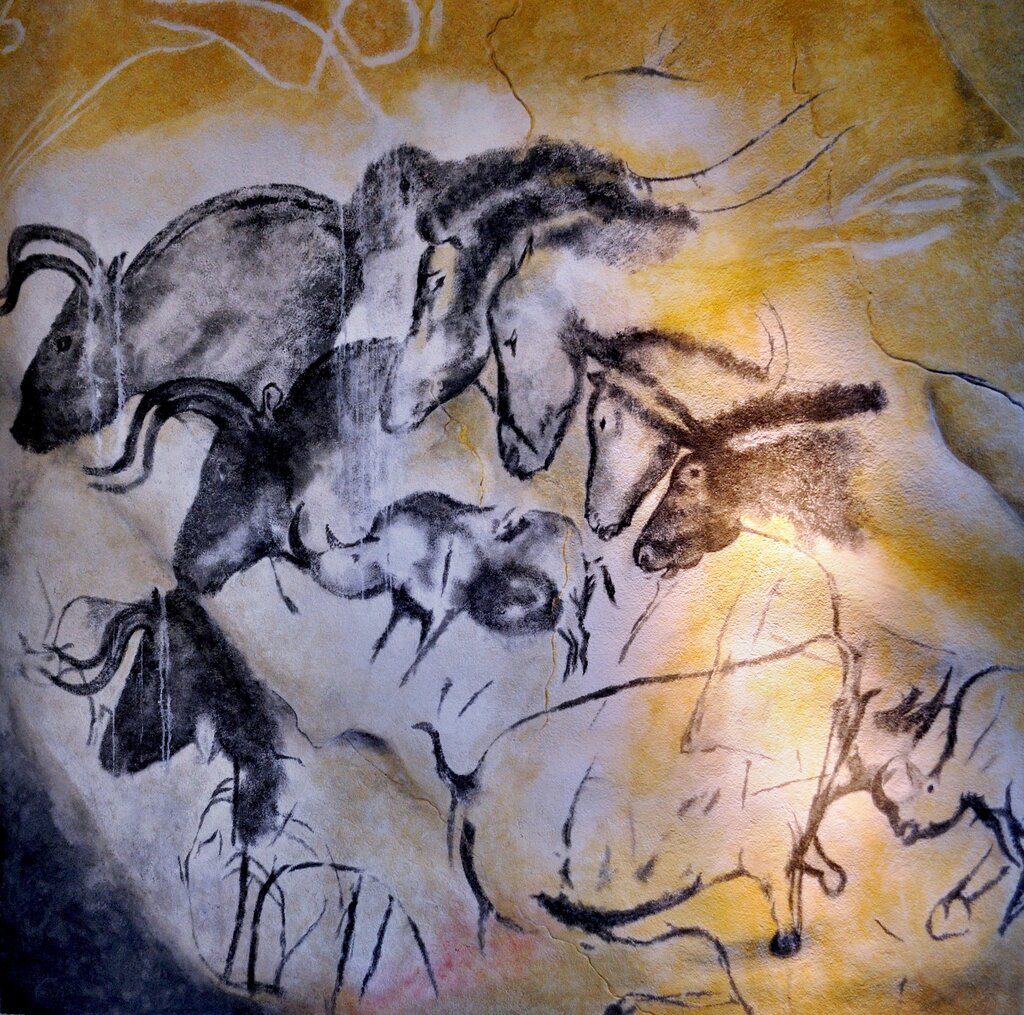
The paintings in Chauvet Cave in southern France are some of the oldest and best-preserved examples. Created over 30,000 years ago, they show a mastery of technique. Artists used the natural contours of the cave walls to give their subjects a sense of three-dimensional form. They scraped the walls clean before painting and used techniques like shading to create depth.
These weren't just pictures of animals. They were narratives about epic hunts, records of the local wildlife, or symbols tied to spiritual beliefs. They tell us what was important to our ancestors.
From Pictures to Patterns
Alongside realistic depictions of animals, early humans also created abstract symbols. These markings represent a major cognitive leap: the ability to use a simple pattern to convey a complex idea. Instead of drawing a whole bison, maybe a few lines could represent the concept of a bison, or perhaps something else entirely.
One of the most significant discoveries of this kind was made at Blombos Cave in South Africa. Archaeologists found pieces of ochre, a type of pigmented clay, engraved with a deliberate cross-hatch pattern. These artifacts are about 75,000 years old, making them some of the earliest evidence of human symbolic thought.
The Blombos engravings are not pictures of anything in the natural world. They are abstract designs. This shows that early humans could create and share meaning through symbols. This ability was the foundation for all later visual communication, from ancient hieroglyphs to the icons on your phone screen today. It was the moment communication moved beyond showing what something looks like to representing what something means.
The discovery of engraved ochre at Blombos Cave is significant because it is considered one of the earliest examples of:
According to the text, what technique did artists in Chauvet Cave use to give their subjects a three-dimensional appearance?