A Journey Through Art History
Prehistoric Art
Voices from the Stone Age
Long before written history, humans felt the need to create. For tens of thousands of years, our ancestors used art to record their world, express beliefs, and perhaps tell stories. This wasn't just decoration. It was a fundamental way of understanding their place in the universe, leaving behind a powerful record of their lives.
The most famous examples are found deep within caves. These dark, hidden galleries were canvases for the first master artists. Using charcoal from burnt wood and pigments ground from minerals like ochre and hematite, they painted stunningly realistic animals.
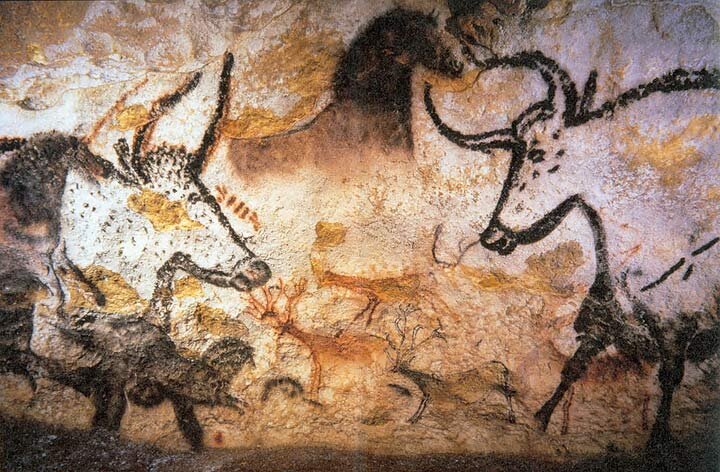
Why did they do it? The subjects are almost always animals: horses, bison, mammoths, and deer. Human figures are rare and usually abstract. This focus suggests the art was tied to their survival. The paintings may have been part of hunting rituals meant to ensure a successful hunt, or perhaps they served a spiritual purpose, connecting the artists to the animal world they depended on.
The artists used the natural, uneven surfaces of the cave walls to give their paintings a three-dimensional quality. A bulge in the rock might become the powerful shoulder of a bison. A crack could serve as the outline of a leg. They applied paint using their fingers, moss, or animal fur, and even blew pigment through hollow reeds to create a spray-paint effect.
Cave paintings show some of the first examples of how humans transcribed their world into visual representations that have deeper meaning.
Art in the Hand
Prehistoric art wasn't confined to cave walls. Early humans also created small, portable sculptures. The most well-known are
figurine
noun
A small statue, especially one of a human form.
Among the most famous of these is the Venus of Willendorf, discovered in Austria and carved around 28,000 BCE. This small limestone figure depicts a female with exaggerated breasts, belly, and hips. Her face is obscured, suggesting she represents a universal idea rather than a specific person.
These "Venus" figurines are often interpreted as symbols of fertility and abundance, perhaps used in rituals to ensure the health of the community and the continuation of life.
They were carved from stone, bone, or ivory, or modeled from clay. Their small size meant they could be carried easily as hunter-gatherer groups moved from place to place. Like the cave paintings, these objects offer a window into the beliefs and values of our distant ancestors, highlighting their concerns with life, birth, and survival.
Monuments in the Landscape
As societies became more settled, a new, monumental form of art emerged: megalithic architecture. This involved arranging massive stones, or megaliths, to create structures. These weren't homes or shelters, but sites with deep cultural and spiritual importance.
The most iconic example is Stonehenge in the United Kingdom, built in phases between 3000 and 1500 BCE. Constructing it was an incredible feat of engineering. Some stones were sourced from over 150 miles away. Its purpose remains a mystery, but its alignment with the movements of the sun, particularly the solstices, suggests it was a massive calendar or a site for astronomical observation and seasonal rituals.
From the intimate scale of a handheld figurine to the monumental grandeur of Stonehenge, prehistoric art shows early humans engaging with the big questions of existence. They used art to connect with nature, understand the cycles of life, and build communities.
Let's review the key terms from this period.
Now, test your knowledge of these ancient artworks.
What materials did early humans primarily use to create pigments for their cave paintings?
The "Venus of Willendorf" is a well-known example of what type of prehistoric art?
These early creations laid the foundation for all art that followed, serving as the first chapter in the long and fascinating story of human creativity.