A Journey Through American History
Pre-Colonial America
A Continent of Nations
Before any European ships reached its shores, North America was home to millions of people. It wasn't an empty wilderness. It was a continent of vibrant, complex, and deeply established nations. These societies were as diverse as the landscapes they inhabited, from the frozen tundra of the far north to the sun-baked deserts of the southwest.
The societies of Native American peoples before the arrival of Christopher Columbus were diverse and rich in culture, displaying sophisticated social structures, complex trade systems, and deep spiritual practices.
Forgetting this diversity is a common mistake. There was no single “Native American” culture. Instead, hundreds of distinct groups, speaking over 300 different languages, developed unique ways of life. Each was shaped by its own history, spiritual beliefs, and, most importantly, its relationship with the land.
Cultural Regions of a Continent
Scholars often group Native American peoples into cultural regions. In these areas, different nations shared similar ways of life because they adapted to similar environments. The geography didn't just determine what people ate or where they lived; it shaped their entire worldview.
In the frigid Arctic, the Inuit and Aleut peoples were masterful hunters, pursuing seals, walruses, and whales in kayaks. Their lives were tuned to the cycles of ice and migration. Further south, in the vast forests of the Subarctic, groups like the Cree and Ojibwa lived in smaller, mobile bands, following moose and caribou.
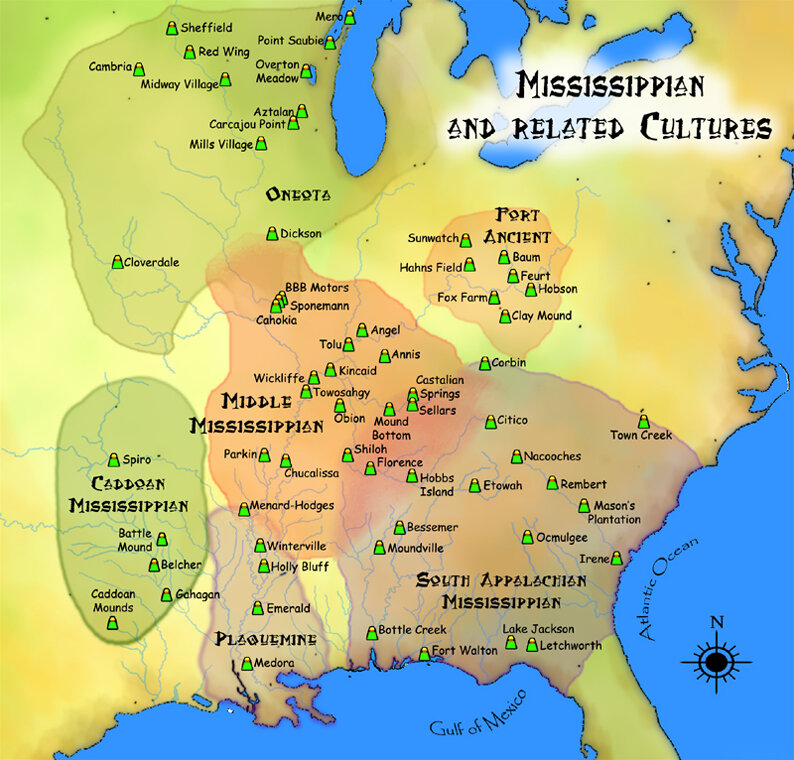
The Northeast was a land of woodlands and rivers. Here, nations like the Haudenosaunee (Iroquois) and Algonquin developed sophisticated political systems and lived in permanent villages, farming corn, beans, and squash. To the south, in the warm, fertile Southeast, large societies like the Cherokee, Choctaw, and the earlier Mississippian culture built enormous earthen mounds and governed complex chiefdoms.
Out on the Plains, before the arrival of horses, people hunted bison on foot and lived in smaller, nomadic groups. In the arid Southwest, the Ancestral Puebloans built incredible cliff dwellings and cities of stone and adobe, mastering irrigation to farm in the desert. The Northwest Coast was a region of immense natural abundance, where peoples like the Tlingit and Haida developed a rich artistic tradition of totem poles and elaborate ceremonies, supported by plentiful salmon and cedar.
Society, Trade, and Spirit
Social structures varied as much as the environments. Some societies, like the Haudenosaunee, were matrilineal, meaning that ancestry and property were traced through the mother’s line. Women held significant social and political power, choosing the male chiefs who would represent their clans.
In contrast, the Mississippian cultures of the Southeast were more hierarchical chiefdoms. Rulers held both political and religious authority, governing large populations from ceremonial centers like Cahokia, near modern-day St. Louis.
No group lived in total isolation. Vast and sophisticated trade networks crisscrossed the continent.
Obsidian from the Rocky Mountains has been found in Ohio. Shells from the Gulf of Mexico were traded as far north as the Great Lakes. Copper from present-day Michigan made its way to the Southeast. This exchange wasn't just about goods; it was an exchange of ideas, technologies, and culture.
Spirituality was woven into every aspect of life. Though beliefs were diverse, a common thread was animism: the idea that the natural world is filled with spirits. Animals, plants, rivers, and mountains were all respected as living beings. Ceremonies were performed to maintain balance with nature, to give thanks for harvests, or to mark important life events.
The Green Corn Ceremony in the Southeast celebrated the new harvest and renewed the community. In the Pacific Northwest, a Potlatch was a great feast where a host would demonstrate their wealth and status by giving away possessions. These practices reinforced social bonds and spiritual beliefs, ensuring the well-being of the people and their world.
Time to check what you've learned.
What is the most accurate statement about the societies of North America before European contact?
In Haudenosaunee (Iroquois) society, ancestry and property were traced through the mother’s line. What is this type of social structure called?
The Americas before 1492 were a world of incredible diversity. Hundreds of independent nations, each with a unique culture, economy, and spiritual system, had built societies that thrived for thousands of years.