A Grand Tour of Western Philosophy
Ancient Greek Philosophy
The First Questions
Western philosophy didn't begin with grand theories about morality or politics. It started with a more basic question: What is all this stuff around us made of?
Before the 6th century BCE, the Greeks explained the world through myths about gods and goddesses. Thunder was Zeus's anger; the changing seasons were a story of divine abduction. But in the bustling port cities of Ionia, a new way of thinking emerged. A group of thinkers, now called the Pre-Socratics, started looking for rational explanations for the natural world.
They were the first to suggest that the universe operates according to understandable laws, not just the whims of the gods. Thales of Miletus, often called the first philosopher, proposed that everything was fundamentally made of water. Anaximander suggested an undefined, boundless substance he called the apeiron. Heraclitus argued that the only constant is change, famously stating that you can't step into the same river twice. These ideas might seem simple now, but they represented a revolutionary shift from myth to reason.
From Thales, who is often considered the first Western philosopher, to the Stoics and Skeptics, ancient Greek philosophy opened the doors to a particular way of thinking that provided the roots for the Western intellectual tradition.
The Turn Inward
After the Pre-Socratics came a thinker who changed the course of philosophy forever: Socrates. He wasn’t interested in what the world was made of; he was interested in how we should live in it. He famously wandered the streets of Athens, engaging everyone from statesmen to craftsmen in conversation, not to lecture them, but to question them.
This method of persistent questioning, designed to expose contradictions and gaps in a person's knowledge, became his legacy. He believed that the first step to wisdom was admitting your own ignorance. His focus was on ethics, justice, and virtue. For Socrates, the most important task in life was to “know thyself” and to care for one's soul through moral reflection.
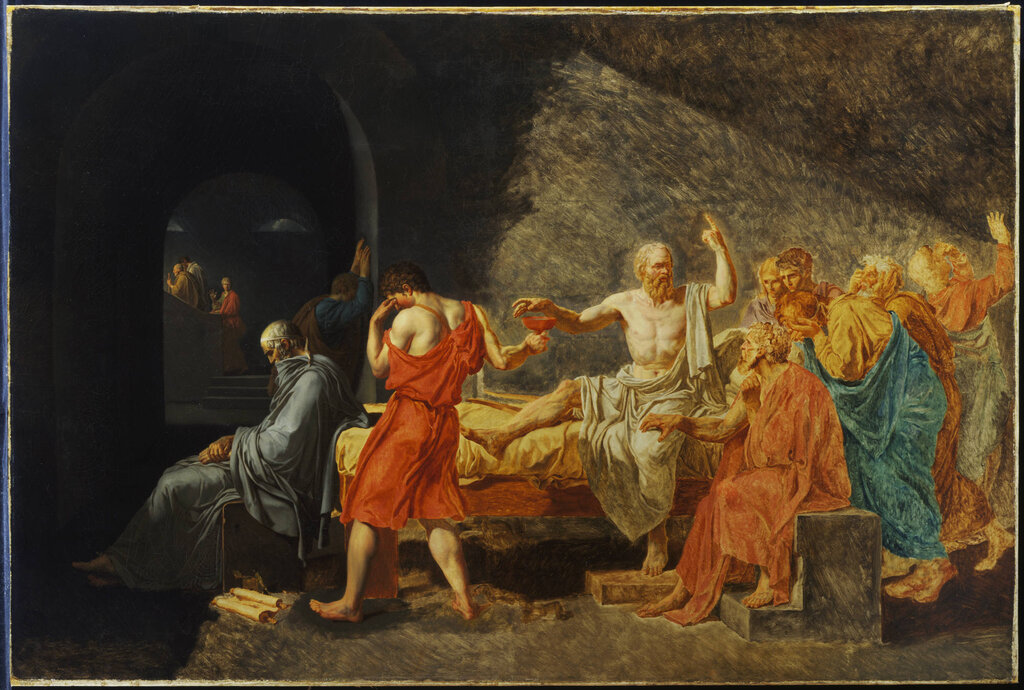
Socratic method
noun
A form of cooperative argumentative dialogue between individuals, based on asking and answering questions to stimulate critical thinking and to draw out ideas and underlying presuppositions.
Shadows on the Wall
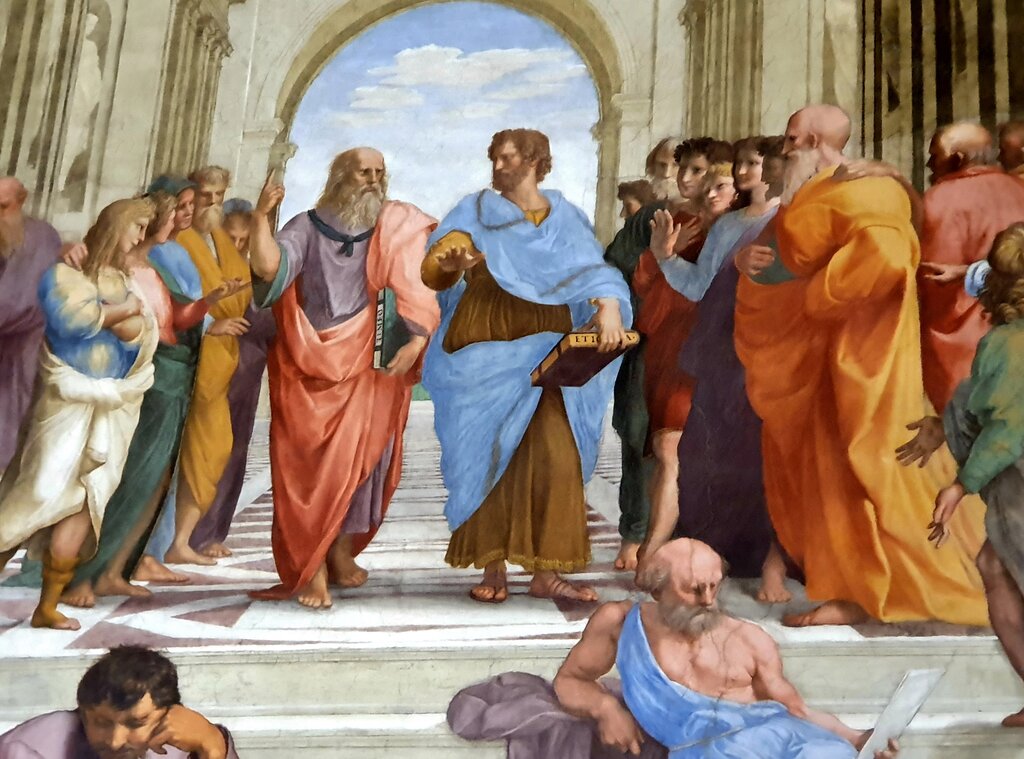
Socrates never wrote anything down. What we know of him comes largely from his brilliant student, Plato. Plato took his teacher's ethical focus and expanded it into a comprehensive system that addressed nearly every aspect of human thought, from knowledge to politics.
Central to his philosophy is the Theory of Forms. Plato argued that the physical world we perceive with our senses is not the real world; it's just a shadow of it. True reality exists in an abstract, spiritual realm of perfect “Forms” or “Ideas.” There is a perfect Form of a Chair, of Justice, of Beauty. Everything in our world is just an imperfect copy of these Forms.
Plato’s political philosophy, laid out in his book The Republic, is built on this foundation. He argued that the ideal state should be ruled by “philosopher-kings”—wise individuals who have been trained to understand the world of Forms and thus know the true nature of justice and goodness.
Plato’s Allegory of the Cave illustrates this idea. Imagine people chained in a cave, facing a blank wall. They watch shadows projected on the wall by things passing in front of a fire behind them. To the prisoners, the shadows are reality. Philosophy, for Plato, is like breaking free from the chains and walking out of the cave to see the true objects in the light of the sun.
The World We See
Plato's most famous student, Aristotle, took a dramatically different approach. While Plato looked to an abstract realm for truth, Aristotle turned his attention to the observable world. He was a biologist, a physicist, a logician, and an ethicist all in one. He believed that knowledge comes from experience and careful observation, a method that laid the groundwork for modern science.
Aristotle created the first system of formal logic, using tools like the syllogism to build sound arguments. In ethics, he wasn't looking for a perfect Form of the Good. Instead, he argued that the goal of human life is eudaimonia, often translated as “flourishing” or “living well.” We achieve this, he said, by cultivating virtues and finding the “Golden Mean” between extremes. For example, courage is the mean between cowardice and recklessness.
| Virtue | Deficiency (Vice) | Mean (Virtue) | Excess (Vice) |
|---|---|---|---|
| Confidence | Cowardice | Courage | Recklessness |
| Pleasure | Insensibility | Temperance | Self-indulgence |
| Spending | Stinginess | Generosity | Extravagance |
Aristotle’s influence is immense. He cataloged knowledge, defined the branches of philosophy, and provided a framework for inquiry that would dominate Western thought for nearly two thousand years.
Life in a Changing World
After Aristotle, the political landscape of Greece changed dramatically with the rise of Alexander the Great. The city-state was no longer the center of life, and people found themselves part of a vast, often chaotic empire. In this new world, philosophy became less about abstract systems and more about a practical question: How can I live a good, tranquil life in a turbulent world?
Two major schools of thought emerged to answer this: Stoicism and Epicureanism.
Stoicism, founded by Zeno of Citium, taught that we can't control what happens to us, but we can control our reaction to it. The key to a peaceful life is to accept fate, cultivate virtue, and perform one's duty without complaint. Logic and reason were the tools to overcome destructive emotions.
Epicureanism, founded by Epicurus, is often misunderstood as a philosophy of hedonism. While Epicurus did argue that the goal of life is pleasure, he defined pleasure not as wild indulgence but as the absence of pain and fear (ataraxia). The best life, he taught, was a simple one, spent with friends and free from the anxieties of politics and superstition.
Both Stoicism and Epicureanism offered a kind of personal therapy. They provided ethical frameworks that helped individuals find meaning and peace in their own lives, regardless of the world outside.
Ready to test your knowledge of these foundational thinkers?
What was the revolutionary shift in thinking introduced by the Pre-Socratic philosophers like Thales and Anaximander?
Which philosopher believed that the key to knowledge was to first admit your own ignorance and engaged people in conversation to expose contradictions in their beliefs?
From asking what the world is made of to defining how to live a good life, the ancient Greeks set the stage for nearly all of Western philosophy to come.