A 26-Century Journey Through Western Philosophy
Ancient Philosophy
From Myth to Reason
Before philosophy, ancient societies explained the world through myths and stories about gods and heroes. Why does the sun cross the sky? A god is driving a chariot. Why are there seasons? A goddess is grieving. These stories provided comfort and order, but they weren't based on reason or evidence.
Around the 6th century BCE in ancient Greece, a new way of thinking emerged. A group of thinkers, now known as the Pre-Socratics, started asking different kinds of questions. They looked at the natural world and tried to find rational explanations for what they saw, marking a pivotal shift from mythological to logical inquiry.
From Thales, who is often considered the first Western philosopher, to the Stoics and Skeptics, ancient Greek philosophy opened the doors to a particular way of thinking that provided the roots for the Western intellectual tradition.
The First Philosophers
The Pre-Socratics were the pioneers. They shared a common goal: to find the single, underlying substance or principle from which everything else in the universe is made. They called this fundamental principle the arche.
Thales of Miletus proposed that the arche was water. He observed that water is essential for life and can exist in different forms—solid, liquid, and gas. A generation later, Anaximander suggested the arche was something he called the apeiron, or "the boundless"—an infinite, undefined substance from which all opposites (like hot and cold) emerged. Others, like Heraclitus, argued that the fundamental nature of reality wasn't a substance at all, but a process: constant change, which he symbolized with fire.
These early philosophers laid the groundwork for science and philosophy by insisting that the world was knowable and that its secrets could be unlocked through observation and reason.
Socrates and the Turn Inward
While the Pre-Socratics looked to the cosmos, Socrates turned his attention inward, to the human soul. He wasn't interested in the fundamental substance of the universe; he was interested in how to live a good life. For Socrates, the most urgent questions were about ethics, virtue, and justice.
Famously, Socrates claimed that he knew nothing. This wasn't false modesty. It was a philosophical position. He believed true wisdom begins with acknowledging one's own ignorance. He spent his days in the Athenian marketplace engaging people in conversation, not to teach them, but to question their most cherished beliefs.
Socratic method
noun
A form of cooperative argumentative dialogue between individuals, based on asking and answering questions to stimulate critical thinking and to draw out ideas and underlying presuppositions.
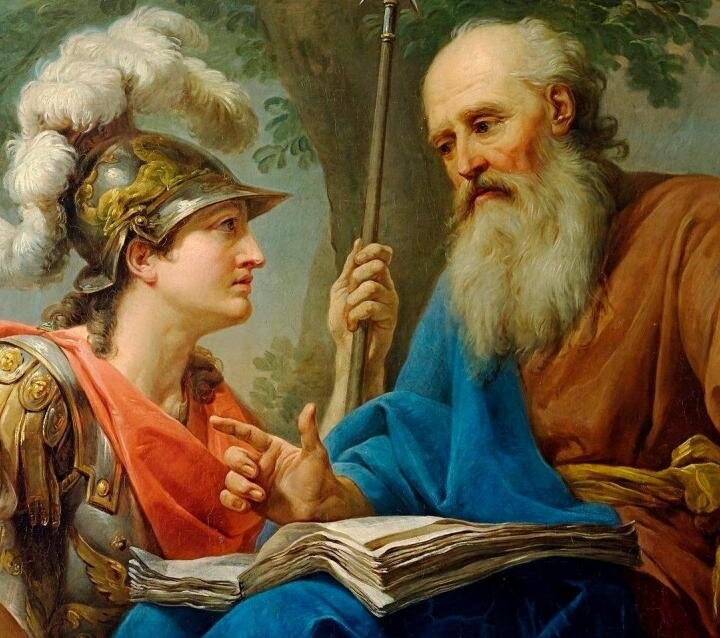
This technique of questioning is now called the Socratic method. Socrates would start with a simple question, like "What is justice?" or "What is courage?" His conversation partner would offer a definition, and Socrates would then ask a series of questions that revealed contradictions or flaws in that definition. The goal wasn't to win an argument, but to guide both participants toward a more profound understanding. For him, this process of self-examination was the very purpose of life.
Plato's World of Forms
Socrates never wrote anything down. What we know of him comes primarily from his star student, Plato. Plato took Socratic ethics and expanded it into a comprehensive system that addressed metaphysics, epistemology, and politics.
At the heart of Plato's philosophy is his Theory of Forms. He argued that the physical world we perceive with our senses is not the real world; it is merely a shadow or imitation of it. The real world is an unchanging, eternal realm of perfect concepts he called "Forms." There is a perfect Form of a Circle, a perfect Form of Justice, and even a perfect Form of a Tree. Everything we see in the physical world is just an imperfect copy of its corresponding Form.
According to Plato, the physical objects we see are like shadows on a cave wall. The real objects casting those shadows are the eternal Forms, which can only be grasped through reason.
This dualistic view of reality has massive implications. If the physical world is just a copy, then true knowledge cannot be gained through sensory experience. It can only be achieved through intellectual contemplation of the Forms.
Plato extended this idea to politics in his famous work, The Republic. He argued that the ideal state should be ruled by philosopher-kings—individuals who have, through rigorous education and reason, come to understand the Form of the Good. Only these enlightened rulers could govern justly because they understand what justice truly is.
Aristotle's Grounded Philosophy
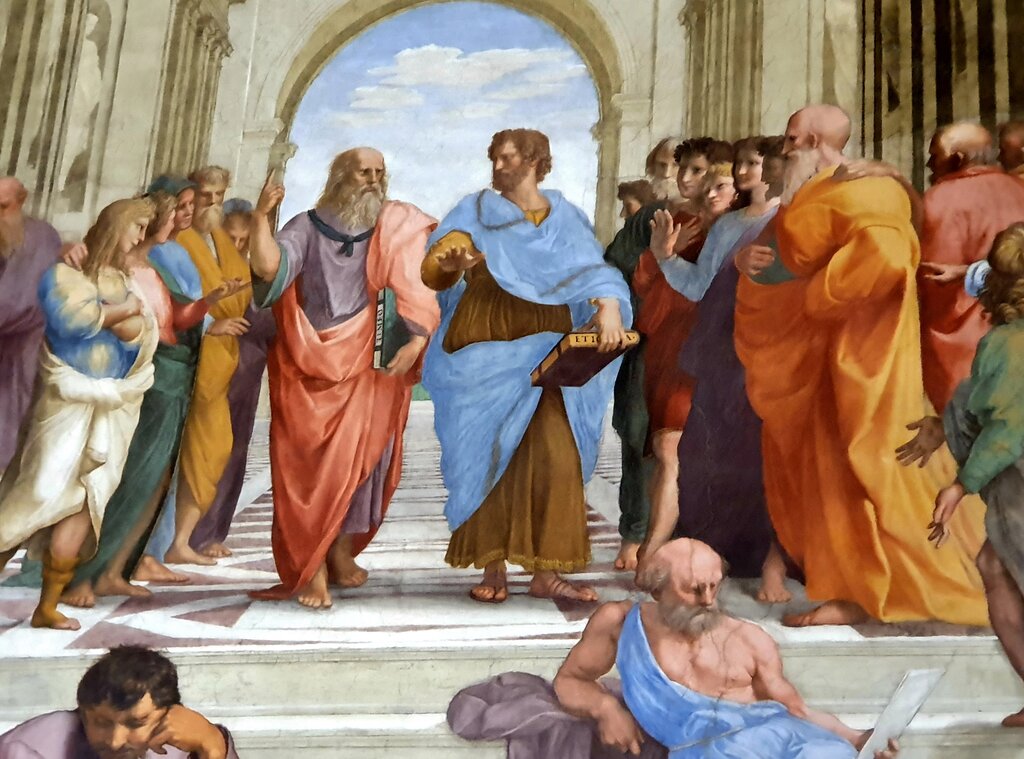
Plato's most famous student, Aristotle, took philosophy in a different direction. While he respected Plato, Aristotle was a more practical and empirical thinker. He believed that knowledge begins with sensory experience. Instead of looking to an abstract world of Forms, Aristotle focused on studying the natural world around him.
Aristotle's contributions were vast. He invented formal logic, creating a system for analyzing arguments called the syllogism. He was also a pioneering biologist, classifying hundreds of animal species based on his observations. His work in these fields remained the standard for centuries.
In ethics, Aristotle also diverged from Plato. He wasn't concerned with an abstract Form of the Good. Instead, he focused on a practical question: What is the goal of human life? His answer was eudaimonia, a Greek word often translated as "happiness" or "human flourishing."
For Aristotle, flourishing is achieved by living a life of virtue. Virtue, he argued, is a "golden mean" between two extremes. For example, courage is the mean between the extremes of cowardice (a deficiency) and recklessness (an excess). This virtuous life is not achieved by just thinking, but by developing good habits through practice and action.
| Philosopher | Key Focus | Path to Knowledge |
|---|---|---|
| Socrates | Ethics & Virtue | Questioning & self-examination |
| Plato | Metaphysics & Politics | Reason & contemplation of Forms |
| Aristotle | Logic, Ethics, & Nature | Observation & experience |
Together, Socrates, Plato, and Aristotle created the intellectual foundation for Western civilization. Their questions about the nature of reality, the limits of knowledge, and the meaning of a good life continue to shape our world today.
What fundamental shift in thinking marked the beginning of philosophy in ancient Greece?
The Pre-Socratic philosophers like Thales and Heraclitus were primarily concerned with identifying the _______.