8th Grade Math Essentials
Real Numbers
Expanding the Number Family
So far, we've worked with several types of numbers. We started with the counting numbers, or natural numbers (1, 2, 3, ...). Then we added zero to get the whole numbers. After that, we included negatives to form the integers.
Most recently, you learned about rational numbers. These are any numbers that can be written as a fraction , where and are integers and isn't zero. This group includes all the integers, plus all the fractions and decimals that either end (like 0.5) or repeat a pattern (like 0.333...).
It might seem like that covers every possible number, but it doesn't. There's another whole category of numbers out there.
This diagram shows how each set of numbers builds on the last. But what lies outside that final box?
The Other Numbers
Meet the irrational numbers. These are numbers that cannot be expressed as a simple fraction. As decimals, they go on forever without ever repeating a pattern.
irrational number
adjective
A number that cannot be written as a simple fraction (a/b). Its decimal representation is non-terminating and non-repeating.
You've probably encountered some famous irrational numbers already.
Pi () is the ratio of a circle's circumference to its diameter. It's approximately 3.14159, but its digits continue infinitely with no discernible pattern.
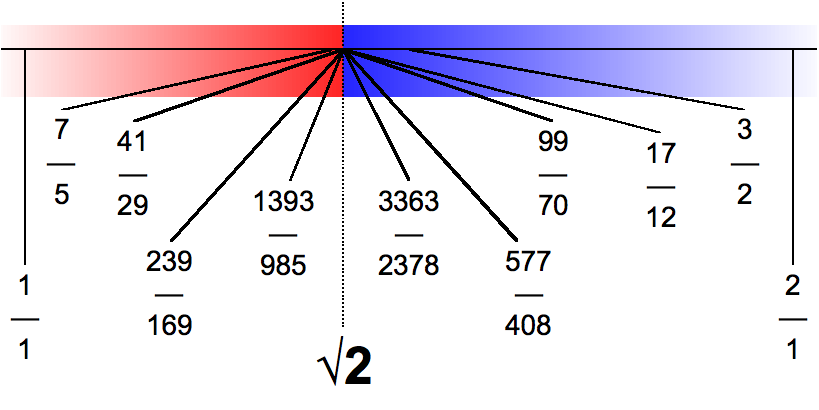
Another common example is the square root of 2 (). It's the number that, when multiplied by itself, equals 2. Its decimal form starts 1.41421356... and also continues forever without repeating.
Rational decimals repeat or terminate. Irrational decimals never do either.
The Real Number Line
When we combine the set of all rational numbers with the set of all irrational numbers, we get the real numbers. Essentially, a real number is any number that can be found on the number line. There are no gaps. Every single point corresponds to a real number, whether it's a simple integer like -5, a fraction like , or an irrational number like .
The fact that irrational numbers exist
This property of the real numbers filling the entire number line without any holes is called completeness. It's a foundational idea for much of higher mathematics, including calculus.
Approximating Irrationals
Since the decimals for irrational numbers go on forever, we can't write them down exactly. However, we can pinpoint their location on the number line by approximating them.
Let's try to place on a number line.
-
Find the perfect squares around it. We know that and . Since 5 is between 4 and 9, must be between and . That means is between 2 and 3.
-
Get more precise. Let's try squaring some decimals. (too small). (too big). So, we know is between 2.2 and 2.3.
-
Go even further. Let's try another decimal place. (very close!). (just over). Now we know is between 2.23 and 2.24.
We could continue this process forever, getting closer and closer to the true value. For most practical purposes, an approximation like 2.24 is good enough to show its location on a number line, a little less than a quarter of the way from 2 to 3.
Understanding the difference between rational and irrational numbers is key to working with the full set of real numbers, which form the foundation for algebra and beyond.
Which of the following best describes an irrational number?
True or False: All integers are also rational numbers.