6th Grade Math Essentials
Number Systems
The World of Numbers
Let's start with the basics. The first numbers we ever learn are for counting: 1, 2, 3, and so on. These are called the natural numbers.
If we add zero to that group, we get the whole numbers. They're the simple, positive numbers without any fractional or decimal parts. Think of them as the building blocks for everything else.

Expanding with Integers
What happens when we need to talk about values less than zero? Imagine temperature dropping below freezing or being in debt. For this, we need negative numbers.
Integers are the set of all whole numbers and their negative opposites. So, the integers include ..., -3, -2, -1, 0, 1, 2, 3, ... and so on, stretching infinitely in both positive and negative directions.
integer
noun
A whole number (not a fractional number) that can be positive, negative, or zero.
A number line is a great way to visualize these numbers and their relationship to each other. Zero sits in the middle. Positive integers are to the right, and negative integers are to the left.
Comparing and Ordering
On the number line, numbers get larger as you move to the right and smaller as you move to the left. This makes comparing them straightforward.
For example, 5 is to the right of 2, so 5 is greater than 2. This is written as .
What about negative numbers? The same rule applies. -1 is to the right of -4, so -1 is greater than -4 (). It might feel strange, but think of it as being "less negative."
To order a set of integers like -5, 3, 0, -2, you just find their spots on the number line and list them from left to right: -5, -2, 0, 3.
Introducing Rational Numbers
Now, what about all the numbers that fall between the integers? These are where rational numbers come in. A rational number is any number that can be expressed as a fraction, where the top number (numerator) and bottom number (denominator) are both integers, and the denominator isn't zero.
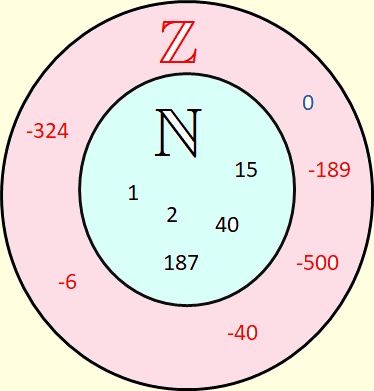
This means all integers are also rational numbers. Why? Because any integer can be written as a fraction with a denominator of 1.
Of course, rational numbers also include all the familiar fractions like , , and . Terminating decimals (like 0.5, which is ) and repeating decimals (like 0.333..., which is ) are also rational numbers.
Like integers, you can place rational numbers on the number line to compare them. For example, would be exactly halfway between 0 and 1, and would be three-quarters of the way from 0 to -1.
To compare two fractions, it's often helpful to find a common denominator or convert them to decimals, but simply visualizing their position on a number line is a powerful first step.
Now, let's test your understanding of these different number types.
The numbers 1, 2, 3, and so on, used for counting, are known as...
Which of the following sets of numbers includes all the others?
Understanding these number systems is the first step in building a strong foundation in mathematics. They provide the framework for almost everything that comes next.