5-Axis CNC Machining Software Mastery
Introduction to 5-Axis CNC Machining
Beyond Three Axes
So far, we've focused on CNC machines that move in three directions: X, Y, and Z. This setup is great for many jobs, but it has limits. To cut a complex, curved surface, you often need to stop the machine, unclamp the part, and manually reposition it. This process is time-consuming and introduces opportunities for error.
Five-axis machining solves this problem by adding two more axes of rotation. Instead of just moving left-right, forward-back, and up-down, the machine can also tilt and rotate the tool or the workpiece itself. This allows the cutting tool to approach the part from almost any angle in a single setup.
Think of it like carving a detailed wooden statue. With only three axes, it's like you can only move your chisel up, down, and side to side. To get to the other side, you have to put the tool down and turn the block of wood. With five axes, it's as if you can tilt and spin the wood block with one hand while carving with the other, all without stopping.
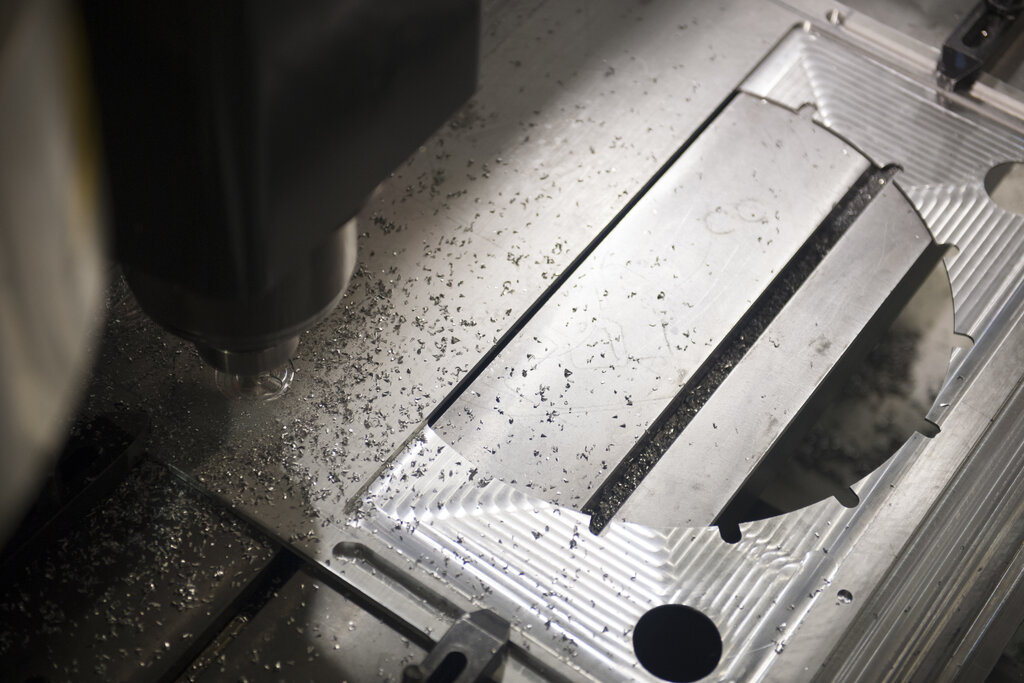
This capability opens up a world of possibilities. Machinists can create incredibly complex geometries with smoother surface finishes. Because the tool can be kept perpendicular to the part's surface, it can cut more efficiently, leading to faster cycle times and longer tool life. Fewer setups also mean less chance for human error when re-positioning the workpiece, resulting in higher accuracy.
How They Move
The two extra rotational axes are typically labeled A and B (or C). The 'A' axis rotates around the X-axis, and the 'B' axis rotates around the Y-axis. How a machine achieves these rotations defines its configuration. The two most common types are trunnion-style and swivel head machines.
In a trunnion-style machine, the worktable itself tilts and rotates the part. The cutting tool moves along the standard X, Y, and Z axes, while the table provides the A and B rotations.
Trunnion machines are often used for smaller, complex parts because the moving table has limits on the weight it can support.
In a swivel head machine, the worktable is stationary. The spindle head, which holds the cutting tool, swivels and rotates to provide the A and B axes of motion. This configuration is better for large, heavy workpieces that would be difficult to move.
Ideal Applications
The ability to machine complex contours in a single setup makes 5-axis CNC ideal for specific industries and parts. It's not the best choice for every job, but for the right ones, it's revolutionary.
| Industry | Example Parts | Why 5-Axis is Used |
|---|---|---|
| Aerospace | Turbine blades, impellers, complex housings | Creates aerodynamic surfaces and intricate internal features with high precision. |
| Medical | Orthopedic implants, surgical tools | Machines complex, organic shapes from tough materials like titanium. |
| Automotive | Engine blocks, cylinder heads, molds for dashboards | Allows for machining of complex ports and passages in a single clamping. |
| Mold Making | Molds for plastics, die casting | Enables the creation of complex mold cavities and cores with excellent surface finish. |
For components with complex geometries, multi-axis CNC machining, such as five-axis machining, is ideal.
Five-axis machines reduce production time, improve accuracy, and expand the geometric complexity of what can be manufactured. By understanding the basics of how they move and where they excel, you can begin to see their immense value in modern manufacturing.
Let's review the core ideas before you test your knowledge.
Ready to check your understanding?
What is the primary advantage of 5-axis machining compared to 3-axis machining?
In a 5-axis setup, the two additional rotational axes are typically labeled A and B. The 'A' axis rotates around which primary axis?