3D Animation Creation From Start to Finish
Introduction to 3D Animation
Bringing Worlds to Life
3D animation is the art of creating moving images in a three-dimensional digital space. Unlike 2D animation, which exists on a flat plane, 3D animation adds depth. This allows artists to create objects and characters that can be viewed from any angle, just like in the real world. Think of it as digital puppetry. Animators build virtual models, give them a skeleton, and then pose them frame by frame to create the illusion of movement.
From Lab to Big Screen
The journey of 3D animation began in university research labs in the 1970s. Early pioneers like Ed Catmull (who would later co-found Pixar) created some of the first 3D rendered images, including a digital version of his own hand. For years, the technology was expensive and limited, mostly used for short sequences in live-action films, like the Genesis effect in Star Trek II: The Wrath of Khan (1982) or the stained-glass knight in Young Sherlock Holmes (1985).
The big breakthrough came in 1995 with the release of Toy Story, the first-ever fully computer-animated feature film. It proved that audiences would connect with stories told entirely through 3D animation, and it opened the floodgates for the industry we know today.
From experimental shorts to blockbuster films, the evolution of 3D animation has been driven by both technological innovation and creative storytelling.
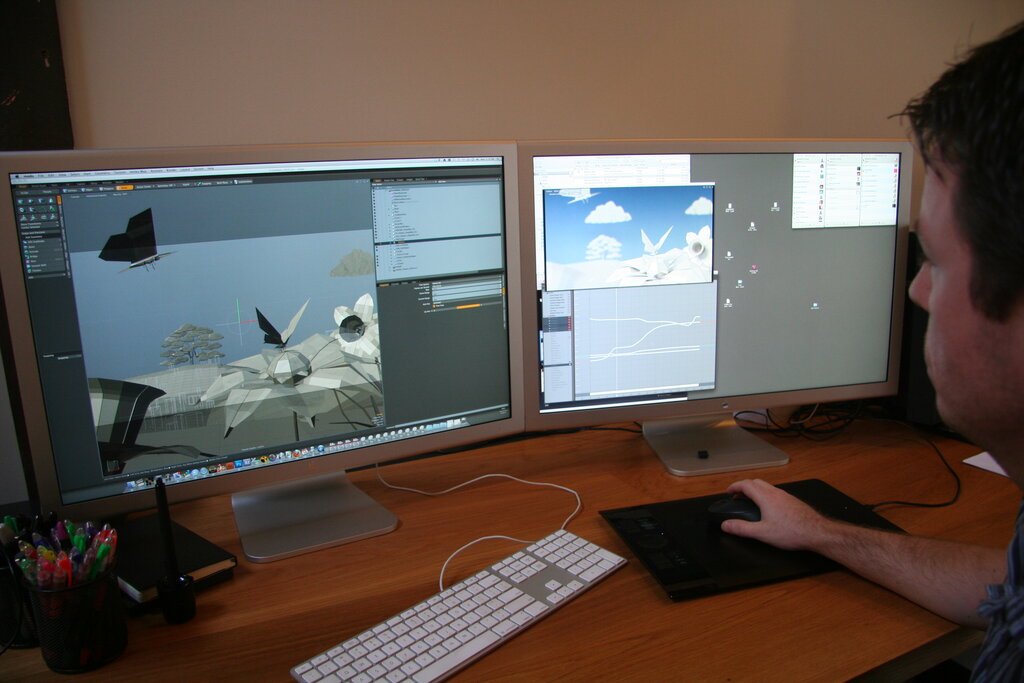
More Than Just Movies
While movies are the most visible application, 3D animation is everywhere. The video game industry relies on it to create immersive worlds and believable characters. Architects use it to create virtual walkthroughs of buildings before they're constructed. Medical students use 3D simulations to practice complex surgeries without risk.
It's also the backbone of virtual reality (VR) and augmented reality (AR), creating the digital environments we step into. From product design and advertising to scientific visualization, 3D animation has become an essential tool for bringing ideas to life.
The Principles of Motion
To make an animation feel real, animators follow a set of core principles. These guidelines help create movement that is convincing and engaging, whether for a bouncing ball or a complex character. The most fundamental of these are timing, spacing, and motion dynamics.
Timing
noun
The speed of an action, determined by the number of frames used to show that action.
Timing gives an object or character its sense of weight and emotion. A character who moves quickly might feel energetic or panicked, while slow movements can suggest sadness, fatigue, or a heavy weight. If a ball takes 24 frames to cross the screen, that action lasts one second. If it only takes 12 frames, the action lasts half a second, making the ball seem much faster.
Spacing
noun
The placement of individual frames or poses in a sequence of movement.
Spacing dictates how an object accelerates and decelerates. If the frames are spaced closely together, the object moves slowly. As the spacing between frames increases, the object appears to speed up. This is how animators create smooth
'ease in' and 'ease out' effects. Think of a car leaving a stop sign. It starts slowly (close spacing) and then picks up speed (wider spacing) before slowing down again to stop (close spacing).
Finally, there's the broader concept of motion dynamics. This is about making movement believable by adhering to the laws of physics. An object should have a sense of weight. A bowling ball will move differently than a beach ball. Characters should have momentum; they can't stop on a dime from a full sprint. Motion dynamics also includes concepts like follow-through, where parts of a character (like hair or clothing) continue to move after the main body has stopped.
Ready to check your understanding?
What is the primary characteristic that distinguishes 3D animation from 2D animation?
Which film is considered the major breakthrough for 3D animation, proving its viability for feature-length storytelling?
Mastering these principles is the first step in an animator's journey. They are the foundation upon which all complex and captivating animation is built.