2-Axis CNC Machining with Protrak Bridgeport
Machine Overview
Meet the Mill
Welcome to the Protrak Bridgeport 2-axis mill. This machine is a workhorse in shops around the world, blending manual control with digital precision. Think of it as a smart drill press that can move in multiple directions. Instead of just drilling holes, it uses rotating cutters to shave away material and shape a part according to a design.
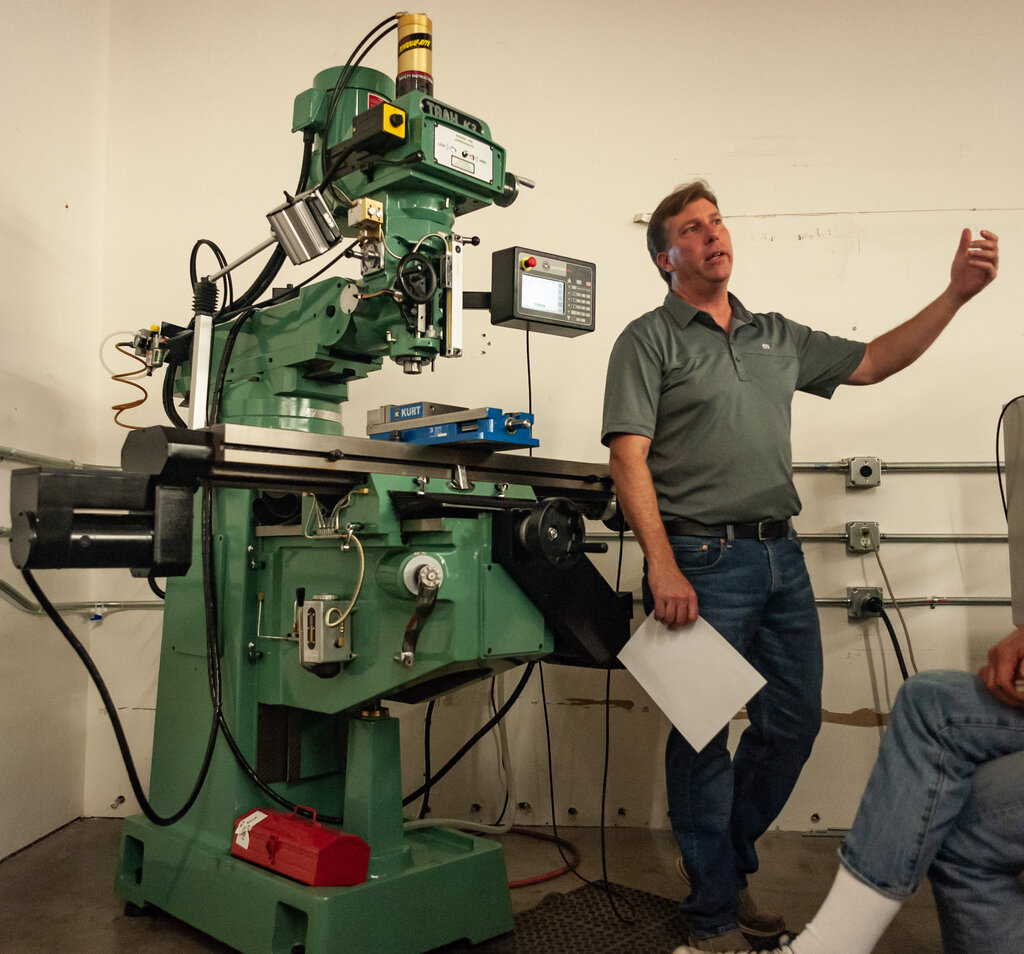
The “2-axis” part of its name means the computer controls the table's movement left-to-right (X-axis) and front-to-back (Y-axis). The up-and-down motion (Z-axis) is controlled manually, which gives you a hands-on feel for the cutting process. Let's break down its main components to understand how it all works together.
The Key Components
Every part of the mill has a specific job. Understanding them is the first step to using the machine effectively and safely. Here's a look at the main anatomy.
Let's go through these parts one by one.
Head: This is the main housing at the top of the machine. It contains the motor and the spindle, which are the guts of the operation.
Spindle and Quill: The spindle is the rotating shaft that holds the cutting tool. It's housed inside the quill, which is a sleeve that can be moved up and down manually to control the cutting depth (the Z-axis).
Table: This is the flat surface where you mount your workpiece. The CNC system moves the table left and right (X-axis) and forward and back (Y-axis) to position the material under the cutter.
Knee: The knee is the large casting that supports the table and saddle. You can raise or lower the entire knee to accommodate workpieces of different heights, making large adjustments before fine-tuning with the quill.
Control Panel: This is the brain of the machine. It's where you'll input commands, view the digital readout (DRO) for precise positioning, and manage the automated movements of the X and Y axes.
Safety First, Always
A CNC mill is a powerful tool, and safety is the most important part of its operation. Metal shavings can be sharp and hot, and moving parts can be dangerous. Always follow these rules to ensure a safe working environment.
| Rule | Description |
|---|---|
| Eye Protection | Always wear safety glasses. Metal chips can fly off the workpiece at high speed. |
| No Loose Items | Remove jewelry, tie back long hair, and avoid loose clothing. These can get caught in the machine's moving parts. |
| Never Leave Unattended | Stay at the machine while it's running. Be ready to hit the emergency stop button if something goes wrong. |
| Keep Hands Clear | Never touch the workpiece or cutter while the spindle is rotating. Wait for it to come to a complete stop before making adjustments. |
| Use a Brush | Clean away chips with a brush, never with your hands or compressed air. Air can embed small, sharp chips into your skin. |
| Secure Your Work | Ensure your workpiece is clamped securely to the table. A loose part can be thrown from the machine with great force. |
Familiarizing yourself with the machine's layout and internalizing these safety rules are the first steps toward becoming a confident and competent operator. In the next section, we'll power on the machine and start moving the axes.