11th Grade Physics Essentials
Kinematics
Describing Motion
Physics often starts with a simple question: How do things move? The study of motion itself, separate from what causes it, is called kinematics. It’s the language we use to describe an object's journey through space.
To speak this language, we need a few key terms. The first is displacement. It’s not just the distance you travel, but also the direction. If you walk 10 feet east from your chair to a window, your displacement is 10 feet east. If you walk back to the chair, your total distance traveled is 20 feet, but your final displacement is zero because you ended up exactly where you started.
Displacement
noun
The change in an object's position, including direction. It is a vector quantity.
Next is velocity, which is more than just speed. Speed tells you how fast you're going, say, 60 miles per hour. Velocity tells you how fast and in what direction: 60 miles per hour north. Like displacement, velocity has both a magnitude (the speed) and a direction.
Finally, we have acceleration. Most people think of acceleration as speeding up, but in physics, it’s any change in velocity. Since velocity includes direction, you are accelerating if you speed up, slow down, or simply change direction. A car turning a corner at a constant speed is still accelerating because its direction of motion is changing.
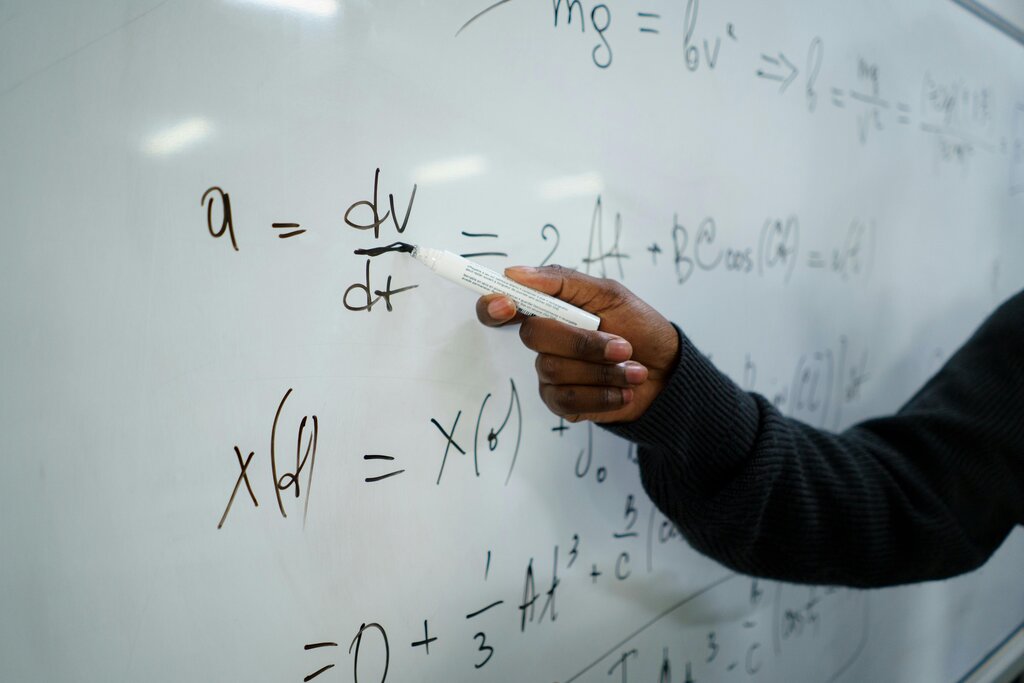
The Math of Motion
When an object's acceleration is constant, we can predict its motion with a set of powerful formulas called the equations of motion. These equations connect displacement (), time (), initial velocity (), final velocity (), and acceleration ().
One key equation relates final velocity to initial velocity, acceleration, and time.
Another tells us how far an object travels (its displacement) during that time.
And if you don't know the time, a third equation connects velocity, acceleration, and displacement directly.
These three equations are the foundation for solving a huge range of problems involving constant acceleration.
Free Fall and Projectiles
One of the most common examples of constant acceleration is free fall. Near the Earth's surface, gravity causes any object to accelerate downwards at a constant rate, which we call . This value is approximately . When analyzing an object falling straight down, we can use the same equations of motion, simply replacing with .
But what if an object is thrown, not just dropped? This is projectile motion. Think of a baseball thrown to home plate or a cannonball fired from a cannon.
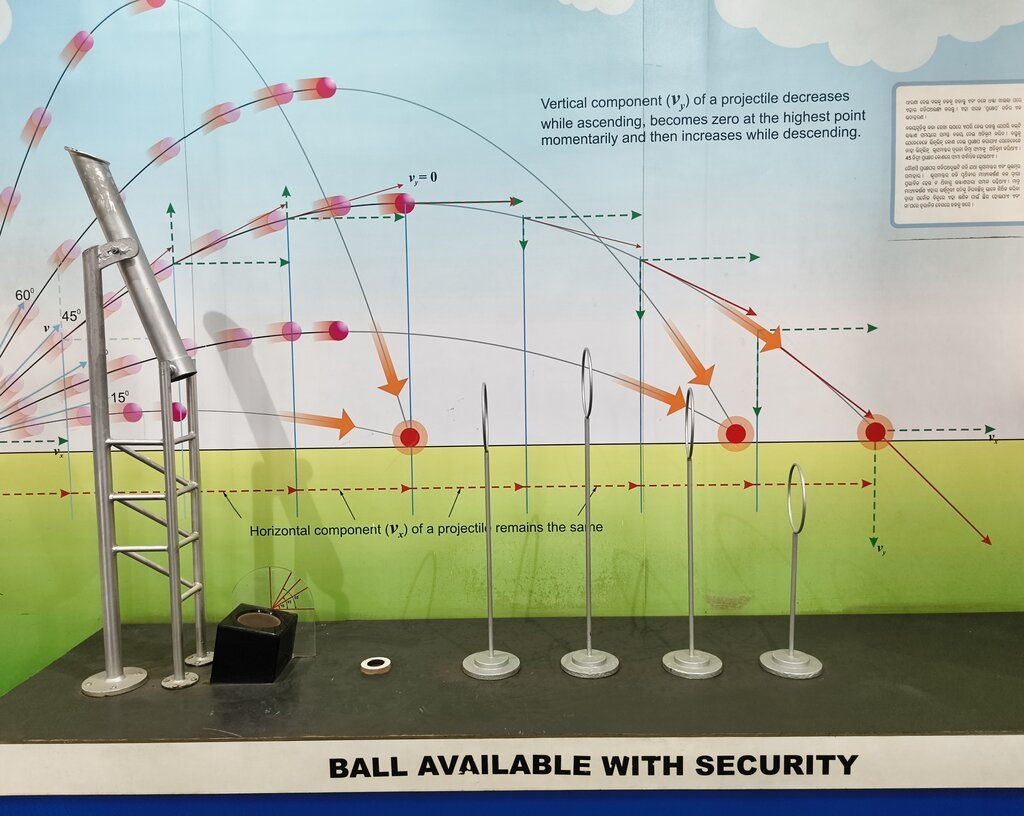
There is one key element to projectile motion---and it is this: You can treat the horizontal motion (x-direction) and the vertical motion (y-direction) as two separate one-dimensional kinematics problem.
This insight is incredibly powerful. An object's horizontal motion is independent of its vertical motion. Once a projectile is launched, there's nothing accelerating it horizontally (ignoring air resistance). So, its horizontal velocity stays constant. Meanwhile, its vertical motion is governed entirely by the constant downward acceleration of gravity, . By analyzing the horizontal and vertical parts of the motion separately, we can predict the projectile's path, or trajectory, with great accuracy.
Visualizing Motion
Sometimes the best way to understand motion is to see it. We can plot an object's position, velocity, and acceleration against time to create graphs that tell a story. For an object with constant acceleration, these graphs have very predictable shapes.
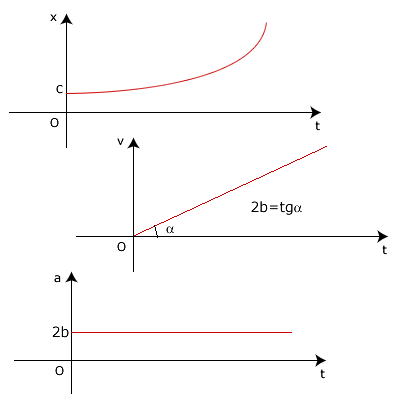
As you can see, the acceleration graph is a flat horizontal line, because it's constant. The velocity graph is a straight, sloped line, showing that velocity changes at a steady rate. And the position graph is a curve (a parabola), because the object covers more and more distance in each successive second as its velocity increases.
The slope of the position-time graph at any point gives you the instantaneous velocity. Likewise, the slope of the velocity-time graph gives you the acceleration. These graphical relationships provide a visual way to connect displacement, velocity, and acceleration.
Ready to test your understanding of motion?
A runner completes one full lap around a 400-meter circular track. What are their total distance traveled and final displacement?
Which of the following scenarios describes an object that is accelerating?
Kinematics provides the essential tools for describing the world in motion, from falling apples to orbiting planets. It's the first step in understanding the grander principles of physics.