10th Grade Chemistry Essentials
Atomic Structure
The Building Blocks of Everything
Everything you see, touch, and breathe is made of atoms. They are the fundamental units of matter. But what are atoms made of? It turns out they are composed of even smaller pieces called subatomic particles.
The three main subatomic particles are protons, neutrons, and electrons. Protons have a positive electrical charge, electrons have a negative charge, and neutrons have no charge at all. Protons and neutrons are packed together in the center of the atom, in a dense core called the nucleus. Electrons are much smaller and orbit the nucleus.
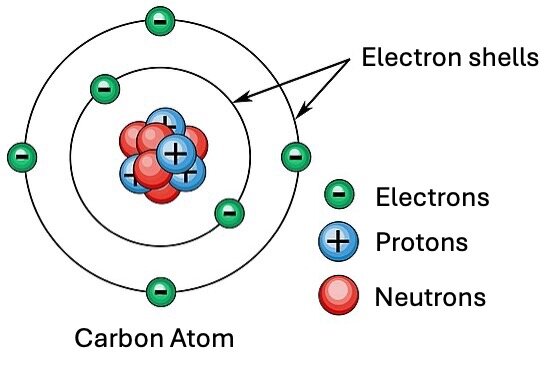
Protons and neutrons have about the same mass, which we measure in a tiny unit called an atomic mass unit (amu). An electron is much, much lighter—it takes almost 2,000 electrons to equal the mass of just one proton. Because electrons are so light, most of an atom's mass is concentrated in its nucleus.
| Particle | Charge | Relative Mass (amu) | Location |
|---|---|---|---|
| Proton | +1 | ~1 | Nucleus |
| Neutron | 0 | ~1 | Nucleus |
| Electron | -1 | ~1/1836 (very small) | Outside nucleus |
An Atom's ID Card
What makes a carbon atom different from an oxygen atom? It's the number of protons. Every element has a unique number of protons in its atoms. This count is called the atomic number (Z). It's the element's fundamental identifier. For example, every single atom with 6 protons is a carbon atom. Any atom with 8 protons is an oxygen atom.
The mass number (A) is the total count of protons and neutrons in the nucleus. Because protons and neutrons make up nearly all of an atom's mass, this number gives us a good estimate of the atomic mass.
We can find the number of neutrons by simply rearranging this: Neutrons = Mass Number - Atomic Number.
Chemists use a standard notation to represent an atom's composition:
Here, X is the element's symbol, A is the mass number, and Z is the atomic number. For a carbon atom with 6 protons and 6 neutrons, its mass number is 12. So, we'd write it as .
While the number of protons defines an element, the number of neutrons can vary.
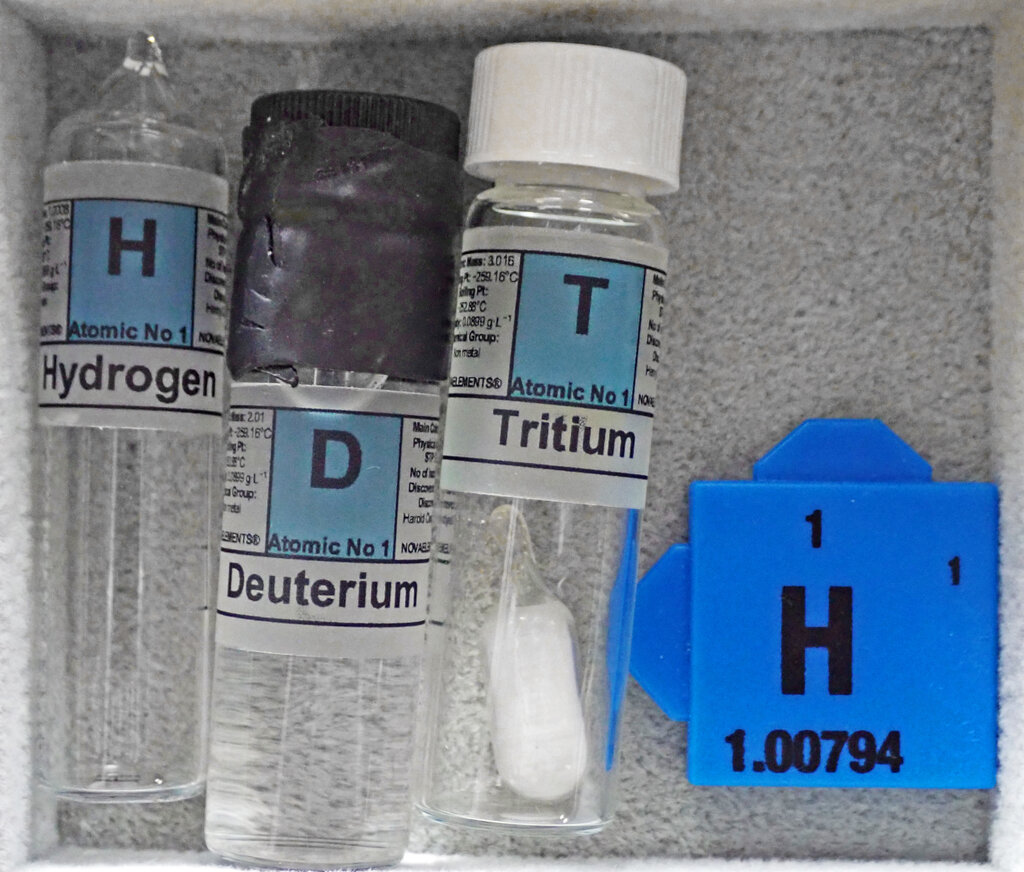
Atoms of the same element that have different numbers of neutrons are called isotopes. They have the same atomic number but different mass numbers. For example, most carbon atoms have 6 neutrons (Carbon-12). But some have 8 neutrons, making them Carbon-14. It's still carbon because it has 6 protons, but it's a heavier version.
Picturing the Atom
Our idea of what an atom looks like has changed a lot over time. It wasn't one single discovery but a series of models, with each one building on the last.
1. Dalton's Model (Early 1800s) John Dalton imagined atoms as tiny, solid, indestructible spheres, like billiard balls. He proposed that all atoms of an element were identical and that compounds were formed by combining atoms in simple ratios. It was a groundbreaking start, but it didn't include subatomic particles.
2. Thomson's Model (1897) J.J. Thomson discovered the electron. Since atoms are electrically neutral, he reasoned there must be a positive charge to balance the negative electrons. He proposed the "plum pudding" model, where negative electrons were scattered within a sphere of positive charge, like plums in a pudding.
3. Rutherford's Model (1911) Ernest Rutherford conducted his famous gold foil experiment. He shot tiny, positively charged alpha particles at a very thin sheet of gold foil. Most particles passed straight through, but a few were deflected at large angles. This was shocking. It was like firing a cannonball at a piece of tissue paper and having it bounce back.
Rutherford concluded the atom must be mostly empty space, with a tiny, dense, positively charged center—the nucleus. The electrons, he proposed, orbited this nucleus like planets around the sun.
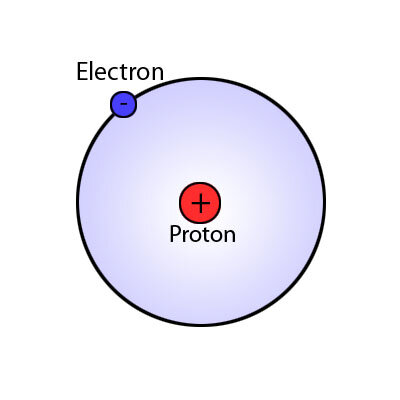
4. Bohr's Model (1913) Niels Bohr refined Rutherford's model. He suggested that electrons could only travel in specific, fixed orbits, or energy levels, around the nucleus. An electron could jump from a lower energy level to a higher one by absorbing energy, and fall back by emitting it. This model was a huge step in explaining chemical properties.
5. The Quantum Mechanical Model (1920s - Present) The modern model of the atom is more abstract. It abandons the idea of fixed orbits. Instead, it describes the probability of finding an electron in a certain region of space. These regions are called orbitals, often visualized as fuzzy "electron clouds." The cloud is denser where the chance of finding the electron is high and thinner where the chance is low. This is the most accurate and complete model we have today.
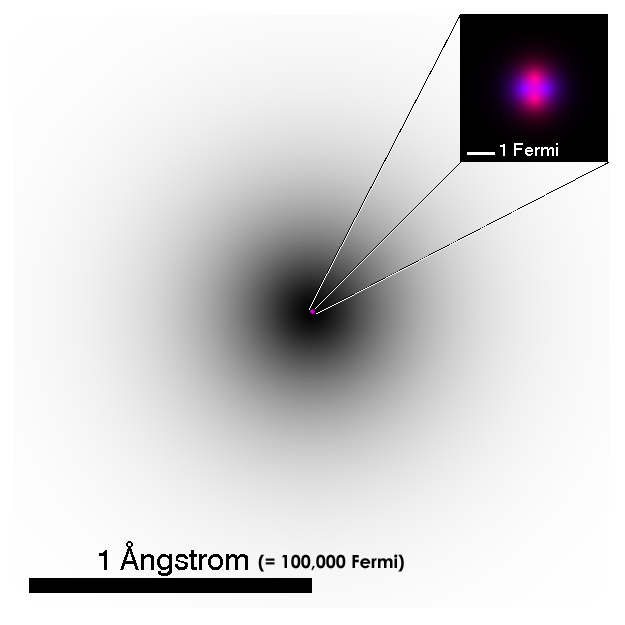
From a simple solid ball to a complex cloud of probability, our understanding of the atom has been a remarkable journey of scientific inquiry.
Ready to test your knowledge?
An atom has an atomic number of 17 and a mass number of 35. How many neutrons does it contain?
Which atomic model first introduced the concept of a dense, positively charged nucleus at the center of the atom?