No history yet

I want to learn about atoms, elements, compounds, mixtures, periodic table and more to year 10 level. I have basic knowledge only

Welcome! I'm really looking forward to working through these chemistry fundamentals with you. To help me tailor our session perfectly for you, could you tell me a little more about what you already know, or if there's a specific area within these topics that you find most challenging?

I'm starting pretty much from scratch and would love to build from the absolute basics.

It is great to have you here! Since you are starting from scratch, we will build a rock-solid foundation together, starting with the absolute basics of how our universe is constructed.

Your path

The Ultimate Building Block

To understand chemistry, we have to start with the smallest possible unit of matter: the . Imagine you have a piece of pure gold. If you were to cut that gold in half, and then cut it in half again, and keep cutting it billions of times, you would eventually reach a point where you cannot cut it anymore without losing the properties of gold. That final, indivisible piece is an atom. Every single thing you can see, touch, or breathe is made of these tiny building blocks.

A simplified 2D model of an atom featuring a central nucleus cluster and two orbiting electrons on concentric paths.

I've started creating a visual model of an atom for you above so you can see how this tiny building block is structured.

Before we dive into how these atoms differ from one another, does this concept of an atom as the ultimate 'Lego brick' of the universe make sense to you?

Yes, continue to the difference between atoms and elements

The Difference Between Atoms and Elements

It is common to hear the words atom and element used almost interchangeably, but there is a clear distinction between them. An is a single physical particle—the actual physical "Lego brick" itself. An , on the other hand, is a specific type of matter that is made up of only one kind of atom. To use our Lego analogy, think of an "atom" as a single, physical plastic brick in your hand. An "element" is the category or design of that brick, such as a "red 2x4 brick." If you have a bucket containing nothing but red 2x4 bricks, you have a pure element. Every single individual piece in that bucket is an atom.

Three identical, separate atoms are shown on the left alongside a dense, structured cluster of the exact same atoms on the right.

As you can see, when we look at a pure element, every single atom inside it is identical in its chemical identity. But how do we actually tell elements apart, and what makes an atom of gold behave so differently from an atom of oxygen? It all comes down to the subatomic particles hidden inside the atom's core.

Continue to the role of protons in identifying elements

The Proton: Nature's Atomic ID Card

To understand how we tell elements apart, we have to look straight into the center of the atom—the nucleus. Inside this core, we find a tiny, positively charged subatomic particle called the . The number of protons in an atom's nucleus is the ultimate deciding factor of its identity, also known as the . If you change the number of protons in an atom, you literally transform it into a completely different element. For example, an atom with exactly 1 proton is always hydrogen. If you have an atom with 6 protons, it is carbon, and if you find one with 79 protons, you're holding gold. It's like a cosmic barcode—every single element has its own unique, unchanging proton count.

Three atom nuclei showing different numbers of protons representing hydrogen, helium, and carbon.

I've generated a simple visual above to show how the number of protons inside the nucleus directly determines which element you are looking at.

Now that you see how the proton acts as a unique ID card, are you ready to look at the rest of the atomic family—the neutrons and electrons—to complete the whole picture?

Continue to neutrons and electrons

The Rest of the Atomic Family

While protons define who an element is, they cannot hold the atom together or interact with the world on their own. That is where and come in. Neutrons sit right in the nucleus alongside protons. They carry no electrical charge at all—they are completely neutral—but they act as a sort of nuclear glue. Because protons are all positively charged, they naturally want to repel each other. Neutrons add the necessary physical mass and stability to hold the nucleus together. Electrons, on the other hand, are the energetic runts of the family. They are extremely tiny, carry a negative charge, and zip around the nucleus in outer orbits called shells. Because electrons sit on the very outside of the atom, they are the parts that bump into other atoms, which means they are entirely responsible for determining an element's chemical reactivity.

The Balancing Act of a Neutral Atom

In their default state, atoms love balance. A normal, always has an equal number of positive protons and negative electrons. For example, if a carbon atom has 6 positive protons in its nucleus, it will have exactly 6 negative electrons orbiting outside. Because the positive and negative charges are perfectly matched, they cancel each other out, leaving the overall atom with a net charge of zero. This delicate electrostatic attraction between the positive center and negative cloud is what holds the entire atom together.

Explain the nuclear glue concept with an analogy

I would love to help you visualize that. To understand how neutrons act as a "nuclear glue," let us leave the microscopic world for a moment and step onto a school playground.

Imagine you have a group of very energetic, identical kids who absolutely refuse to stand near each other—every time they get close, they push each other away with incredible force. These kids are like your positively charged . Because they all carry the same positive charge, they naturally want to repel one another. If you tried to pack them all into a tiny room (the nucleus), they would instantly scatter.

Now, imagine a group of calm, friendly camp counselors who walk into the crowd. These counselors represent the . They do not have any electrical charge of their own, so they do not push anyone away. Instead, they stand between the rowdy kids, holding their hands, diffusing the tension, and keeping everyone together in a peaceful group. The counselors are the "glue" that prevents the room from bursting apart.

Protons flying apart due to electrostatic repulsion versus protons and neutrons bound together stably by the strong nuclear force.

I have created an interactive visualization above to show you this playground analogy in action, contrasting what happens to protons with and without their neutron "counselors."

Now that we have mastered the structure of individual atoms, we have completed our first major milestone in our learning path! Are you ready to see how these atoms start chemically combining to form entirely new substances?

What happens if an atom has too many neutrons?

That is a brilliant question, and it takes us right to the heart of how atoms can vary. If an atom has too many neutrons, the nucleus becomes unstable, turning the atom into a radioactive . Remember, neutrons act as the calm camp counselors holding the positive protons together. But if you stuff too many counselors into that small space, the room gets overcrowded and structurally unstable. To relieve this stress, the unstable nucleus will eventually spit out particles or energy to try to find a balanced state again—a process we call . This means the atom is radioactive. Even though the number of neutrons can change, making the atom heavier or lighter, it is still the exact same element because the proton count hasn't changed. For instance, a normal carbon atom has 6 protons and 6 neutrons, but if it has 8 neutrons, it becomes Carbon-14, which is unstable and radioactive.

A side-by-side comparison of a stable carbon-12 nucleus and an unstable, bloated carbon-14 nucleus.

I have created a visual comparison above to show how adding those extra neutrons physically crowds the nucleus, tipping it from stable to unstable.

This concept of isotopes and nuclear stability marks the very end of our first unit on Atoms and Elements!

How are you feeling about everything we have covered so far? If you are ready, we can move right into our next subtopic, where we will explore how these atoms chemically combine to form compounds and mixtures.

Continue to Compounds and Mixtures

Welcome to Unit 2! Now that you have a firm grasp of individual atoms, we are ready to explore what happens when different elements meet and combine. Our first major concept in this unit is the . A compound is a substance formed when two or more different elements are chemically bonded together. Think of elements as individual letters of the alphabet, and compounds as actual words. When you chemically bond those letters together, you create a brand-new entity with its own distinct meaning. For example, when you take the element sodium (a highly reactive metal) and chemically bond it to chlorine (a toxic gas), they undergo a chemical reaction to form sodium chloride—which is just ordinary, harmless table salt that you sprinkle on food.

Give me another example of a compound

Another classic example is , which is a compound made of hydrogen and oxygen chemically bonded together. On their own, hydrogen and oxygen are highly flammable, invisible gases. Hydrogen is so explosive it was used to power the space shuttle, and oxygen is the gas that fires need to burn. Yet, when they undergo a chemical reaction and bond together, they completely transform. They become a stable, clear liquid that we actually use to put out fires. This dramatic transformation is the hallmark of any compound: the starting elements completely lose their individual identities to create something brand new.

Are the atoms in a compound easy to separate?

The short answer is: no, they are actually incredibly difficult to separate. Because the atoms in a are locked together by strong chemical bonds, you cannot simply pry them apart with physical force, filter them out, or shake them free.
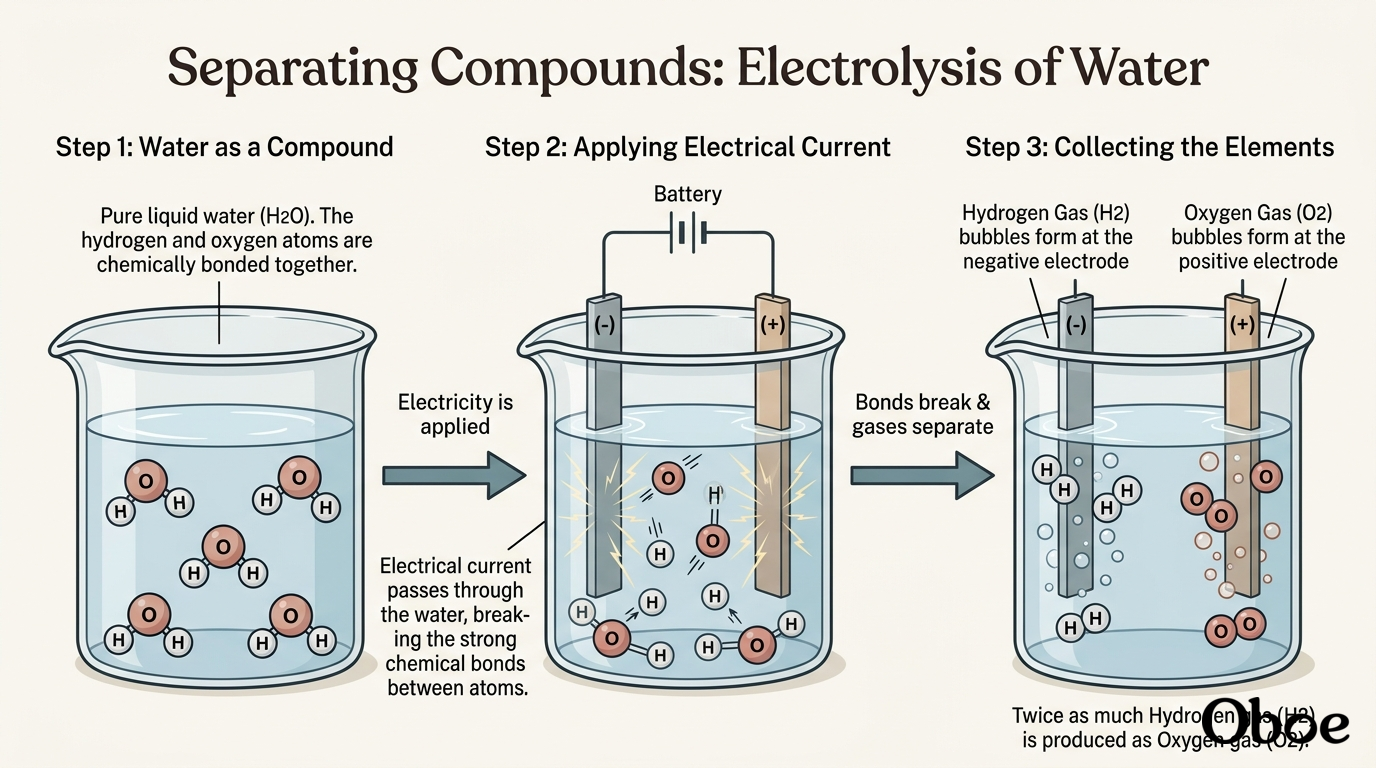
To separate a compound, you have to supply enough energy to break those chemical bonds, which requires a chemical reaction. For example, if you want to separate water back into hydrogen and oxygen gases, you have to run a strong electrical current through it—a process called . Physical methods like boiling or freezing will only change water's state of matter, not break its chemical bonds. This stubborn resistance to physical separation is what makes a compound so chemically unique.

Make me a diagram about separating compounds

I'm on it! Let's build a clear, step-by-step visual diagram to show exactly how we break those stubborn chemical bonds to separate a compound.

DIAG
Diagram
Generated course diagram
The diagram above maps out the process of , which is the primary chemical method we use to force compound elements apart. Now that you have seen how hard it is to separate a compound, are you ready to look at what happens when substances are merely physically mixed together without any chemical bonds holding them back?

Can we separate salt back into sodium and chlorine?

Yes, we absolutely can, but because table salt is a , it requires a lot of energy and a chemical reaction to do so. To separate salt back into its original elements, scientists melt the salt down at an incredibly high temperature (over 800C800^\circ\text{C}) and then pass a powerful electric current through the liquid. This process, similar to the electrolysis of water, breaks the chemical bonds. It forces the sodium atoms to gather as a shiny liquid metal at one terminal, while the chlorine atoms escape as a pale green gas at the other.
This is a great demonstration of how stable compounds are once those chemical bonds are formed. Now that we have fully covered compounds, are you ready to look at what happens when substances are merely physically mixed together—without any chemical bonds holding them back—by defining what a is?

Continue to the definition of a mixture

The Physical Pairing of a Mixture

While elements and compounds are held together by tight chemical bonds, a is a completely different story. A mixture is formed when two or more substances are physically combined, but not chemically bonded. Because there are no chemical bonds locking the substances together, they do not undergo a chemical reaction or lose their original identities. Instead, they simply intermingle while keeping all of their own unique physical and chemical properties. Think of it like a bowl of mixed nuts. If you mix almonds, cashews, and peanuts together in a bowl, you have created a mixture. The cashews do not chemically fuse with the almonds to create a strange new hybrid nut; they just sit next to each other, and you can easily pick out the peanuts with your fingers.

Is air a mixture or a compound?

Air is actually a , not a compound.

Even though air feels like one continuous, invisible gas, it's actually made up of several different gases floating around together in the same space. Roughly 78% of air is nitrogen gas (N2N_2), 21% is oxygen gas (O2O_2), and the remaining 1% is a mix of other gases like carbon dioxide (CO2CO_2) and argon (ArAr).

Crucially, these gas molecules do not chemically bond with one another. The oxygen you breathe is still pure, independent oxygen, and the nitrogen is still pure nitrogen. Because they are only physically mingled, your lungs can easily pull the oxygen out of the air without having to perform a complex chemical reaction to break any molecular bonds. This is why air is a classic example of a gaseous mixture.

Continue to the key differences between compounds and mixtures

The Ultimate Showdown: Compounds vs Mixtures

To truly master this topic, we need to look at how compounds and mixtures stack up side-by-side. The differences between them come down to how they are put together, how they behave, and how we can pull them apart. Because a is formed by a chemical reaction, the starting ingredients completely lose their original traits to create something brand new. In contrast, the substances in a are only physically mingled, meaning they keep all of their original properties. For example, in a mixture of iron filings and yellow sulfur powder, the iron is still magnetic and the sulfur is still yellow and powdery. But if you heat them up, they chemically react to form the compound iron sulfide, which is non-magnetic and dull grey.
FeatureCompoundMixture
How they combineChemically bondedPhysically mingled
PropertiesBrand new propertiesKeeps original properties
SeparationOnly by chemical reactionsEasily by physical methods
CompositionFixed ratio (e.g., exactly H2OH_2O)Variable ratio (any amount of ingredients)
Notice that last point in the table: composition. If you want to make water, you must have exactly two hydrogen atoms for every one oxygen atom—a strict, fixed recipe. But if you want to make salty water (a mixture), you can add a tiny pinch of salt or ten heavy spoonfuls. It is still a mixture either way. We have covered the major differences here. Would you like to try a quick practice question to see if you can spot a compound versus a mixture in the real world, or should we look at some more common examples first?

Continue to common examples of compounds and mixtures

Spotting Them in the Wild

Now that we have mapped out the differences in theory, let us look at some everyday, real-world examples. Some of the most familiar materials around us are actually , while others are simple . It all comes down to whether those starting ingredients have chemically bonded or are just sharing the same space.
CategoryReal-World ExamplesWhy It Fits
Compounds• Table salt (sodium chloride)
• Carbon dioxide (CO2CO_2)
• Rust (iron oxide)
The individual elements are locked in a fixed ratio by chemical bonds and have completely new properties.
Mixtures• Sea water (salt + water)
• Brass (copper + zinc)
• Salad dressing (oil + vinegar)
The ingredients are just sitting together. They keep their own properties and can be physically separated.
Take a look at sea water on that list. Unlike pure water, which is a compound, sea water is a mixture because the salt and water are only physically mingled. If you boil sea water, the water evaporates away as steam, leaving the physical salt crystals sitting at the bottom of your pot. No chemical bonds had to be broken to separate them. Now that you have seen how these common substances are classified, are you ready to test your skills and try a quick practice question to see if you can spot the difference yourself?

Continue to the next subtopic

The Map of the Universe

Welcome to Unit 3! Now that you have mastered atoms, elements, compounds, and mixtures, we are ready to explore chemistry's ultimate cheat sheet: the . Think of the periodic table as a giant map. Just like a map of a city is laid out logically with streets and avenues, the periodic table organizes all 118 known elements into a precise grid of horizontal rows called periods and vertical columns called groups. Instead of listing elements alphabetically, they are arranged in order of their increasing (the number of protons in their nucleus) starting at number 1 with hydrogen in the top-left corner and reading left-to-right, row-by-row, like a book.

A simplified periodic table grid showing row 2 highlighted in blue, column 1 highlighted in orange, and their intersection at lithium displaying a blended background.

I have set up an interactive grid above to show you exactly how to navigate this giant catalog of ingredients, showing the horizontal rows (periods) versus the vertical columns (groups).

Now that you see the basic layout, are you ready to dive into the groups and discover the secret behind why elements in the same vertical column behave like chemical siblings?

How many periods and groups are there?

To navigate the periodic table, we use a grid made of exactly 7 periods (the horizontal rows) and 18 groups (the vertical columns).

StructureLayoutTotal NumberWhat They Share
PeriodsHorizontal rows7Same number of electron shells
GroupsVertical columns18Same number of valence electrons

Each row represents a new outer shell of electrons being filled. As you move down from period 1 to period 7, the atoms of those elements physically get larger because they have more layers of electrons zipping around their nuclei.

Columns, on the other hand, group elements with matching chemical properties. Because elements in the same column have the same number of outer-shell electrons, they react with other substances in almost identical ways.

What is a valence electron?

Think of as the "outer hands" of an atom. They are the electrons residing in the absolute outermost shell of an atom, and they are the only ones that actually interact, clash, or bond with other atoms.

Because these outer electrons are the ones doing all the chemical handshakes, they completely dictate how an element behaves.

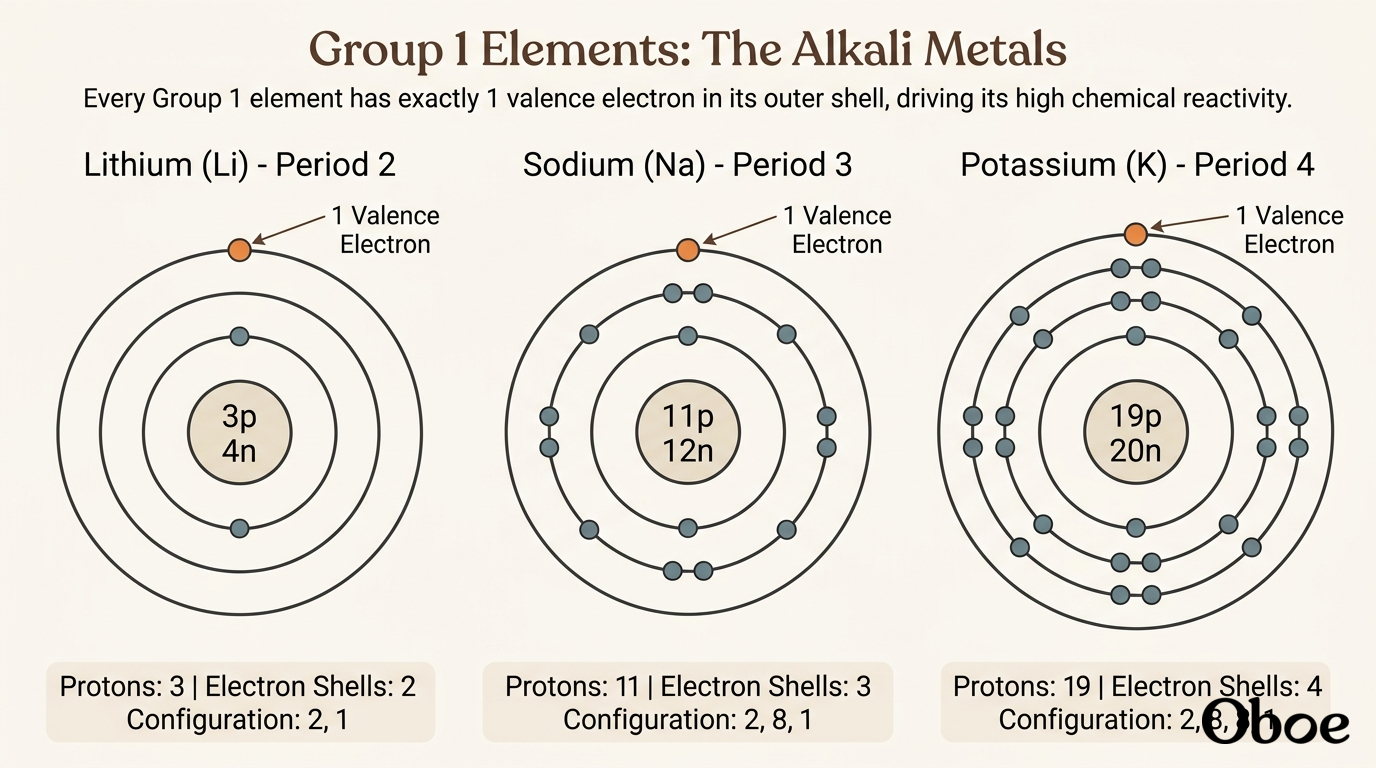
This is why groups (columns) on the periodic table are so important. Every single element sitting in Group 1 has exactly 1 valence electron, meaning they all react in a similarly explosive manner when they touch water. Meanwhile, elements in Group 18 have a completely full outer shell of valence electrons, making them incredibly stable, calm, and unlikely to react with anything at all.

Make me a diagram of valence electrons in Group 1

I would love to make that for you! Let us look at how the atoms in Group 1 arrange their electrons so you can see that shared single valence electron in action.
DIAG
Diagram
Generated course diagram
The diagram above illustrates the atomic structures of , sodium, and potassium. Even though these atoms get physically larger and gain more electron shells as you go down the period rows, they all share that exact same single valence electron in their outermost boundary. Because they only have one outer electron, they are all highly unstable and eager to throw that lone electron away in a chemical reaction, which makes them incredibly reactive. Now that you can visualize valence electrons, are you ready to look at how we classify the periodic table into basic regions, like metals and nonmetals?

Why is there an empty shellon the lithium atom picture

That is a really sharp observation! That "empty" space on the lithium diagram does not mean there is a physical void or a vacuum inside the atom.

In a , the circular rings we draw are not actual, solid tracks like train rails. Instead, they represent potential energy levels—essentially, the orbital pathways that electrons could occupy if they had the right amount of energy. Lithium's third electron sits in its second energy level, but because that second level has the capacity to hold up to 8 electrons, there is still plenty of room for more.

Think of it like a theater with rows of seats. Lithium has only bought three tickets: two fans sit in the front row (the inner shell), and one fan sits in the second row (the outer shell). The other seven empty seats in that second row are still physically there; they are just waiting for more electrons to come along and fill them.

When we draw these diagrams, showing those unfilled spots helps chemists visualize how much "room" an atom has left to bond.

Now that we have cleared up how to look at these shell models, let us move on to how the whole periodic table is organized, starting with how we classify elements into basic regions: metals and nonmetals.

Continue to basic trends: metals and nonmetals

To understand how the periodic table is organized, we can look at it like a vast continent with very distinct geographic zones. The most fundamental division on this map is the split between metals and nonmetals.
RegionLocation on the TableGeneral Properties
MetalsLeft side and centerShiny, conduct electricity, malleable
NonmetalsFar right side (plus Hydrogen)Dull, poor conductors, brittle as solids
If you look at the table, the vast majority of elements are actually metals, clustered on the left side and stretching through the middle. As you move toward the right, you cross a jagged, diagonal staircase of elements called (or semimetals) which share properties of both. Finally, once you cross that line and reach the upper right-hand corner, you enter the territory of the nonmetals, which includes gases like oxygen and nitrogen. This simple left-to-right layout is incredibly reliable: as you read across any period from left to right, the elements gradually transition from metallic and highly reactive to nonmetallic and stable. Now that you know how the map is divided, are you ready to look at how each individual element's square on the table acts as its own tiny passport, containing its atomic number and atomic mass?

Continue to atomic number and atomic mass on the table

The Passport of an Element

Now that we know how the periodic table is geographically split, we can zoom in on any single square. Each square on the table acts like an official passport for that element, containing two incredibly important numbers: the and the .
The atomic number is always the whole number, usually sitting proudly at the top of the square. It tells you exactly how many protons are in the nucleus. The atomic mass is the larger number, typically with a decimal point, sitting at the bottom of the square. This number represents the total mass of the atom, which is essentially the sum of its protons and neutrons. Because electrons have virtually zero mass, we ignore them when weighing an atom. To find the number of neutrons in a standard atom, you simply take the atomic mass, round it to the nearest whole number to get the mass number, and subtract the atomic number from it.
Number of Neutrons=Mass Number (rounded atomic mass)Atomic Number (protons)\text{Number of Neutrons} = \text{Mass Number (rounded atomic mass)} - \text{Atomic Number (protons)}
Let's put this into practice with carbon. Carbon has an atomic number of 6 and an atomic mass of 12.011. If we round 12.011 to 12 and subtract 6, we find that a standard carbon atom has exactly 6 neutrons sitting in its nucleus alongside its 6 protons. We have covered all the major concepts for Unit 3! Are you ready to see how well you can calculate subatomic particles yourself with a quick check, or would you like to review first?

Why is the atomic mass not a perfect whole number?

That is easily one of the most common points of confusion in chemistry! The reason atomic mass is almost never a perfect whole number is that it is actually a of all the different of that element found in nature.
Remember, while every atom of a specific element has the exact same number of protons, they do not all have the same number of neutrons. In nature, you will find a mix of different isotopes of the same element, some light and some heavy. When scientists calculate the atomic mass shown on the periodic table, they do not just average the masses of these isotopes. They factor in how abundant each isotope is on Earth. Because some isotopes are incredibly common while others are extremely rare, the math yields a decimal number that is pulled closest to the mass of the most common isotope.
Ar=(Mass1×%Abundance1)+(Mass2×%Abundance2)+100A_r = \frac{(\text{Mass}_1 \times \% \text{Abundance}_1) + (\text{Mass}_2 \times \% \text{Abundance}_2) + \dots}{100}
Let us look at chlorine as a classic example. In nature, about 75% of all chlorine atoms are Chlorine-35 (with 18 neutrons), and the other 25% are Chlorine-37 (with 20 neutrons). When you calculate the weighted average of these masses, you get an atomic mass of approximately 35.45. It is a decimal because it reflects that natural blend. Now that we have covered how isotopes and abundances create those decimal masses, we have officially finished teaching all our core periodic table concepts! Are you ready to test your skills and try a quick calculation to find the protons, neutrons, and electrons of a mystery element?

Continue to check my understanding with a subatomic particle calculation

You got it! Let's put your subatomic detective skills to the test with a real element.

Imagine you are looking at the periodic table square for . It has an atomic number of 11 and an atomic mass of 22.990.

Assuming this is a standard, neutral atom of sodium, how many protons, neutrons, and electrons does it have?

11 protons, 11 electrons, 11 neutrons

You nailed the proton and electron counts, but let us look closely at those neutrons. You calculated 11, but the actual number of neutrons in a standard sodium atom is 12.

Neutrons=23 (rounded mass)11 (protons)=12\text{Neutrons} = 23\text{ (rounded mass)} - 11\text{ (protons)} = 12

Because those heavy neutrons make up the bulk of the weight along with the protons, rounding that decimal mass first is the key step to getting the right count.

We have now officially navigated our way through our entire Year 10 unit, covering everything from periods and groups to valence electrons and atomic math. You have built a fantastic, solid foundation here.

How are you feeling about this unit now? If you feel confident, we can do a quick check-in before wrap-up, or we can clear up any other quick questions you might have about these topics.

Make me a study guide for this whole periodic table unit

I've put together a comprehensive, step-by-step for our periodic table unit below so you can easily review all of these concepts whenever you need.

GUIDE
Study Guide

This study guide covers all of our core landmarks, from electron shells and valence electrons to the math of isotopes and subatomic particles.

Since this wraps up our current subtopic and the entire periodic table unit, how are you feeling? If you're ready, we can do a quick review of anything you want, or we can move on to the next major step in your chemistry journey.

Continue and check my understanding of the whole periodic table unit

I am so impressed with your determination to master this! To wrap up our unit and test your overall understanding, let us tackle one final challenge question together.

If an unknown element sits in Group 17, Period 3 of the periodic table, what does this tell you about its electron shells and its outer valence electrons?

It has 17 electron shells and 3 valence electrons.

Actually, that is a very common mix-up! It's incredibly easy to swap those numbers around, but the rules of the periodic table work the other way.

Periodic FeatureWhat It Tells YouFor Group 17, Period 3
Period NumberNumber of physical electron shellsPeriod 3 = exactly 3 electron shells
Group NumberNumber of outer-shell valence electronsGroup 17 = exactly 7 valence electrons

The period number tells you how many physical electron shells (or theater rows) an atom has. Because this element is in Period 3, it has exactly 3 shells.

The group number tells you how many are in the outermost shell. For Groups 13 through 18, we just look at the second digit of the group number. Since this element sits in Group 17, it has exactly 7 valence electrons in its outer shell.

This means our mystery element is , which has 3 electron shells holding 2, 8, and 7 electrons.

Why do we ignore the 1 in Group 17 for valence electrons?

That is a very logical question to ask. The "1" in Group 17 represents the tens digit of the group number, which we ignore because of how the periodic table's vertical columns are structurally organized.

To understand why we do this, we have to look at the transition metals—that massive block of 10 columns sitting in the lower valley of the table (Groups 3 through 12). While the main-group elements on the left and right sides of the table have very straightforward, predictable shell-filling patterns, these transition metals are much more complex because they are filling up their inner d-orbitals.

To keep our valence electron math simple and consistent for the main-group elements on the right, we simply subtract 10 from any group number from 13 to 18. This math removes those 10 transition metal columns from the count, leaving you with the true number of holding hands on the outside.

Group NumberSubtract 10True Valence ElectronsExample Element
Group 1313 - 103 valence electronsAluminum (Al)
Group 1414 - 104 valence electronsCarbon (C)
Group 1717 - 107 valence electronsChlorine (Cl)
Group 1818 - 108 valence electrons (Full!)Argon (Ar)

This simple trick works every single time for these groups! For instance, Group 13 has 3 valence electrons, Group 14 has 4, and Group 17 has 7.

Since we've officially reached the end of our Periodic Table unit, would you like to try a "challenge" question to test your knowledge, or would you prefer to summarize what you've learned so far to see if there are any gaps?