WRO RoboSports Spike Prime Design
RoboSports Mechanical Architecture
Building a Winning Chassis
In competitive robotics, a well-designed chassis is the foundation of victory. It's more than just a platform for motors and sensors; it's the skeleton that dictates how your robot moves, reacts, and survives on the competition mat. For fast-paced games like WRO RoboSports, your design choices must prioritize agility, stability, and speed.
A robot that can't move predictably is a robot that can't score points consistently.
Every match involves rapid acceleration, sudden stops, and sharp turns. A flimsy or poorly balanced chassis will flex under stress, waste motor power, and might even tip over at a critical moment. Let's break down how to build a chassis that is both robust and nimble.
Stability and Rigidity
Two principles govern a robot's stability: a low and a rigid frame. The center of gravity (CG) is the average location of the weight of the robot. Imagine it as a single point where all the robot's weight is concentrated. A lower CG makes the robot less likely to tip over when accelerating or cornering, just as a race car sits much lower to the ground than a bus.
Frame rigidity is equally important. A frame that twists or bends under load is inefficient. If your chassis flexes when a motor tries to turn a wheel, some of that motor's torque is wasted on bending the frame instead of moving the robot. A strong, rigid frame ensures that all the power from your motors translates directly into motion.
A common and effective way to achieve both goals is the 'box robot' design. This involves building a rectangular or square frame, often using beams to create a sturdy, enclosed structure. This design protects the valuable Spike Hub and electronics inside, provides a low and central mounting position for heavy components, and offers plenty of consistent attachment points for mechanisms.
Drive and Wheel Choices
How your robot puts power to the ground is a critical decision. The two most common configurations are two-wheel drive (2WD) and four-wheel drive (4WD).
Two-Wheel Drive (2WD): Two powered wheels, typically at the front or back, with unpowered casters or low-friction sliders for balance. Steering is achieved by varying the speed and direction of the two drive wheels (differential drive). It's highly agile and can turn on a dime.
Four-Wheel Drive (4WD): All four wheels are powered. This setup provides excellent traction and pushing power, making it very stable and difficult to push around. However, turning can be less precise.
When a 4WD robot turns, the wheels on the inside of the turn need to travel a shorter distance than the wheels on the outside. Since they are all trying to spin at a similar speed, the wheels must slip or scrub against the mat. This is known as and requires significant motor power to overcome the friction.
| Feature | Two-Wheel Drive (2WD) | Four-Wheel Drive (4WD) |
|---|---|---|
| Agility | Very High (tight turns) | Moderate (wider turns) |
| Pushing Power | Low to Moderate | Very High |
| Stability | Good (with wide base) | Excellent |
| Turning Precision | High | Moderate (due to skid) |
| Complexity | Simple | More complex wiring & build |
Your choice of wheels is closely linked to your drive system. For a 2WD robot, you want high-traction tires on your two drive wheels and very low-friction casters or sliders for the other contact points. Using high-grip wheels all around on a 2WD system can cause it to stutter during turns as the unpowered wheels resist being dragged sideways.
For 4WD, all wheels should be high-traction to maximize grip and pushing power. The specific type of tire can be chosen based on the mat surface to find the perfect balance between grip and the ability to execute smooth skid-steer turns.
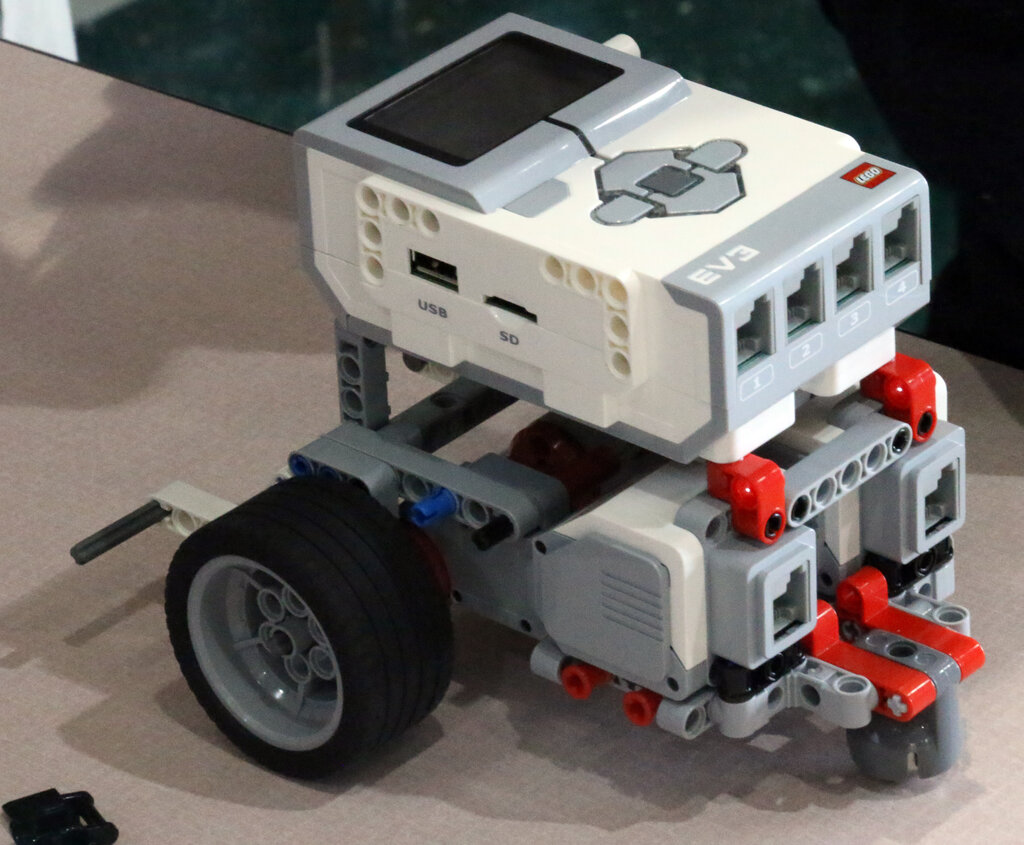
Finally, consider the chassis geometry. The wheelbase (distance between front and rear axles) and track width (distance between left and right wheels) are key. A wider track increases side-to-side stability, while a shorter wheelbase allows for faster, tighter turns. Many successful competition robots are nearly square, offering a good compromise between turning agility and stability.
What are the two most important principles for designing a stable and efficient robot chassis?
Why is a low center of gravity (CG) advantageous for a competitive robot?
A well-built chassis is a huge advantage. By focusing on a low center of gravity, a rigid frame, and the right drive configuration for your strategy, you create a reliable platform that lets you focus on the game.