Wormholes Explained
Introduction to General Relativity
A New Idea of Gravity
For centuries, Isaac Newton's view of gravity held sway. He described it as an invisible force, a pull that every object exerts on every other object. This idea works remarkably well for most things, from calculating the orbit of Mars to figuring out why an apple falls from a tree. But Albert Einstein had a different, more profound idea. He suggested that gravity isn't a force at all.
In 1916, Einstein published his theory of general relativity, theorizing that what we perceive as gravity results from the curvature of space and time.
Instead of a pull, Einstein saw gravity as a consequence of the shape of the universe itself. He unified the three dimensions of space with the one dimension of time into a single, four-dimensional fabric: spacetime. According to general relativity, it's the bending and warping of this fabric that we experience as gravity.
The Equivalence Principle
Einstein's journey to this new understanding began with what he called his "happiest thought." It's a powerful thought experiment known as the equivalence principle.
Imagine you are in a windowless room, like an elevator. You feel your normal weight pressing you to the floor. Now, consider two possibilities. First, the elevator is resting on the surface of the Earth, where gravity is pulling you down. Second, the elevator is in deep space, far from any planet or star, but is accelerating upwards at a constant rate of m/s, the same acceleration as Earth's gravity.
Einstein's brilliant insight was that there is no experiment you could perform inside the room to tell these two scenarios apart. The feeling of gravity is completely indistinguishable from the feeling of acceleration.
This principle is the cornerstone of general relativity. It establishes a deep connection between gravity and acceleration, suggesting that gravity isn't a force but a property of the reference frame you're in. If gravity and acceleration are two sides of the same coin, then gravity must be related to the geometry of spacetime itself.
Spacetime Gets Curved
If gravity is part of spacetime's geometry, how does that work? Think of spacetime as a flat, stretchy sheet, like a trampoline. If you place a heavy object, like a bowling ball, in the center, the sheet curves and sags. Now, if you roll a smaller ball, like a marble, nearby, it won't travel in a straight line. Instead, it will follow the curve in the sheet created by the bowling ball, spiraling inward.
From the marble's perspective, it's just moving forward. But to an outside observer, it looks like the bowling ball is "pulling" the marble toward it. This is Einstein's model for gravity.
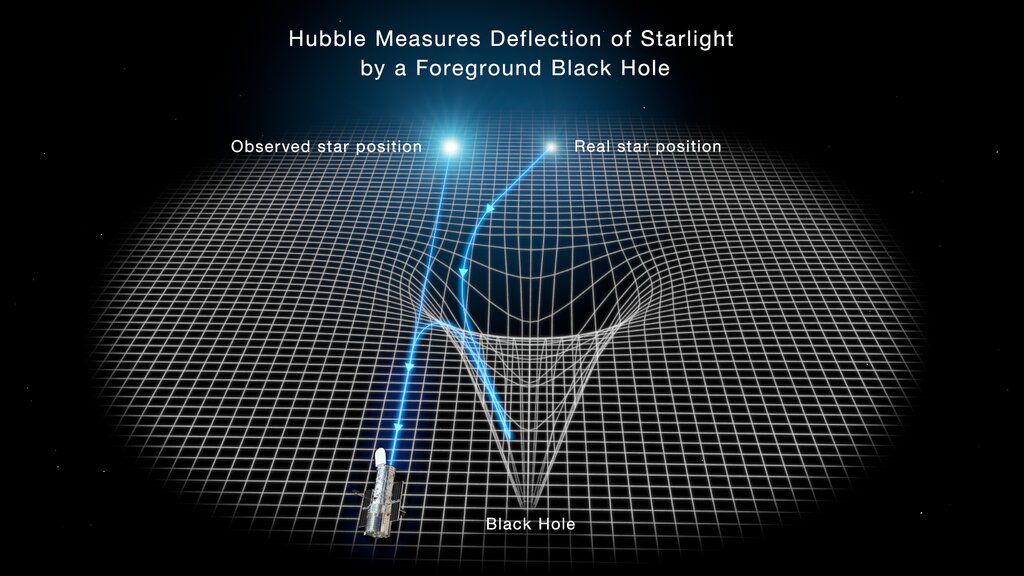
Mass and energy tell spacetime how to curve, and the curvature of spacetime tells matter how to move. The Earth isn't being pulled by the Sun; it's following the straightest possible path through the curved spacetime created by the Sun's immense mass. What we perceive as the force of gravity is simply us moving along these cosmic contours.
The Einstein Field Equations
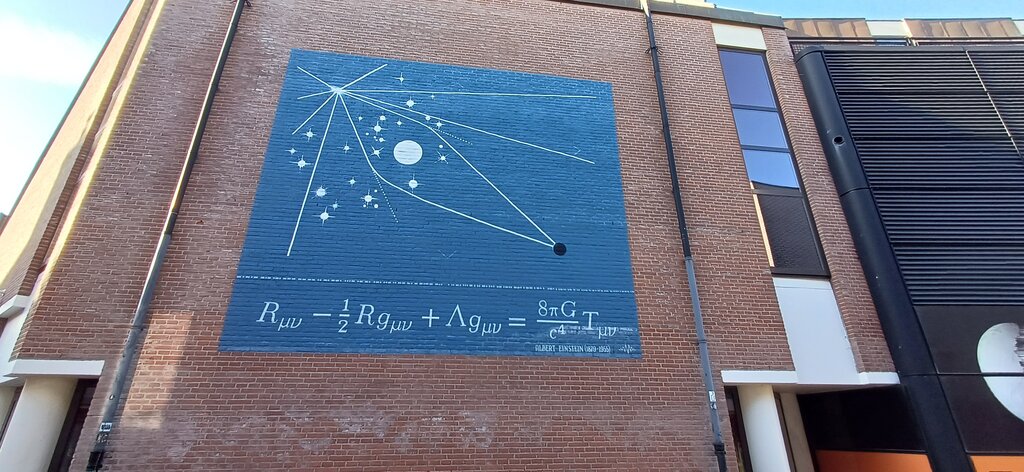
Einstein didn't just describe this idea with analogies; he quantified it with a set of elegant and powerful equations. These are known as the Einstein field equations. In a compact form, the core equation looks like this:
Let's break down what this means without getting lost in the math. The left side of the equation describes the geometry of spacetime. The term is the Einstein tensor, which represents the curvature. The right side describes the distribution of mass and energy in spacetime. The term is the stress-energy tensor, which is a mathematical object that includes information about the density and flux of energy and momentum.
In essence, the equation says: The curvature of spacetime is directly proportional to the amount of energy and momentum within it.
These equations are the heart of general relativity. They are a set of rules that connect the distribution of matter and energy in the universe to the geometric structure of spacetime. Solving these equations can describe everything from the orbit of Mercury to the expansion of the universe and the existence of black holes.
Understanding these foundational principles—the equivalence of gravity and acceleration, the curvature of spacetime by mass, and the equations that govern this relationship—is the first step toward exploring some of the most mind-bending possibilities the universe has to offer.