Wilderness First Aid Essential Prep
Wilderness Assessment System
The Patient Assessment System
In a hospital, you have machines and a team to help you. In the wilderness, you have your brain, your hands, and what's in your pack. This is why the Patient Assessment System, or PAS, is the foundation of backcountry medicine. It's a systematic, repeatable process that helps you identify problems, make decisions, and track a patient's condition over time.
Unlike urban first aid where help is minutes away, wilderness care can stretch for hours or days. A patient's condition can change. The PAS isn't a one-and-done checklist; it's a cycle. You will perform it, treat what you find, and then repeat it to catch new developments. This cyclical approach is what makes it so powerful in remote environments.
The core principle of wilderness first aid is this: Do no further harm, and keep the patient stable until definitive care is available.
Scene Size-Up
Before you rush in, stop. Your first responsibility is to your own safety. A rescuer who becomes a patient only makes the situation worse. The scene size-up is a rapid, 360-degree scan of the environment to identify any potential dangers.
Ask yourself a few key questions:
- Am I safe? Look for environmental hazards like rockfall, avalanche danger, lightning, or rising water. Is there an aggressive animal nearby? Is the mechanism of injury, like a falling tree, still a threat?
- What happened? Observe the scene for clues. A deployed airbag in a car, a fallen climbing rope, or scattered gear can tell you a lot about the forces involved.
- How many patients? Don't focus only on the loudest person. There might be quieter, more critically injured patients nearby.
- Do I have the right gear? Assess if your Personal Protective Equipment (PPE), like gloves and goggles, is adequate for the situation.
Only when you've determined the scene is safe for you and your team should you approach the patient.
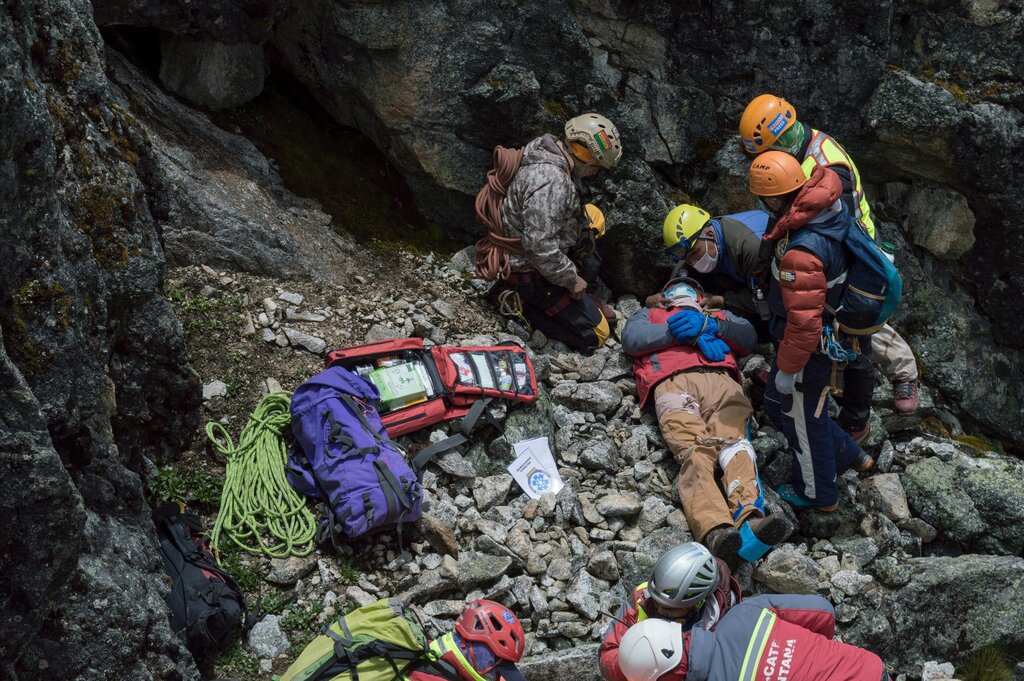
Primary and Secondary Surveys
Once the scene is secure, you can begin assessing the patient. This process is split into two distinct phases: the primary survey to find and fix immediate life-threats, and the secondary survey for a more detailed picture of the patient's condition.
The primary survey, as outlined by the Advanced Trauma Life Support (ATLS) guidelines, involves a systematic evaluation of the patient's airway, breathing, and circulation (ABCs).
The Primary Survey uses the mnemonic ABCDE to check for problems that could kill a person in the next few minutes. As you find a problem at each step, you must fix it before moving to the next.
- A - Airway: Is the patient's airway open and clear? If they are talking to you, it's open. If they are unconscious, you may need to open it manually. In any trauma patient, you must protect the spine from further injury by maintaining while you manage the airway.
- B - Breathing: Is the patient breathing? Look, listen, and feel for chest rise and air movement. Note the rate and quality. Is it fast, slow, or labored? Severe bleeding from the chest must be sealed.
- C - Circulation: Does the patient have a pulse? Check for a radial pulse (on the wrist) or a carotid pulse (on the neck). Perform a "blood sweep" by running your gloved hands over the patient's body and under them, looking for severe, life-threatening bleeding. Control any major hemorrhage immediately.
- D - Disability: What is the patient's mental status, or Level of Responsiveness (LOR)? We use the AVPU scale: Alert, responds to Verbal stimuli, responds to Painful stimuli, or Unresponsive. This gives a quick baseline of their neurological function.
- E - Environment: Protect the patient from the elements. Get them out of the rain, off the cold ground, or out of the direct sun. Hypothermia is a major risk even in moderate temperatures, especially for an injured person. Add or remove clothing as needed to maintain a normal body temperature.
After completing the primary survey and managing any life-threats, you can move on to the more detailed Secondary Survey. This is where you conduct a thorough head-to-toe physical exam, check vital signs, and get a patient history.
The Secondary Survey involves three key components:
| Component | Description |
|---|---|
| Head-to-Toe Exam | A physical inspection of the entire body, from scalp to toes, looking and feeling for Deformities, Contusions, Abrasions, Punctures/Penetrations, Burns, Tenderness, Lacerations, and Swelling (DCAP-BTLS). |
| Vital Signs | Quantitative measurements that provide a snapshot of the patient's physiological state. These should be taken and recorded every 15 minutes for a stable patient, or every 5 minutes for an unstable one. |
| Patient History | Using the SAMPLE mnemonic to gather information about the patient and the incident. |
Vital Signs and History
Monitoring vital signs is crucial for tracking a patient's condition. In the field, you'll focus on these key indicators:
- Heart Rate (HR): The number of beats per minute. Note if it's strong or weak, regular or irregular.
- Respiratory Rate (RR): The number of breaths per minute. Note if it's easy or labored.
- Skin Color, Temperature, and Moisture (): Assess by looking at the nail beds or inside the lower lip and feeling the forehead with the back of a gloved hand. Skin can be pale, flushed, or blue (cyanotic); hot, cool, or cold; and dry, moist, or wet.
- Level of Responsiveness (LOR): Re-evaluate using the AVPU scale and note if there are any changes.
To get the patient's history, the SAMPLE mnemonic is an effective tool:
- S - Signs & Symptoms: What do you see? What does the patient tell you is wrong?
- A - Allergies: Does the patient have any allergies, especially to medications?
- M - Medications: What medications do they take? Both prescription and over-the-counter.
- P - Pertinent medical history: Do they have any pre-existing medical conditions like asthma, diabetes, or heart problems?
- L - Last intake and output: When was the last time they ate or drank anything? What was it?
- E - Events leading to injury: What was the patient doing right before the incident occurred? Get a story of what happened.
Finally, all this information must be documented. Clear, concise documentation is vital for tracking the patient's progress and for handing them off to a higher level of care. A standard format for this is the . This structured approach ensures no critical information is missed.
What is the primary reason the Patient Assessment System (PAS) is described as a cyclical process in a wilderness context?
When arriving at the scene of an incident, what is the very first step a rescuer must take before approaching the patient?
The Patient Assessment System is your most powerful tool in the backcountry. Practice it until it becomes second nature. A calm, systematic approach in a chaotic situation can make all the difference.