Wi-Fi Explained
Introduction to Wireless Communication
Sending Signals Through Air
Wireless communication feels like magic. Information zips from your phone to a satellite and back again, all invisibly. But it's not magic, it's physics. At its core, wireless communication is about converting information—like your voice or a text message—into electromagnetic waves.
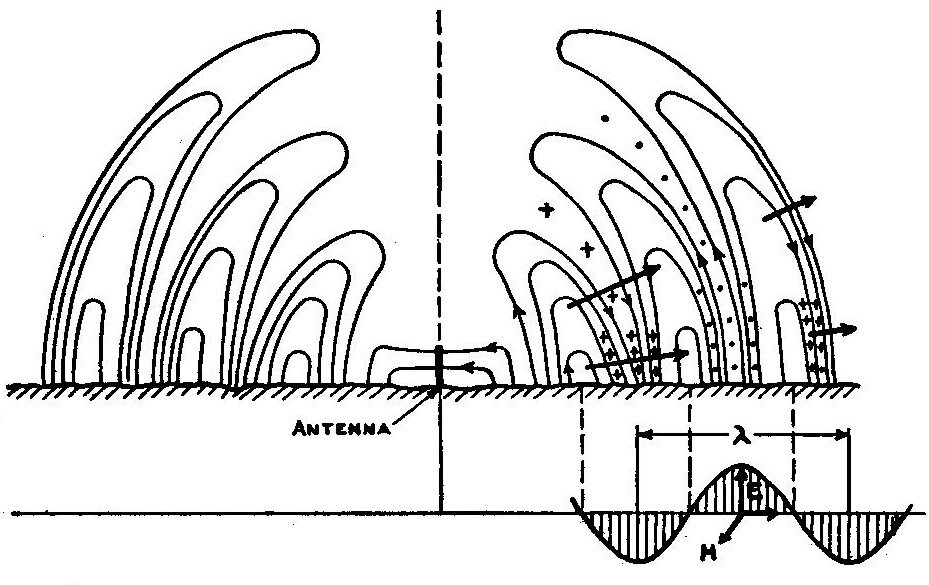
Think of it like skipping a stone across a pond. The stone creates ripples that travel outward. A radio transmitter does something similar, but instead of a stone, it uses an antenna to create ripples in the invisible electromagnetic field that surrounds us. These ripples are radio waves.
A transmitter makes electrons wiggle back and forth in an antenna. This movement generates waves that travel out at the speed of light. A receiver, like the one in your car radio or Wi-Fi router, has its own antenna. When these waves hit the receiver's antenna, they make the electrons inside it wiggle in the same pattern. The receiver then decodes this pattern back into the original information.
To send different kinds of information, we change, or modulate, the wave. Two basic properties of a wave we can change are its frequency and wavelength.
- Frequency: How many wave cycles pass a point per second. It's measured in Hertz (Hz).
- Wavelength: The physical distance between two wave peaks.
They have an inverse relationship. The higher the frequency, the shorter the wavelength.
The Electromagnetic Spectrum
Radio waves are just one part of a much larger family called the electromagnetic spectrum. This spectrum includes everything from the low-frequency radio waves that carry AM radio signals to the extremely high-frequency gamma rays found in space. Visible light is a tiny slice of this spectrum, sandwiched between infrared and ultraviolet.
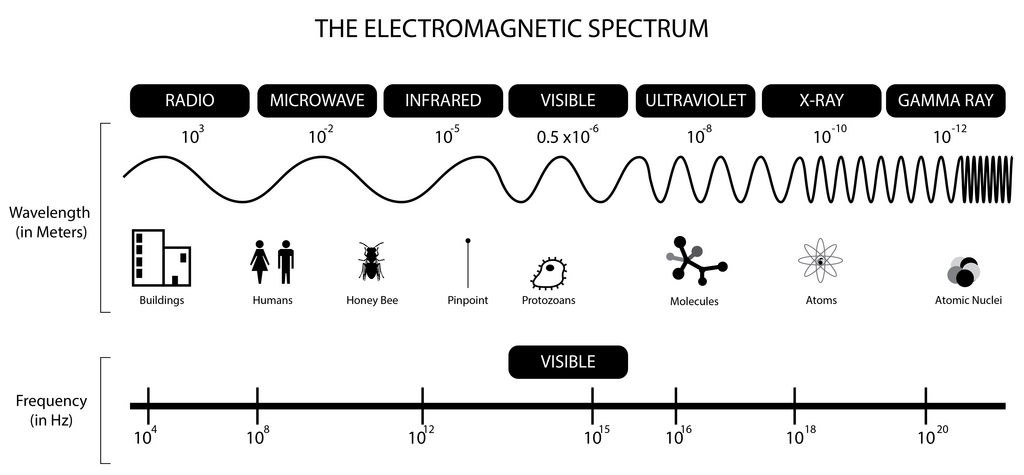
Governments and international bodies regulate this spectrum, assigning different frequency bands for specific uses. This prevents interference, so your baby monitor doesn't accidentally pick up a pilot's radio transmission. Different frequencies have different properties. Lower frequencies can travel farther and pass through obstacles like walls more easily, but they can't carry as much data. Higher frequencies can carry massive amounts of data, but they have a shorter range and are more easily blocked.
| Frequency Band | Common Uses | Characteristics |
|---|---|---|
| Low Frequency (LF) | AM Radio, Navigation | Long range, low data rate |
| High Frequency (HF) | Shortwave Radio | Can bounce off the ionosphere for very long distances |
| Very High (VHF) / Ultra High (UHF) | FM Radio, TV Broadcast, Cell Phones | Good balance of range and data capacity |
| Super High (SHF) | Wi-Fi, Satellite, Radar | High data rate, shorter range, requires line-of-sight |
Wireless Pros and Cons
The biggest advantage of wireless communication is obvious: mobility. You're not tethered to a wall by a cable. This freedom has transformed how we live and work, allowing for everything from smartphones to remote sensors in farmers' fields.
However, wireless communication has its challenges. One major issue is interference. Since wireless signals travel through the open air, they can be disrupted by other signals, physical objects like buildings, and even microwave ovens. This can lead to dropped connections or slower speeds.
Unlike a wired connection that provides a private, dedicated path, wireless signals are shared and travel through an unpredictable environment.
Another challenge is security. Because the signals are broadcast, anyone with the right equipment could potentially listen in. This is why encryption is a critical part of modern wireless systems, scrambling the data so that only the intended recipient can understand it.
Finally, there's the issue of range and power. A stronger signal can travel farther, but it requires more power, which is a key concern for battery-operated devices like your phone.
Ready to check your understanding?
At its most fundamental level, how does wireless communication transmit information?
What is the relationship between a wave's frequency and its wavelength?
Understanding these fundamentals—from how radio waves carry information to the trade-offs between different frequencies—is the first step to seeing how technologies like Wi-Fi work.