Vibe Coding Explained
Introduction to Vibe Coding
What Is Vibe Coding?
Imagine you're building a house. In traditional programming, you're the one laying every single brick, mixing the mortar, and framing the walls. You need to know exactly how each piece fits together.
Vibe coding is different. You're the architect, describing the house you want to an incredibly fast, slightly quirky robot builder. You say, "I want a two-story house with a blue door and a big window in the living room," and the robot starts building. Your job shifts from manual labor to directing, refining, and correcting the robot's work.
Vibe coding is a way of building software by directing an AI to produce runnable code from plain-English instructions, shifting your role from typing syntax to shaping intent, UX, and edge cases.
At its core, vibe coding is a partnership between a human developer and an AI, usually a large language model (LLM). The developer provides high-level instructions, goals, and feedback in natural language. The AI generates the actual code. This process is iterative—you describe, the AI builds, you test, you refine your description, and the AI builds again. It’s a creative, conversational flow that prioritizes speed and experimentation over meticulously writing every line by hand.
How It's Different
The fundamental shift is from writing code to directing code generation. A traditional programmer spends their time focused on syntax, algorithms, and debugging specific lines. A vibe coder spends more time on the big picture: defining features, describing user experience, and testing the final output.
The skillset changes, too. While foundational programming knowledge is still crucial for spotting errors and making smart refinements, communication becomes a key skill. You have to get good at writing clear, effective prompts to guide the AI.
| Aspect | Traditional Coding | Vibe Coding |
|---|---|---|
| Focus | Syntax, algorithms, line-by-line logic | High-level goals, user experience, outcomes |
| Developer's Role | Coder, builder | Director, architect, tester |
| Process | Write → Compile → Test → Debug | Describe → Generate → Test → Refine |
| Key Skill | Language proficiency, logic | Prompt engineering, critical evaluation |
The Good and The Bad
The biggest advantage of vibe coding is speed. It can dramatically accelerate prototyping and the creation of simple applications. It also lowers the barrier to entry, allowing people with great ideas but less technical experience to build software. For experienced developers, it can eliminate tedious, repetitive tasks, freeing them up to solve more complex problems.
However, this new approach comes with significant challenges. The code generated by an AI can be inefficient, difficult to maintain, or contain subtle security flaws. A developer who doesn't understand the underlying code might not be able to spot these issues.
There's also the risk of over-reliance. If new programmers only learn to prompt an AI, they may never develop the deep problem-solving skills that come from wrestling with code directly. It’s a classic “black box” problem: you get an output that works, but you may have no idea how or why.
Relying on AI without understanding the code it generates is like driving a car without knowing how the brakes work. It's fine until it isn't.
Tools of the Trade
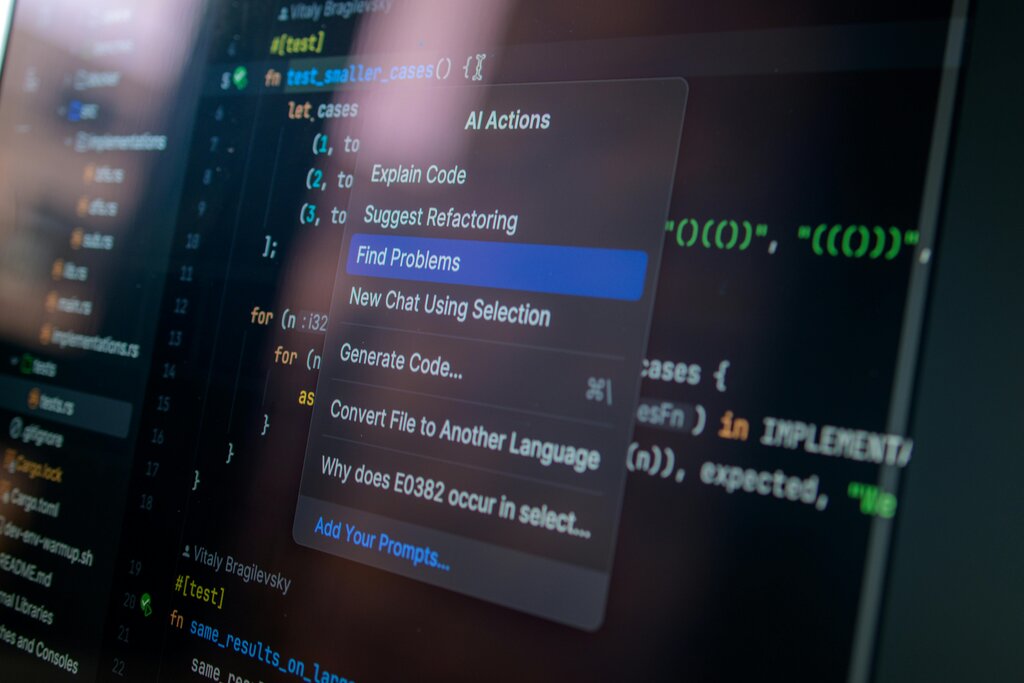
Vibe coding isn't tied to one specific tool. It’s a workflow that can be adopted using a variety of AI assistants. Some are integrated directly into code editors, like GitHub Copilot, which suggests lines or entire functions as you type. Others, like Cursor, are AI-native editors built from the ground up for this kind of conversational development.
Even general-purpose LLMs like ChatGPT can be used for vibe coding. A developer might paste in a piece of code and ask the AI to refactor it, or describe a feature and ask it to generate the necessary code from scratch.
Let's review the key ideas before you test your knowledge.
Ready to check your understanding?
According to the architect and builder analogy used in the text, what is the role of a developer in "vibe coding"?
Which of the following is identified as a significant risk or challenge of vibe coding?
Vibe coding represents a major shift in software development. By understanding its principles, benefits, and risks, you can better navigate this evolving landscape.